On this page
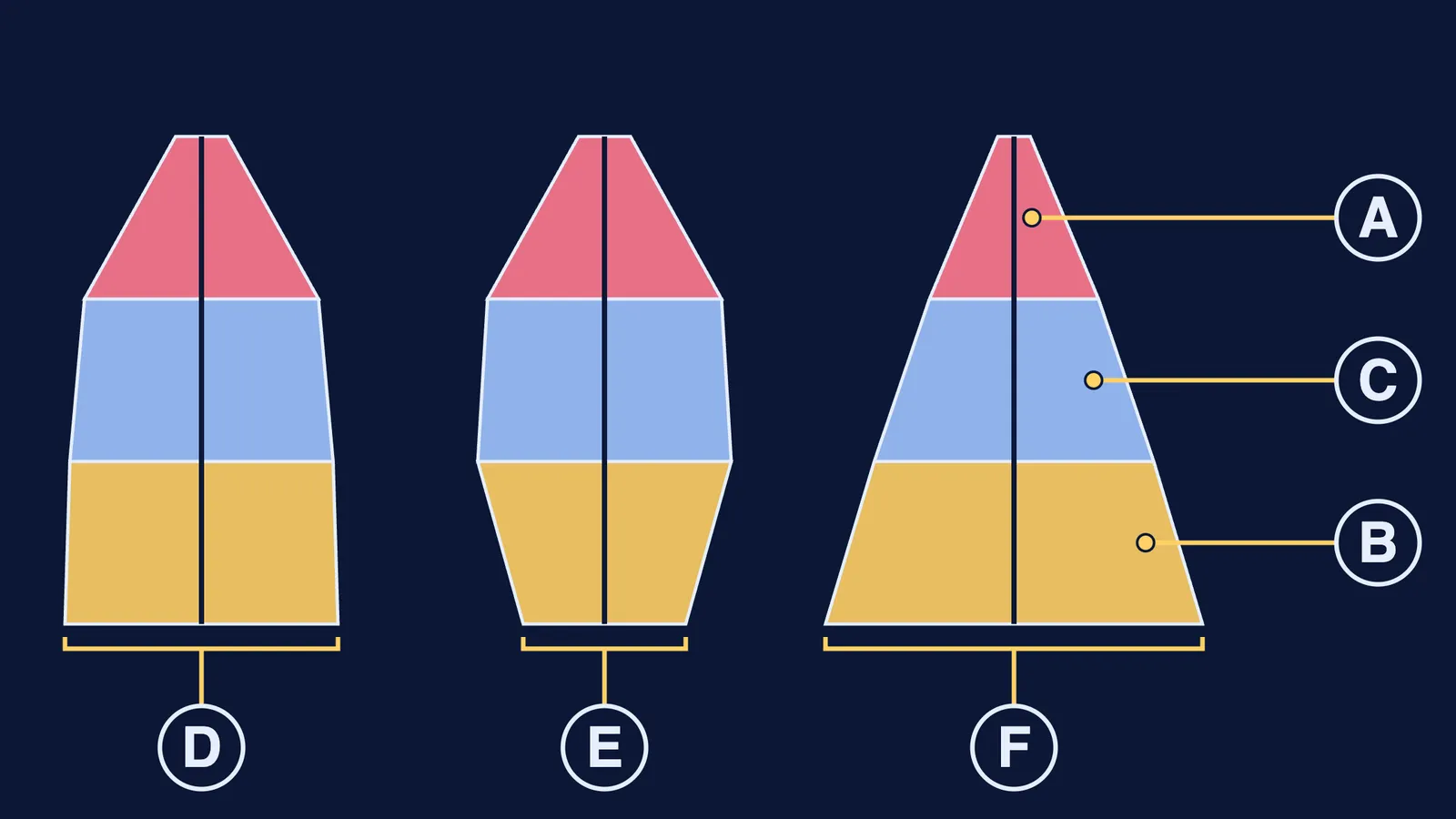
The schematic above is our own drawing of the three age-pyramid shapes from NCERT, set in a new order, with letters A to F used in Q1 to Q6. For Q7 to Q14 you get the remaining figures as text, with no picture needed. Every fact is from NCERT's Class 12 Biology chapter on Organisms and Populations (Reprint 2026-27). Unit 10, Ecology and Environment, of the NMC's NEET (UG) syllabus lists population attributes, including age distribution, and population interactions.
Which figures of Organisms and Populations does this set use?
The chapter has five figures and one table: age pyramids (Figure 11.1), the four processes around population density (11.2), exponential and logistic curves (11.3), fig and wasp (11.4), a bee on an orchid (11.5) and Table 11.1 of interaction signs.
What should you look for first in a pyramid or a curve?
Say what one bar, band or axis measures before you touch a letter.
Judge a shape by comparing neighbouring parts, never by overall size.
Turn every sign pair or arrow into a short sentence: "this one gains, that one loses".
Q1 to Q6: what do letters A to F stand for in the three pyramids?
Paired statements (Q3, Q5, Q8, Q11, Q13) share one key: (1) only Statement I is accurate (2) only Statement II is accurate (3) I and II are both accurate (4) I and II are both inaccurate.
Q1. Band B, at the base of every pyramid, holds individuals who: (1) have passed reproductive age (2) have not yet reached reproductive age (3) are breeding now (4) have just immigrated
Answer: (2). NCERT names the lowest band pre-reproductive.
Q2. Pair each hero letter with what it marks. List-I: A; B; D; F. List-II: I. Pre-reproductive band; II. Expanding pyramid; III. Post-reproductive band; IV. Stable pyramid. (1) A-I, B-III, D-IV, F-II (2) A-III, B-I, D-II, F-IV (3) A-III, B-IV, D-I, F-II (4) A-III, B-I, D-IV, F-II
Answer: (4). Top band, bottom band, near-straight sides, broad base.
Q3. I: In pyramid E, band B is narrower than band C. II: NCERT would read pyramid E as a stable population.
Answer: (1). A base narrower than the band above it marks a declining population.
Q4. Which pyramid shows a population that is growing? (1) D (2) E (3) F (4) all three equally
Answer: (3). F has the widest pre-reproductive base, NCERT's expanding shape.
Q5. I: For humans, age pyramids generally show males and females in the same diagram, as the two halves here suggest. II: The outline of a pyramid hints at the growth status of the population it describes.
Answer: (3). NCERT states both.
Q6. Each band in these pyramids is plotted as: (1) per cent of individuals in an age group (2) biomass of the age group (3) per capita death rate (4) number of species present
Answer: (1). NCERT defines age distribution as per cent individuals of a given age or age group.
Answer key for the lettered diagram: three age pyramids
A: post-reproductive band. B: pre-reproductive band. C: reproductive band. D: stable pyramid. E: declining pyramid. F: expanding (growing) pyramid.
Can you answer the growth-curve and interaction figures from words?
Q7. Figure 11.2 draws population density N with four arrows. Which two point into N? (1) mortality and emigration (2) natality and emigration (3) mortality and immigration (4) natality and immigration
Answer: (4). NCERT: natality and immigration raise density; mortality and emigration lower it.
Q8. About Figure 11.2. I: The immigration arrow counts members of the population who leave the habitat. II: Density at t + 1 rises when B + I is larger than D + E.
Answer: (2). Leaving is emigration; Nt+1 = Nt + [(B + I) – (D + E)] gives II.
Q9. Match the parts of Figure 11.3. List-I: M. Curve a; N. Curve b; T. Horizontal line K; V. Flat last stretch of curve b. List-II: I. Asymptote at carrying capacity; II. J-shaped, resources not limiting; III. Sigmoid, Verhulst-Pearl logistic; IV. Carrying capacity, the ceiling set by limited resources. (1) M-II, N-III, T-IV, V-I (2) M-III, N-II, T-IV, V-I (3) M-III, N-II, T-I, V-IV (4) M-IV, N-III, T-II, V-I
Answer: (1). This is how NCERT's caption and text describe the figure.
Q10. Reading curve b from left to right, the phases are: (1) acceleration, lag, asymptote, deceleration (2) lag, acceleration, deceleration, asymptote (3) lag, deceleration, acceleration, asymptote (4) asymptote, acceleration, deceleration, lag
Answer: (2). NCERT lists them in this order for limited resources.
Q11. I: Curve b flattens because resources in the habitat are unlimited. II: NCERT calls curve a the more realistic model for most animals.
Answer: (4). Curve b levels off because resources are limited, and NCERT calls the logistic model more realistic.
Q12. In Table 11.1, which two interactions carry the same sign pair? (1) mutualism and commensalism (2) competition and amensalism (3) predation and parasitism (4) commensalism and amensalism
Answer: (3). Both are + for one species and – for the other.
Q13. About Figure 11.4. I: Panel (a) shows the wasp pollinating a fig flower. II: Panel (b) shows the wasp laying eggs in a fig fruit, whose developing seeds feed its larvae.
Answer: (3). NCERT describes both sides of this mutualism.
Q14. Figure 11.5 shows a bee on an orchid flower. NCERT says many orchid floral patterns evolved to: (1) attract the right pollinator insect, such as bees and bumblebees, and ensure pollination by it (2) keep every insect away from the nectar (3) draw birds that disperse the seeds (4) let the flower set seed without any visitor
Answer: (1). NCERT ties this to co-evolution of flower and pollinator, and notes that not all orchids offer rewards.
Which mistakes deserve a second attempt?
Redraw the three pyramids from memory and shade the bands without looking.
Tag every miss as a reading slip or a missing fact; fix the second kind by rereading the NCERT paragraph it came from.
Try other formats: the Organisms and Populations statement and match-the-list set, assertion-reason questions on this chapter and how the logistic curve reaches carrying capacity.
Not sure whether growth curves or interactions need work first? Fermi's AI tutor works out what you already know and builds a plan for the session.