

On this page
Organisms and Populations (NCERT Class 12 Biology, Chapter 11) is short, so its questions turn on one swapped word or sign. The 14 items below are original, each verified in the NCERT chapter, Reprint 2026-27; the sums use our own numbers.
Where is Organisms and Populations in the NEET (UG) syllabus?
The 2026 NMC syllabus puts it in Unit 10, Ecology and Environment: population interactions and attributes such as growth, birth and death rates and age distribution.
The NTA Information Bulletin for NEET (UG) 2026 sets 90 Biology questions out of 180 in a 180-minute paper, with four marks for each right answer and one deducted for each wrong one.
What is the fastest way through Statement I and II pairs?
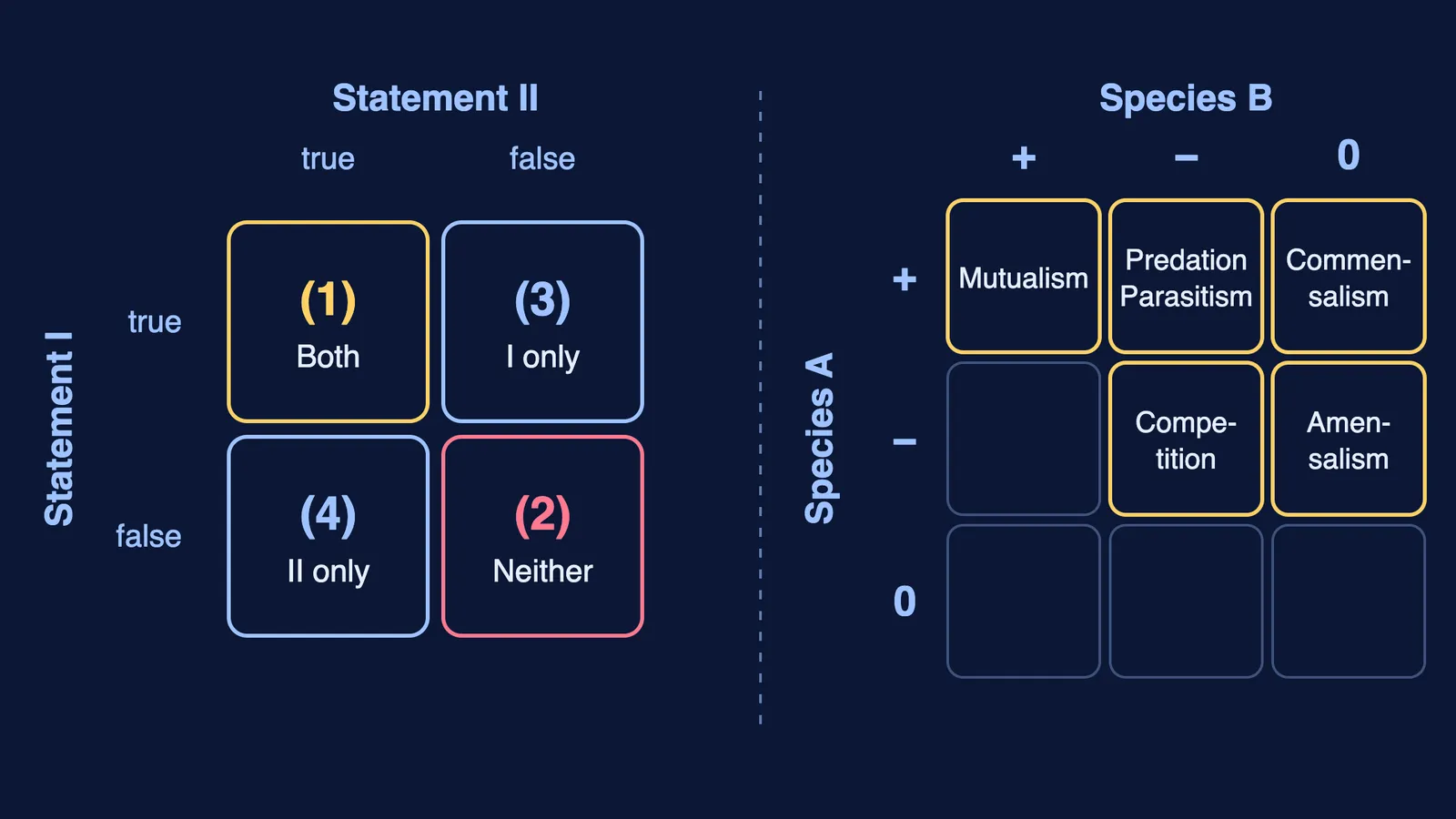
Test each statement on its own. Underline the detail a setter could flip (a name, a number, "once") and check just that in the NCERT text. More in our guide to statement-based questions. Options for Q1 to Q6:
Both correct
Both incorrect
I correct, II incorrect
I incorrect, II correct
Q1. I: Ecology deals with four levels: organisms, populations, communities and biomes. II: Asexually produced individuals cannot form a population for ecological study.
Answer: (3). NCERT counts asexually produced groups as populations too.
Q2. I: Normally, migration outweighs births and deaths in changing density. II: In a newly colonised habitat, immigrants may add more than births.
Answer: (4). Births and deaths usually dominate.
Q3. I: In dN/dt = rN, r equals b − d, both taken per capita. II: The r value NCERT quotes for the Norway rat is higher than that for the flour beetle.
Answer: (3). Norway rat 0.015, flour beetle 0.12.
Q4. I: Bamboo and Pacific salmon breed just once in a lifetime. II: Oysters and pelagic fishes make few, large offspring.
Answer: (3). They make many small offspring.
Q5. I: The human liver fluke uses a snail and a fish as its intermediate hosts. II: Parasites typically gain extra sense organs and a fuller digestive system.
Answer: (3). NCERT lists loss of unnecessary sense organs and of the digestive system.
Q6. I: By Gause's principle, two closely related species using the same resources cannot coexist indefinitely. II: MacArthur found five warbler species sharing one tree through different foraging.
Answer: (1). The second is resource partitioning.
Q7. Which statements are correct?
A. Close to a quarter of all insects feed on plants.
B. Thorns, as in Acacia and Cactus, are the commonest morphological defence of plants.
C. Plants make nicotine, caffeine and quinine as chemical defences against herbivores.
D. Endoparasites have more elaborate anatomy than ectoparasites.
Options: (1) A, B and C only (2) A and D only (3) B, C and D only (4) A, B, C and D
Answer: (1). Endoparasite anatomy is greatly simplified; only their life cycles are more complex.
Which pair should you fix first in match-the-list questions?
Scan the coded answers first. Fix your most certain pair, cross out codes that contradict it, then check the pair that splits the rest. See our match-the-list method.
Q8. Example and interaction.
List-I: A. Fungus with alga in a lichen; B. Clown fish among sea anemone tentacles; C. Koel eggs in a crow's nest; D. Flamingoes and resident fishes eating the same zooplankton
List-II: I. Competition; II. Parasitism; III. Mutualism; IV. Commensalism
(1) A-III, B-II, C-IV, D-I (2) A-III, B-IV, C-II, D-I (3) A-IV, B-III, C-II, D-I (4) A-III, B-IV, C-I, D-II
Answer: (2). The anemone gains nothing; the koel is a brood parasite.
Q9. Scientist and finding.
List-I: A. Verhulst and Pearl; B. Gause; C. MacArthur; D. Darwin
List-II: I. Unchecked elephants reaching huge numbers; II. The logistic growth model; III. Warblers coexisting on one tree; IV. Competitive exclusion
(1) A-II, B-IV, C-III, D-I (2) A-IV, B-II, C-III, D-I (3) A-II, B-III, C-IV, D-I (4) A-I, B-IV, C-III, D-II
Answer: (1). Verhulst-Pearl growth is the sigmoid model.
Q10. Term and meaning.
List-I: A. Natality; B. Emigration; C. Carrying capacity (K); D. Intrinsic rate of natural increase (r)
List-II: I. Members leaving the habitat in the period; II. Births added in the period; III. b − d per capita; IV. Most individuals the habitat can support
(1) A-I, B-II, C-IV, D-III (2) A-II, B-I, C-III, D-IV (3) A-II, B-I, C-IV, D-III (4) A-IV, B-I, C-II, D-III
Answer: (3). K is the asymptote of the sigmoid curve.
Q11. Case and what it shows.
List-I: A. Abingdon tortoise lost after goats arrived; B. Prickly pear in Australia checked by a moth; C. Copepods on a marine fish; D. Fig and its partner wasp
List-II: I. Ectoparasitism; II. One-to-one co-evolved mutualism; III. Invasive species checked by a native-range predator; IV. Competition via better browsing
(1) A-IV, B-I, C-III, D-II (2) A-III, B-IV, C-I, D-II (3) A-IV, B-III, C-II, D-I (4) A-IV, B-III, C-I, D-II
Answer: (4). NCERT names copepods as ectoparasites of many marine fish.
How do you solve the single-correct growth sums?
Write the equation first; each wrong option comes from a skipped term.
Q12. A forest patch has 640 langurs. In a year: 128 births, 32 arrivals, 96 deaths, 16 departures. Find the new density and per capita birth rate.
(1) 688; 0.2 (2) 640; 0.2 (3) 688; 0.25 (4) 592; 0.2
Answer: (1). Nt+1 = 640 + [(128 + 32) − (96 + 16)] = 688; 128/640 = 0.2 per langur per year; 0.25 counts arrivals as births.
Q13. Unlimited resources, N = 2,000, per capita b = 0.09 and d = 0.03 per year. What is dN/dt?
(1) 180 (2) 60 (3) 120 (4) 240
Answer: (3). r = 0.06, so dN/dt = 0.06 × 2,000 = 120 per year; 180 forgets deaths.
Q14. Logistic growth with r = 0.25 per year, K = 1,200 and N = 240. What is dN/dt?
(1) 60 (2) 48 (3) 12 (4) 0
Answer: (2). 0.25 × 240 × (960/1,200) = 48; 60 drops the (K − N)/K factor.
How should you practise this set?
Attempt all 14 in one timed sitting, log what tripped you on each miss, and reread the matching NCERT paragraph. Then try our Organisms and Populations assertion-reason set.
Still mixing up amensalism and commensalism, or r and K? Fermi's AI tutor works out what you already know and builds a plan for the session.


