On this page
Organisms and Populations is Chapter 11 of the CBSE Class 12 Biology curriculum for 2026-27. In the CBSE Class 12 Biology sample paper for 2026-27, Section A has 16 questions of 1 mark each, and questions 13 to 16 are assertion-reason items.
The 10 questions below are original, and every statement is checked against the NCERT Organisms and Populations chapter (Reprint 2026-27). For full chapter notes, start with our Organisms and Populations Class 12 board exam guide.
How do you answer assertion-reason questions?
Judge each statement on its own first. Only if both are true, ask whether R is the direct cause of A. Our three-check method for assertion-reason questions walks through this step by step.
Options for Q1 to Q6:
(A) Both A and R are true and R is the correct explanation of A.
(B) Both A and R are true but R is NOT the correct explanation of A.
(C) A is true but R is false.
(D) A is false but R is true.
Options for Q7 to Q10:
(A) Both statements are correct.
(B) Both statements are incorrect.
(C) Statement I is correct, Statement II is incorrect.
(D) Statement I is incorrect, Statement II is correct.
Organisms and populations assertion-reason questions
Q1 (easy). Assertion (A): Sex ratio is an attribute of a population, not of an individual. Reason (R): A single organism has only one sex, so a proportion of males to females can be worked out only for a group.
Answer: (A). Both are true, and R is the very reason NCERT gives: one organism has a sex, only a group can have a ratio. Trap: second-guessing and marking (B).
Q2 (easy). Assertion (A): NCERT does not count the female mosquito as a parasite of humans. Reason (R): A female mosquito takes human blood to reproduce.
Answer: (B). Both are true per NCERT. But needing our blood is an argument for calling it a parasite, not against it, so R cannot explain A. Trap: linking two true sentences about the same animal.
Q3 (medium). Assertion (A): In a newly colonised habitat, immigrants may raise numbers more than births do. Reason (R): In ordinary circumstances, natality and mortality matter most for changes in population density.
Answer: (B). Both are true. R describes the normal case, while A is the special case NCERT names as the exception, so R cannot explain it. Trap: choosing (A) because both share a paragraph.
Q4 (medium). Assertion (A): The Monarch butterfly is highly distasteful to the birds that prey on it. Reason (R): The adult Monarch butterfly makes this distasteful chemical in its own body cells.
Answer: (C). A is true. R is false: the butterfly acquires the chemical during its caterpillar stage by feeding on a poisonous weed. Trap: assuming every defence chemical is made by the animal itself.
Q5 (medium). Assertion (A): The Mediterranean orchid *Ophrys* gets pollinated without offering the bee any reward. Reason (R): One petal of the flower resembles a female bee, so male bees pseudocopulate with it and carry pollen to the next flower.
Answer: (A). Both are true, and R is the mechanism, which NCERT calls sexual deceit, that lets the orchid get pollination without paying nectar or pollen. Trap: thinking every plant-pollinator pair must exchange food.
Q6 (hard). Assertion (A): When all *Pisaster* starfish were removed from an enclosed intertidal area, the number of invertebrate species there rose. Reason (R): Predators help maintain species diversity by reducing the intensity of competition among competing prey species.
Answer: (D). A is false: more than 10 invertebrate species became extinct within a year, because competition among them was no longer held down. R is true, and it is why the species were lost. Trap: reasoning that fewer predators must mean more prey species.
Statement I and Statement II questions with answers
Q7 (medium). Statement I: In predation, parasitism and commensalism alike, the two interacting species live in close association. Statement II: In commensalism, both interacting species benefit.
Answer: (C). Statement I is true per NCERT. Statement II is false: in commensalism one species benefits and the other is neither harmed nor benefited (+, 0); both benefiting is mutualism. Trap: mixing up the sign pairs.
Q8 (medium). Statement I: India's tiger census in national parks and reserves often estimates numbers indirectly, from pug marks and fecal pellets. Statement II: In an area with 200 carrot grass plants and one huge banyan tree, per cent cover or biomass describes the banyan's population size better than a count does.
Answer: (A). Both are correct. Population sizes are often estimated indirectly, and counting one banyan would underestimate its role in that community. Trap: thinking population density must always be a number of individuals.
Q9 (hard). Statement I: In Connell's field experiments on the rocky coasts of Scotland, the smaller barnacle *Chthamalus* excluded the larger *Balanus* from the intertidal zone. Statement II: Herbivores and plants appear to be more adversely affected by competition than carnivores.
Answer: (D). Statement I reverses the result: the larger, competitively superior *Balanus* dominates and excludes the smaller *Chthamalus*. Statement II matches NCERT. Trap: remembering the names but not who won.
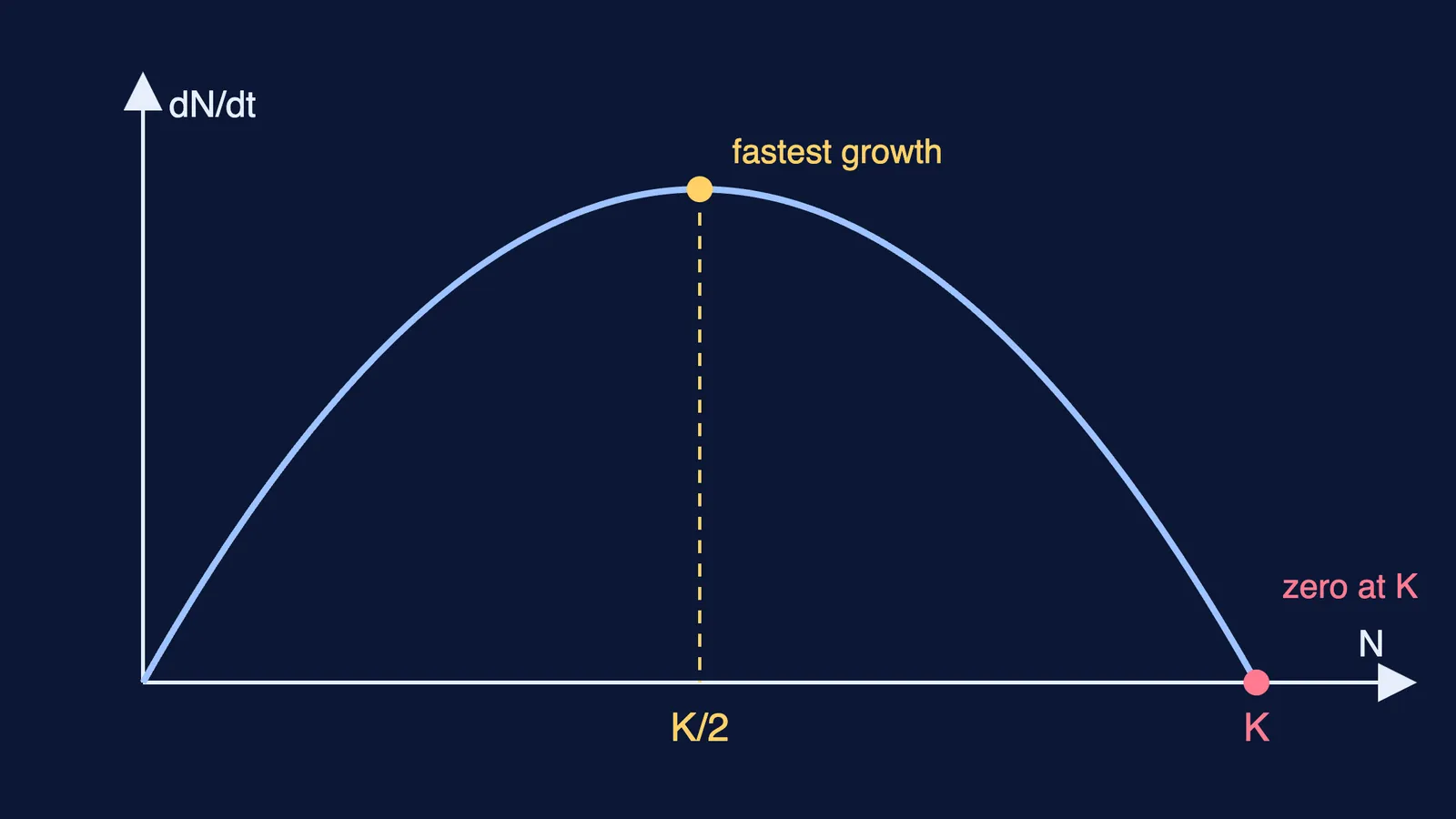
Q10 (hard). Statement I: In logistic growth, dN/dt = rN(K - N)/K is highest when the population reaches its carrying capacity K. Statement II: A population growing exponentially with r = 0.14 per year takes about 20 years to double.
Answer: (B). Both are incorrect. At N = K the factor (K - N)/K is zero, so growth stops; the product rN(K - N)/K is largest at N = K/2. From Nt = N0 e^(rt), doubling time is ln 2 / r = 0.693 / 0.14, about 5 years, not 20. Trap: treating the top of the S-curve as the point of fastest growth.
How should you use this set?
Cover the answers and mark all 10 in one sitting.
For each miss, write in one line which statement failed or which link broke.
Re-read the NCERT paragraph behind it, then retry the misses two days later.
If the J-shaped and S-shaped curves still blur together, the Fermi Simulation Lab has interactive simulations for the ideas that are easier to see than to read. For longer practice on the same chapter, try our Organisms and Populations case study questions.