On this page
Organisms and Populations comes down to one graph, two equations, one sign table and a set of named examples. Learn those cold and most board questions become routine.
How many marks is Organisms and Populations in the 2026-27 CBSE board exam?
In the CBSE Biology curriculum for 2026-27, Unit X, Ecology and Environment, carries 10 marks out of 70 in the Class XII theory paper. Those 10 marks are shared with Ecosystem and Biodiversity and its Conservation; CBSE prints no separate mark for this chapter.
The same document keeps population interactions (mutualism, competition, predation, parasitism) and population attributes (growth, birth and death rates, age distribution). Your textbook is the NCERT chapter, Reprint 2026-27. It opens directly at 11.1 Populations, so check any older guide's pages on habitat or adaptations against the reprint before revising them. CBSE's list leaves out commensalism, amensalism and life history variation, but they are still in the chapter; read them once.
What should you write for population attributes and growth?
Population attributes. NCERT defines birth and death rates as per capita rates: births or deaths divided by the number of individuals present. Its lotus example gives 8/20 = 0.4 offspring per lotus per year. Sex ratio and age distribution are also population attributes.
Age pyramids. Draw pre-reproductive, reproductive and post-reproductive bands for expanding, stable and declining populations; a wide base means growth, a narrow base decline.
Growth equation. With births (B), deaths (D), immigration (I) and emigration (E): Nt+1 = Nt + [(B + I) - (D + E)].
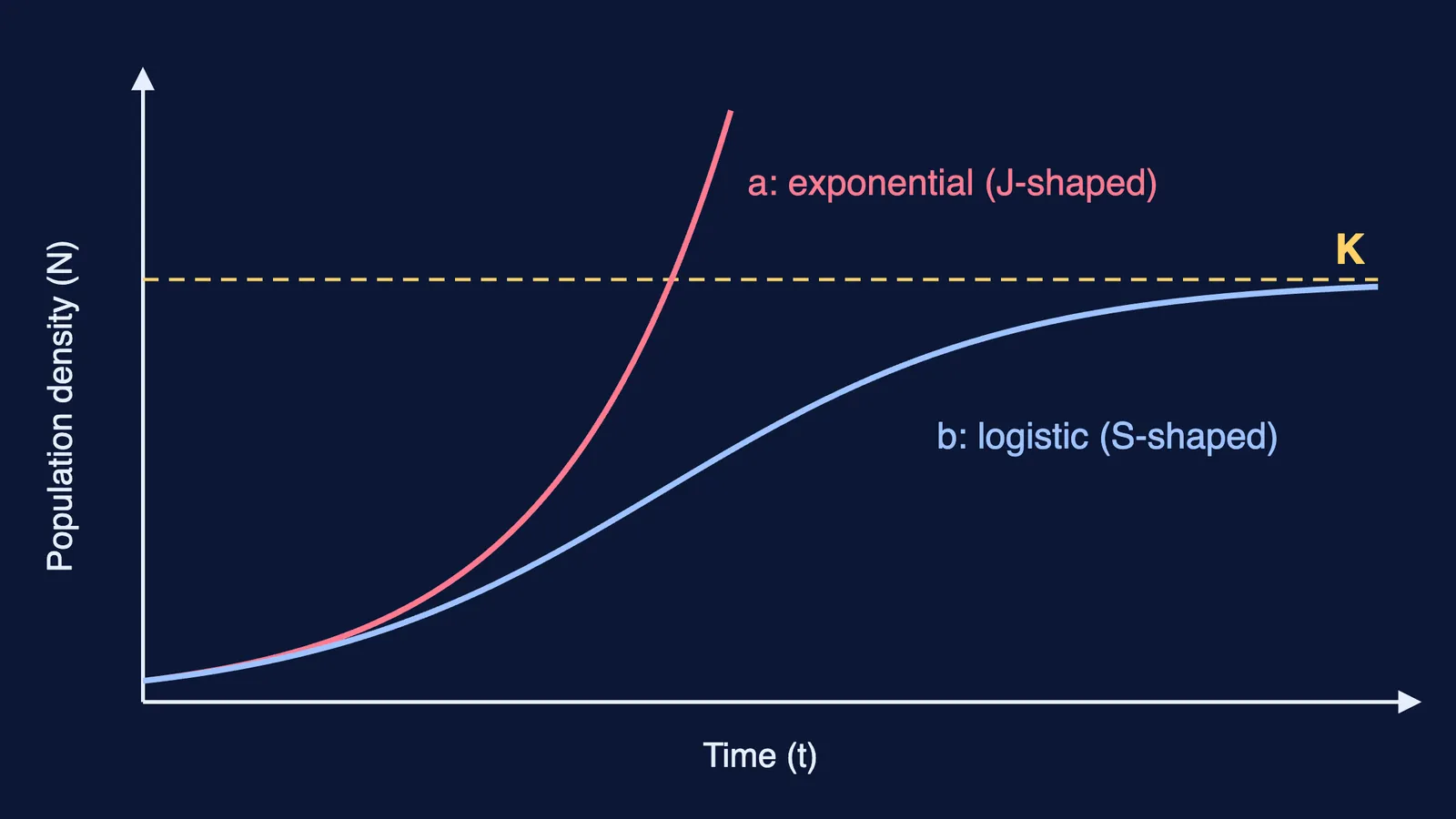
Exponential growth. With unlimited resources, dN/dt = rN, where r = b - d is the intrinsic rate of natural increase. The curve is J-shaped; the integral form is Nt = N0 e^rt.
Logistic growth. With limited resources, dN/dt = rN[(K - N)/K], where K is the carrying capacity. The sigmoid curve shows a lag phase, acceleration, deceleration and an asymptote at K. NCERT calls this Verhulst-Pearl logistic growth, a more realistic model.
Which population interactions and examples does NCERT use?
NCERT's Table 11.1 gives each interaction as signs for species A and B:
Mutualism (+, +): lichens; fig and its wasp.
Competition (-, -): flamingoes and fish sharing zooplankton; Connell's barnacles.
Predation (+, -): tiger and deer; the moth that controlled prickly pear in Australia.
Parasitism (+, -): Cuscuta; koel laying eggs in a crow's nest.
Commensalism (+, 0): orchid on a mango branch; cattle egret and cattle.
Amensalism (-, 0): NCERT gives no example, so do not invent one.
The CBSE 2026-27 sample paper tests this table with unfamiliar organisms: Question 28 puts a nematode inside an ant, and the marking scheme gives one mark for naming parasitism and defining it. Test your own examples with how to check mutualism and commensalism examples against NCERT.
How do you set out 2-, 3- and 5-mark answers?
2 marks: name, one-line definition, NCERT example. The marking scheme for Question 21B gives one mark for naming mutualism and why both benefit.
3 marks: three separate points, each a mark. In a case study, name the interaction, give its signs and tie it to the passage's organisms.
5 marks: a labelled graph with both curves and K, both equations with symbols defined, and a short contrast. NCERT exercise 8 asks for the logistic curve with a diagram.
Method 1, counts. Nt+1 = 250 + [(75 + 10) - (25 + 5)] = 250 + 55 = 305.
Method 2, per capita rates. b = 75/250 = 0.3 and d = 25/250 = 0.1, so r = 0.3 - 0.1 = 0.2 per year. Natural increase = rN = 0.2 x 250 = 50. Net migration = 10 - 5 = 5. End of year: 250 + 50 + 5 = 305.
Both give 305. r uses births and deaths only; migration is added separately. For doubling-time questions, see exponential growth numericals step by step.
What are the assertion-reason and case-study traps?
NCERT says Gause's competitive exclusion principle may hold when resources are limiting, but not otherwise. An assertion that it always holds is false.
Competition can involve unrelated species (flamingoes and fish) and can occur without limiting resources (interference competition).
An orchid on a mango branch is commensalism, not parasitism.
NCERT does not count the female mosquito as a parasite.
Birth rate is a population attribute; an individual has births, not a birth rate. More on this in population attributes an individual does not have.
Still confusing the curves? The Fermi Simulation Lab has interactive simulations for the ideas that are easier to see than to read.
What is a good revision plan for this chapter?
Day 1: read 11.1.1 and 11.1.2; draw the pyramids and both curves from memory.
Day 2: write both equations with every symbol defined; redo the worked example with new numbers.
Day 3: rebuild Table 11.1 with examples; answer the ten NCERT exercises.
Day 4: attempt sample paper Questions 21B and 28 and mark them against the scheme.
Last day: one timed 5-mark logistic-curve answer, graph included.