On this page
Biodiversity and Conservation is Chapter 13 of the NCERT Class 12 Biology textbook (Reprint 2026-27). It sits in Unit X, Ecology and Environment, which carries 10 of the 70 theory marks in the CBSE 2026-27 Biology curriculum. Those 10 marks are shared with Organisms and Populations and Ecosystem; this chapter has no separate mark. This guide is for written board answers, not NEET.
What does the 2026-27 syllabus cover?
The curriculum lists patterns, importance, loss and conservation of biodiversity, plus hotspots, endangered organisms, extinction, Red Data Book, sacred groves, protected areas and Ramsar sites. NCERT does not explain Red Data Book or Ramsar sites; ask your teacher how deep to go. The 2026-27 sample paper has 1-mark, 2-mark, 3-mark, 4-mark case-based and 5-mark questions; option A of its five-mark Question 33 is a case on threats to biodiversity.
Which NCERT facts should you write exactly?
From the NCERT chapter:
Levels: genetic (*Rauwolfia vomitoria* reserpine across Himalayan ranges; more than 50,000 rice strains in India), species (more amphibian species in the Western than Eastern Ghats), ecological (India's ecosystem diversity exceeds Norway's).
Global count: IUCN (2004): slightly more than 1.5 million species described; Robert May estimates about 7 million in all.
India: 2.4 per cent of world land, 8.1 per cent of species, one of 12 megadiverse countries.
Evil quartet: habitat loss and fragmentation (most important), over-exploitation (Steller's sea cow, passenger pigeon), alien species invasions (Nile perch in Lake Victoria, *Parthenium*, *Lantana*) and co-extinctions (a host fish and its parasites).
In situ: protect the whole ecosystem. Of 34 hotspots, three cover India: Western Ghats and Sri Lanka, Indo-Burma, Himalaya. India has 14 biosphere reserves, 90 national parks and 448 wildlife sanctuaries. Sacred groves: Khasi and Jaintia Hills (Meghalaya), Aravalli Hills (Rajasthan), Western Ghat regions of Karnataka and Maharashtra, and Sarguja, Chanda and Bastar (Madhya Pradesh).
Ex situ: zoos, botanical gardens, cryopreservation of gametes, in vitro fertilisation, tissue culture, seed banks.
Add NCERT's three reasons to conserve and Ehrlich's rivet popper analogy.
How do you solve a species-area question?
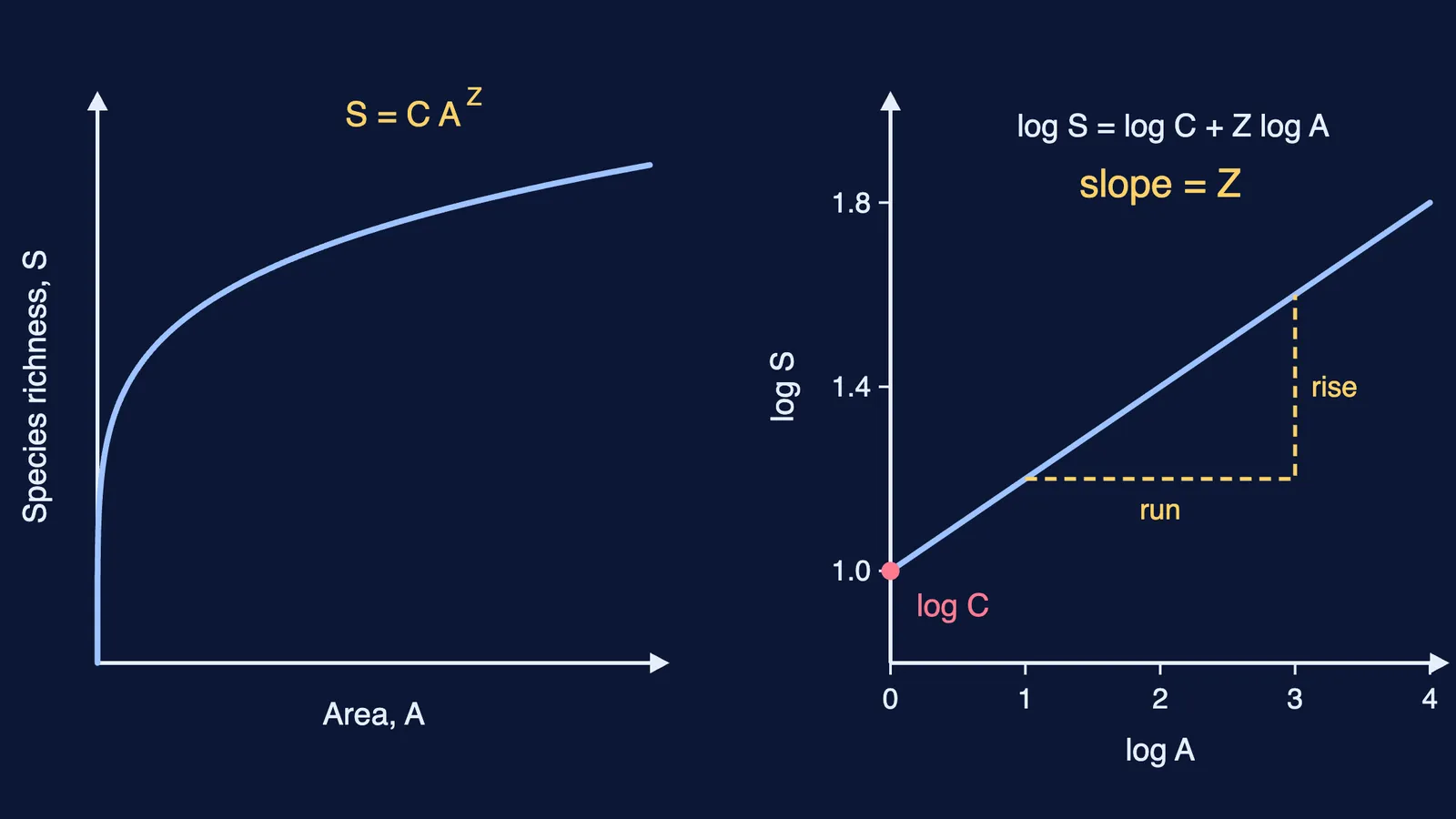
NCERT credits Alexander von Humboldt: within a region, the more area he explored, the more species he found, up to a limit. On linear axes the curve is a rectangular hyperbola; on log axes it becomes the straight line log S = log C + Z log A, where Z is the slope. Z is 0.1 to 0.2 within regions, whatever the group, but 0.6 to 1.2 across continents.
Worked example (invented data). C = 10 and Z = 0.2. How many species would 10,000 km² hold?
Method 1, log form. log S = log 10 + 0.2 × log 10,000 = 1 + 0.2 × 4 = 1.8. S = antilog 1.8 ≈ 63 species.
Method 2, tenfold steps. Each tenfold rise in area multiplies S by 10^0.2 ≈ 1.585. From S = C = 10 at A = 1, four steps give 15.8, 25.1, 39.8, 63.1.
Independent check. log 63.1 = 1.800, matching 1 + 0.8. Halving the area keeps 0.5^0.2 ≈ 87 per cent of species at Z = 0.2 but about 45 per cent at Z = 1.15: a steeper slope means lost area costs more species.
If logs trip you up, the Fermi Problem Library has worked problems with a step-by-step solver that explains the reasoning rather than printing an answer.
How should you set out 2-, 3- and 5-mark answers?
2 marks: a definition plus one NCERT example. "Sacred groves are forest tracts given total protection for religious and cultural reasons; in Meghalaya they shelter rare and threatened plants."
3 marks: three separate points, or a labelled graph plus one line, such as the three hypotheses for tropical richness: more evolutionary time, a constant environment, more solar energy.
5 marks: follow the marking scheme for Question 33, option A. It gives one mark for each threat named and tied to a clue in the case, and one for an in situ step with a reason.
Which assertion-reason and case-study traps cost marks?
The sample paper uses the standard four assertion-reason options.
NCERT says alien species can be brought in by accident or on purpose. A reason claiming they are always deliberate is false.
A hotspot needs high species richness and high endemism. One alone is not enough.
Only the log graph is a straight line.
Seed banks are ex situ; sacred groves are in situ.
Map each case clue to one cause. In the marking scheme, harvesting wild plants is over-exploitation, foreign grass is alien invasion, birds lost with nesting trees is co-extinction, fire is habitat loss.
What is a good seven-day revision plan?
Levels, global and Indian figures.
Latitudinal gradient, three hypotheses, Figure 13.2 drawn both ways.
Two species-area sums, both methods.
The evil quartet, one example each.
In situ versus ex situ, with hotspots and sacred groves.
Sample paper Question 33, timed, then marked against the scheme.
NCERT exercises 1 to 7, answered aloud.
Start tonight: write the three levels from memory.