On this page
India being a megadiverse country is a standard line in the Biodiversity and Conservation chapter. Here are the exact numbers, where they come from, and why a newer source gives slightly different ones.
What does megadiverse mean?
Megadiverse countries are the world's most biodiversity-rich countries, "with a particular focus on endemic biodiversity" (species found nowhere else), as the Biodiversity A-Z glossary defines them. The idea was first proposed in 1988, in work by the conservationist Russell Mittermeier, and the glossary lists 17 countries, including India, China, Brazil, Indonesia and Australia.
To qualify, the glossary says, a country must have at least 5,000 endemic plant species and must have marine ecosystems within its borders. Together these countries account for at least two thirds of all non-fish vertebrate species and three quarters of all higher plant species, according to the same glossary.
Your textbook uses a different count. NCERT's Class 12 biology chapter 13 calls India "one of the 12 mega diversity countries of the world". Both counts are in use; for a school or entrance exam answer, write the NCERT figure.
Why is India a megadiverse country?
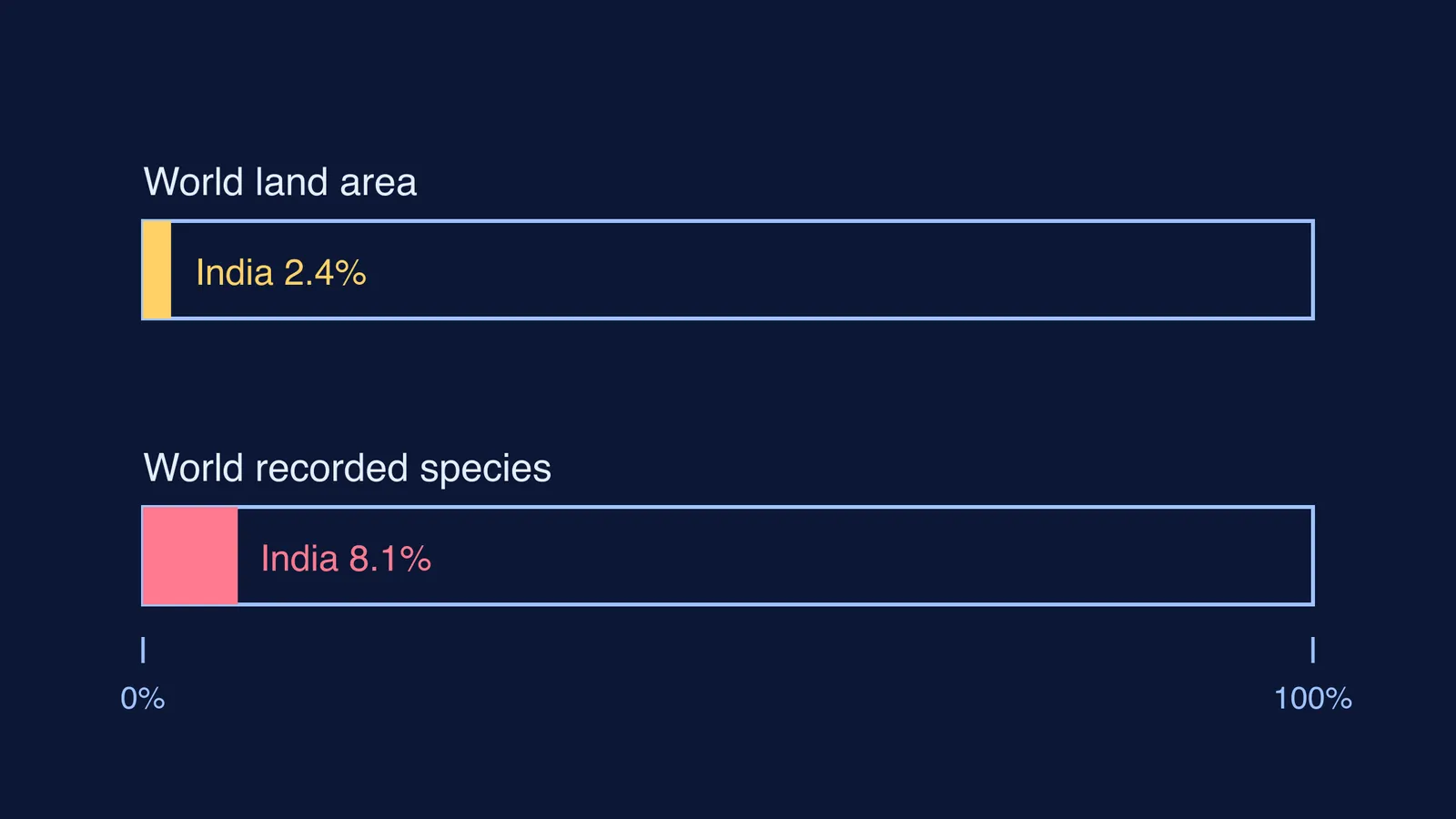
The short answer is the gap between land and life. India has only 2.4 percent of the world's land area, but its share of global species diversity is 8.1 percent, NCERT states.
Divide one by the other and India holds about 3.4 times the share of species its land share would suggest (8.1 ÷ 2.4 = 3.375). The same chapter gives context for this richness:
Latitude. Species diversity generally falls as you move from the equator towards the poles. India has much of its land area in the tropical latitudes and more than 1,200 species of birds, NCERT notes.
Hotspots. Three biodiversity hotspots, the Western Ghats and Sri Lanka, Indo-Burma and the Himalaya, cover India's exceptionally high biodiversity regions, according to NCERT.
Variety of ecosystems. With deserts, rain forests, mangroves, coral reefs, wetlands, estuaries and alpine meadows, India has greater ecosystem diversity than a Scandinavian country like Norway, the chapter says.
If the three levels of diversity still blur together, our post on genetic, species and ecological diversity with India's examples separates them.
How many plant and animal species does NCERT say India has?
Nearly 45,000 species of plants and twice as many animals have been recorded from India, NCERT says. "Twice as many" means roughly 90,000 animal species.
The Convention on Biological Diversity's India profile gives larger counts: over 91,200 animal species and 45,500 plant species documented, with India harbouring nearly 7-8 percent of the world's recorded species. It also counts 4 of the 34 global hotspots in India, adding Sundaland to NCERT's three; our guide to biodiversity hotspots in India covers all four.
How does NCERT estimate the species still undiscovered?
Here is the worked example, using only figures from the NCERT chapter.
The IUCN (2004) puts described plant and animal species at slightly more than 1.5 million worldwide.
Robert May's estimate puts the true total at about 7 million.
If we accept May's estimate, only about 22 percent of species have been recorded, NCERT says (1.5 ÷ 7 is roughly 0.21).
Apply that to India's plants: 45,000 ÷ 0.22 ≈ 2,04,500 in total, so about 1,59,500 still unnamed. NCERT states this as "more than 1,00,000 plant species" yet to be discovered.
Apply it to animals: 90,000 ÷ 0.22 ≈ 4,09,000 in total, so about 3,19,000 still unnamed. NCERT says "more than 3,00,000 animal species".
Once you can rebuild these numbers, you no longer need to memorise them. For more practice with estimates like this, the Fermi Problem Library has worked problems with a step-by-step solver that explains the reasoning rather than printing an answer.
Fact card to revise from
Copy this onto one index card. Every line is from the NCERT chapter.
India's share of world land: 2.4 percent
India's share of global species diversity: 8.1 percent
India's status: one of 12 megadiversity countries (NCERT's count)
Plants recorded from India: nearly 45,000 species
Animals recorded from India: about twice as many as plants
Bird species in India: more than 1,200
Species recorded worldwide (IUCN 2004): slightly more than 1.5 million
Robert May's global estimate: about 7 million, so about 22 percent recorded
Undiscovered in India: more than 1,00,000 plants and more than 3,00,000 animals
Hotspots covering India: Western Ghats and Sri Lanka, Indo-Burma, Himalaya
Cover the numbers and say each one aloud, then check. A day later, rebuild the undiscovered counts from 22 percent alone. Watch for the common slip of swapping the percentages: land comes first and is the smaller number.
Next, read our guide to the evil quartet of biodiversity loss. If a term such as endemism still feels shaky, the Fermi Concept Library gives every concept in biology its own lesson.