On this page
If you have ever chopped bhindi or palak and then rinsed the pieces under the tap, you have washed away some of the vitamins you meant to eat. The fix costs nothing: wash first, cut second.
Why wash vegetables before cutting them?
Because two important groups of vitamins dissolve in water. Vitamin C and the B vitamins are water-soluble, and the ICMR-National Institute of Nutrition's Dietary Guidelines for Indians (2024) warn that B complex vitamins and vitamin C may be lost if cooking water is thrown away.
The same document's Guideline 13, "Adopt appropriate pre-cooking and cooking methods", is direct about the order of work. Vegetables and fruits should be washed thoroughly with potable water before peeling or cutting. Cut vegetables, leafy vegetables and fruits should not be soaked in water, because water-soluble minerals and vitamins tend to get lost.
The school textbook says the same thing. In the current NCERT Class 6 science book, Curiosity, Chapter 3, "Mindful Eating: A Path to a Healthy Body", students read that washing cut or peeled vegetables and fruits may result in the loss of some vitamins, and that all fruits and vegetables should still be washed thoroughly before eating. If you want the bigger picture of which vitamins are which, our guide to vitamin classification and deficiency diseases sorts them out.
What happens to vitamins at a cut surface?
A knife opens the cells along every cut face, so juice, with its dissolved vitamins, sits on the surface. Water poured over it carries some away.
There is a second route of loss. A review in the Journal of the Science of Food and Agriculture describes vitamin C and the B vitamins as both water-soluble and oxygen-labile, meaning they break down when exposed to oxygen (Rickman, Barrett and Bruhn, 2007). The ICMR-NIN guidelines make the same point in kitchen terms: cutting vegetables into small pieces exposes more of the food to the air, and vitamins are lost through oxidation.
How big is the effect? Washing ready-to-eat white cabbage with plain water reduced its vitamin C content by 16–29%, according to a study summarised in a 2021 review in Antioxidants (Mieszczakowska-Frąc and colleagues, 2021). The same review notes that leafy vegetables, with their large surface, can lose more through cutting and washing.
How much more surface does chopping create?
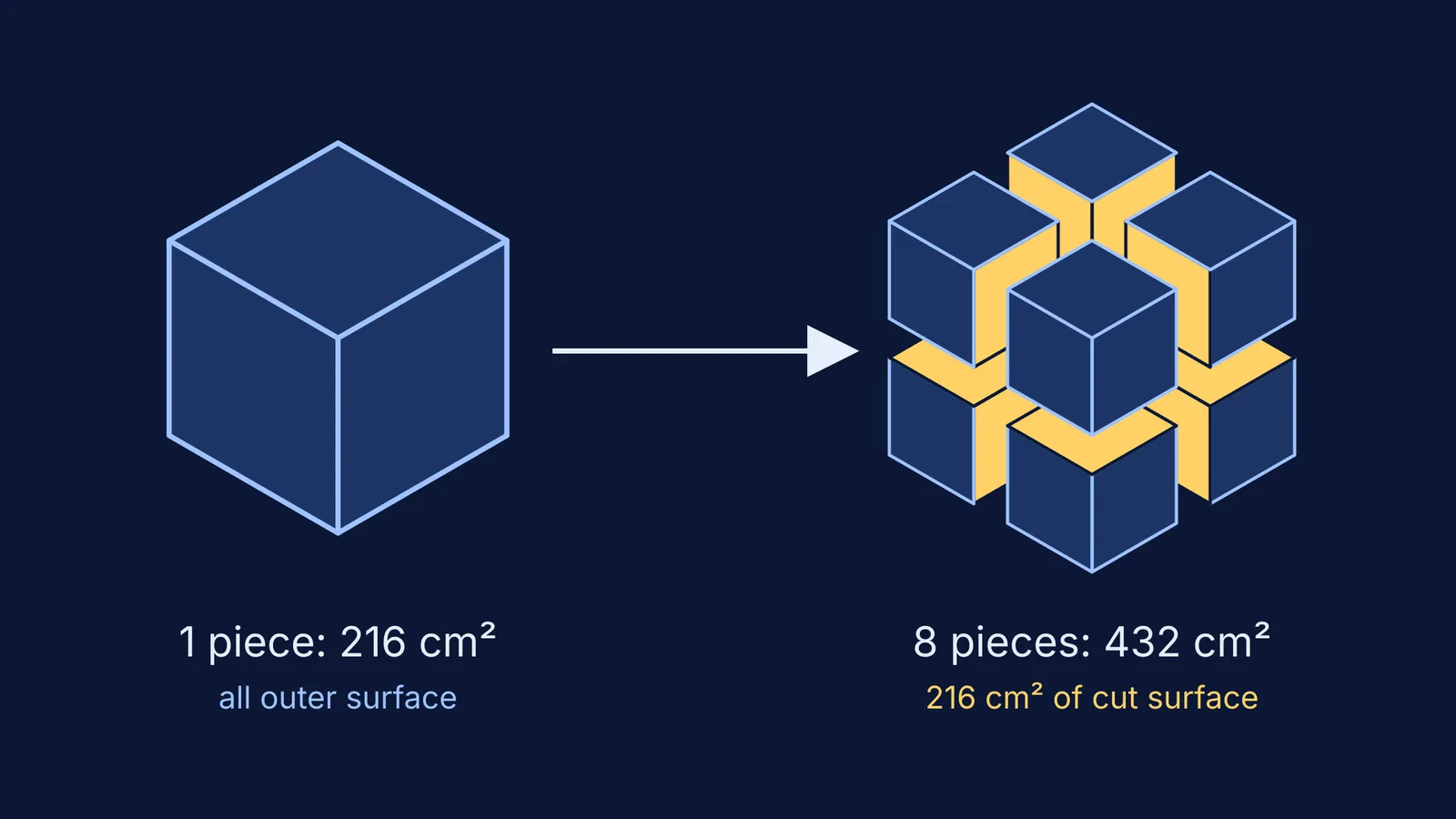
Picture a vegetable as a simple 6 cm cube. A cube has 6 faces, so its surface area is 6 × side².
Whole: 6 × 6 × 6 = 216 cm², all of it outer surface.
Cut into 8 cubes of 3 cm: 8 × 6 × 9 = 432 cm². The surface has doubled, and 216 cm² of it is fresh cut face.
Cut into 27 cubes of 2 cm: 27 × 6 × 4 = 648 cm², three times the original.
Diced into 1 cm cubes: 216 × 6 × 1 = 1,296 cm², six times the original, and 1,080 cm² of it is cut surface.
The pattern: if you cut each edge into n equal parts, the total surface goes up n times while the volume stays the same. Finer chopping gives water and air far more cut surface to work on. It is the same geometry behind why small pieces cook faster.
Does soaking chopped vegetables make it worse?
Yes. Some kitchens keep cut potatoes or brinjal in water so they do not brown, or chop everything the night before. The ICMR-NIN guidelines advise against both: cut vegetables should not be soaked, and cut vegetables and fruits should be eaten as early as possible because their shelf life and nutrient content fall sharply.
The guidelines add three more tips. Avoid washing rice and pulses again and again. Cook with the lid on, since food cooks faster and keeps more nutrients. Steam rather than boil, so vegetables do not sit in water.
A kitchen checklist for washing and cutting
Wash whole vegetables and fruits under running drinking-quality water before you peel or cut them.
For palak, methi and other greens, wash the whole leaves, drain them, then chop.
Cut just before you cook or eat, not hours ahead.
Keep pieces as large as the recipe allows.
Do not leave cut pieces standing in water.
Rinse rice and dal to clean them, but not again and again.
Cook with a lid on and add only the water you need.
If you do boil vegetables, use the water in dal, soup or gravy instead of pouring it away.
Can you test this yourself?
If you have access to a school lab, the DCPIP test shows vitamin C levels as a colour change. Our guide to testing vitamin C in juices with DCPIP explains the method; compare a vegetable washed whole with one chopped and then rinsed. If the difference between water-soluble and fat-soluble vitamins still feels fuzzy, the Fermi Concept Library covers every concept in physics, chemistry, biology, mathematics and computing, each with its own lesson.
Next time you reach for the knife, turn on the tap first.