

On this page
In 2004, two New Zealand school students used this colour test and found far less vitamin C in a blackcurrant drink than its maker claimed. In 2007 the manufacturer pleaded guilty to 15 charges and was fined NZ$217,500, says a Salters-Nuffield Advanced Biology core practical sheet. The same test can also show what boiling does to the vitamin C in juice.
What does DCPIP do in the vitamin C test?
DCPIP (2,6-dichlorophenolindophenol) is a blue dye that is reduced by ascorbic acid to a colourless compound, as a 2019 paper in the journal Sensors describes. The same paper notes that the dye turns pink in acid conditions, which helps explain why the endpoint with juice is given as colourless or slightly pink on the Salters-Nuffield sheet.
Vitamin C gives electrons to DCPIP: the dye is reduced and the vitamin is oxidised. A fixed amount of DCPIP needs a fixed amount of vitamin C to lose its colour, so juice richer in vitamin C needs fewer drops.
If you mix up oxidation and reduction, the Fermi Concept Library has its own lesson for every concept in chemistry and biology, each with its place in the map. For where vitamin C sits among the other vitamins, see our guide to vitamin classification and deficiency diseases.
How do you test fruit juice for vitamin C with DCPIP?
This method follows the Salters-Nuffield core practical, with a boiled sample added. Wear eye protection, and boil only under your teacher's supervision.
Pipette 1 cm³ of DCPIP solution into a clean test tube.
Add a vitamin C standard of known concentration drop by drop, shaking gently after each drop, until the blue colour has just disappeared. Record the number of drops.
Repeat with fresh juice. If only one or two drops decolourise the DCPIP, dilute the juice and test again.
Boil a measured volume of the same juice for a fixed time, such as five minutes. Cool it, then top it up with distilled water to its starting volume.
Test the boiled juice the same way. Do three repeats per sample.
Dilute dark juices such as blackcurrant until pale, the sheet adds, or their colour hides the endpoint.
How do you work out vitamin C from the number of drops?
Use one ratio: vitamin C in juice = concentration of standard × (drops of standard ÷ drops of juice).
A worked example with made-up practice numbers: a 0.1% standard holds 1 mg of vitamin C per cm³ and needs 4 drops. Fresh orange juice averages 12 drops. The boiled juice averages 18 drops.
Fresh juice: 1 × 4 ÷ 12 = 0.33 mg per cm³, or 33 mg per 100 cm³.
Boiled juice: 1 × 4 ÷ 18 = 0.22 mg per cm³, or 22 mg per 100 cm³.
Vitamin C kept after boiling: 12 ÷ 18 × 100 = 67%, so about a third was lost.
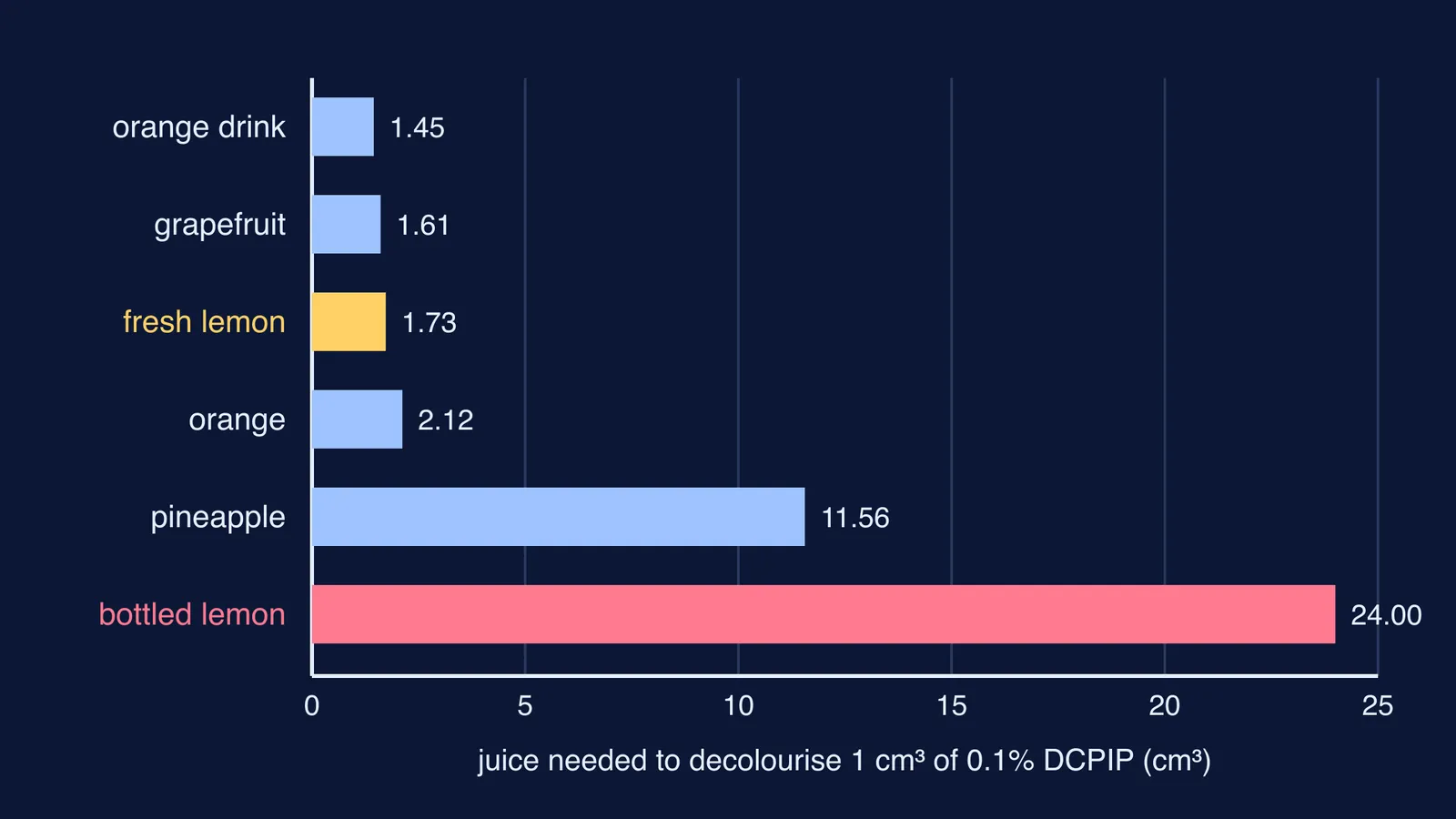
In the Salters-Nuffield sample results, fresh lemon juice took 1.73 cm³ to decolourise 1 cm³ of 0.1% DCPIP, while bottled lemon juice took 24.00 cm³, about 14 times as much.
If the ratio step is where your answer goes wrong, the Fermi Problem Library has worked problems with a step-by-step solver that explains the reasoning rather than printing an answer.
Why does boiled juice need more drops?
A 2021 review in the journal Foods by Maria Giannakourou and Petros Taoukis names temperature and oxygen as the main factors behind vitamin C loss during processing. Oxygen converts ascorbic acid to dehydroascorbic acid, and once that is hydrolysed the vitamin activity is lost. The review cites one broccoli study in which boiling in water lost 33% of the vitamin C and microwaving lost 16%, while steaming kept the most.
The Salters-Nuffield teacher notes point out that heat-treated juice often has vitamin C added, so a carton's result may not show what heat did to the fruit's own vitamin C. DCPIP can also be reduced by other substances in juice, such as phenolic compounds (the Sensors paper uses DCPIP to measure both), so comparing fresh and boiled samples of the same juice is fairer than comparing two different fruits.
What should your results table and evaluation include?
Columns: sample, repeats 1 to 3, mean drops, vitamin C in mg per 100 cm³, and percentage of fresh.
Controlled variables: the same volume of DCPIP, the same dropper, the same mixing, and boiled juice cooled before testing.
Sources of error: judging the endpoint, uneven drop size, evaporation while boiling, and juice standing in air before testing.
Improvements: a burette, and a white tile behind the tube.
For how to phrase these in your file, see our guide to precautions and sources of error in practicals, or read the story of Albert Szent-Györgyi and vitamin C.
Count your drops, average your repeats, and let the ratio tell you how much the heat destroyed.


