

On this page
Your Class 12 biology chapter names three levels of biodiversity and gives one Indian example for each. The examples are easy to memorise and easy to mix up in a question. Here is what each level means, where the examples come from, and a three-question test you can use on any statement.
What are genetic, species and ecological diversity?
The NCERT Class 12 chapter Biodiversity and Conservation says, on page 216, that diversity exists at all levels of biological organisation, from macromolecules within cells to biomes, and picks out three as the most important.
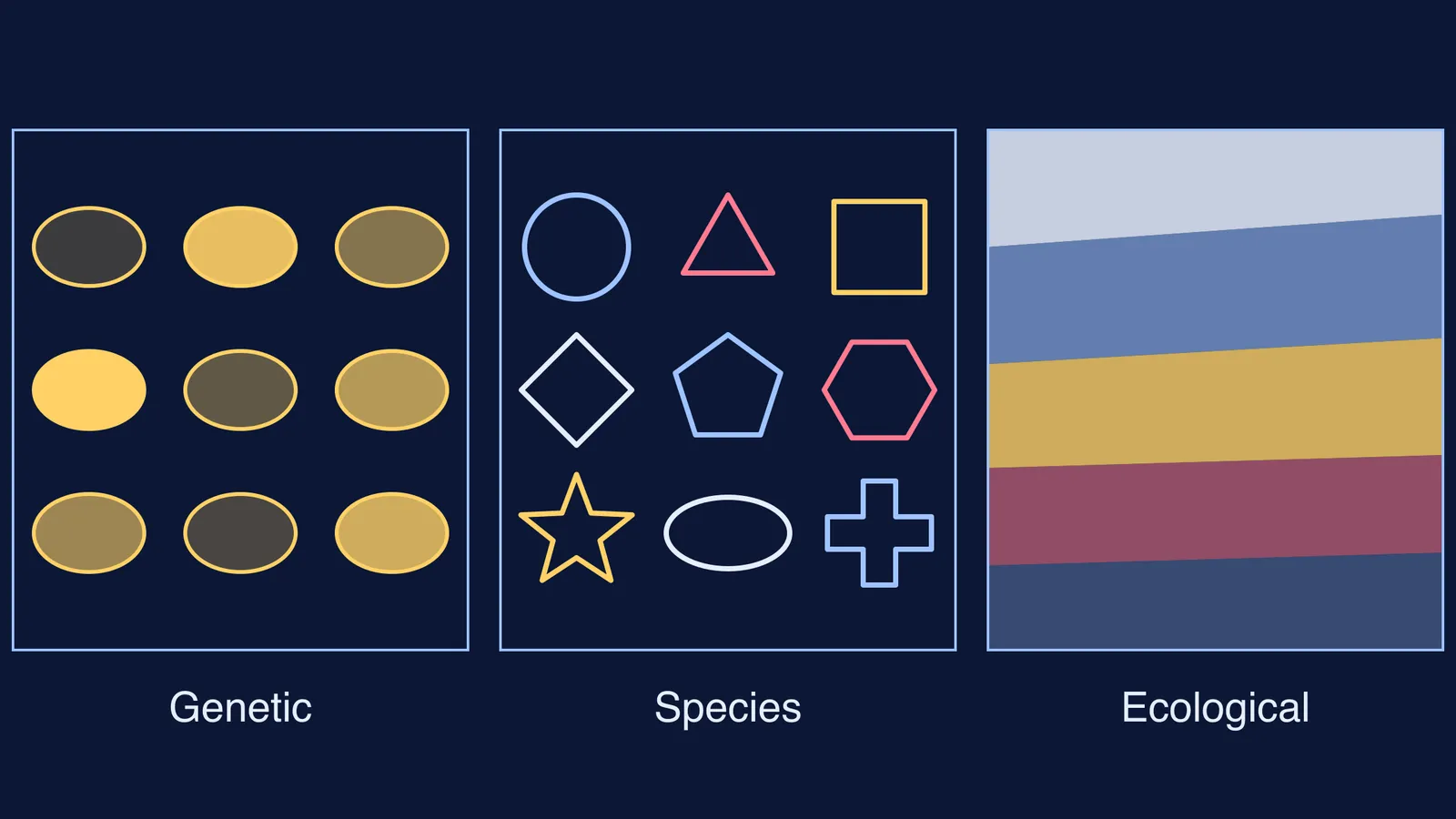
Genetic diversity is variation within a single species across the range where it grows, according to NCERT.
Species diversity is the variety of species in a place, such as the amphibians of a mountain range.
Ecological diversity is the variety of ecosystems in a region, such as deserts, forests and wetlands within one country.
What are examples of genetic diversity in India?
NCERT's first example is the medicinal plant *Rauwolfia vomitoria*. Plants of this one species growing in different Himalayan ranges can differ in the potency and concentration of reserpine, the active chemical they produce (NCERT, page 217). Same species, different chemistry: that is genetic diversity.
The same page gives two crop examples. India has more than 50,000 genetically different strains of rice and 1,000 varieties of mango (NCERT, page 217). Every one of those rice strains belongs to the same species. What differs is their genes, and those differences can show up in traits such as grain size or aroma.
Why does this matter? A species with many strains has more raw material for coping with a new pest or a dry year. If the strains are lost, the species survives in name but loses much of that variation.
Why are the Western Ghats an example of species diversity?
NCERT states that the Western Ghats have a greater amphibian species diversity than the Eastern Ghats (NCERT, page 217). The comparison is between two places, and what is counted is different species. That is what makes it species diversity rather than genetic diversity.
One frog shows how distinct those species can be. In 2003, S. D. Biju and Franky Bossuyt reported a burrowing frog from India in *Nature* that was so unlike known frogs that they placed it in a new family; its DNA showed its closest relatives live only on the Seychelles (Biju and Bossuyt, Nature, 2003). This is the purple frog. The EDGE of Existence programme says it is restricted to the Western Ghats, that its family has been evolving independently for around 100 million years, and that it is listed as Endangered on the IUCN Red List.
For the conservation side of this region, read our post on Madhav Gadgil and the science of saving the Western Ghats.
How is India's ecological diversity different from Norway's?
NCERT's ecological example compares countries. India, with its deserts, rain forests, mangroves, coral reefs, wetlands, estuaries and alpine meadows, has greater ecosystem diversity than a Scandinavian country like Norway (NCERT, page 217).
Here you are counting types of ecosystem, not strains or species. The same chapter adds that India has only 2.4 per cent of the world's land area but 8.1 per cent of global species diversity (NCERT, page 219). Our explainer on India's share of world biodiversity works through those figures.
How do you tell the three levels apart in a question?
Ask three questions of any statement, in this order.
Is everything being compared one species? If yes, it is genetic diversity.
If not, is it a count of different species in a place? Then it is species diversity.
Is it a count of ecosystem types, such as forest, desert or reef, in a region? Then it is ecological diversity.
Try it on five statements before you read the answers.
Two rice strains differ in aroma and grain length.
One hill range holds more frog species than another.
A state has a salt desert, mangroves and a coral reef.
Rauwolfia plants from two Himalayan valleys yield different amounts of reserpine.
Norway has fewer ecosystem types than India.
Answers: genetic, species, ecological, genetic, ecological.
Assertion-reason questions can move an example to the wrong level, for instance pairing the Western Ghats amphibians with genetic diversity. The three questions catch the swap. If the levels are clear but alpha, beta and gamma diversity still blur together, our guide to alpha, beta and gamma diversity separates those terms.
If biodiversity links to ideas you have not met yet, the Fermi Concept Library gives every concept in biology its own lesson and shows its place in the map, so you can see what to revise first. If you get stuck on the method in a worked question, the Fermi Problem Library has worked problems with a step-by-step solver that explains the reasoning rather than printing an answer.
Before your next ecology test, write the three questions at the top of your rough sheet and use them on every diversity statement.


