

On this page
India's ecological wealth presents a striking contrast. It holds a tiny fraction of the Earth's physical land but harbours a massive share of the world's plants and animals. This makes the region a critical centre for global conservation and a frequent topic in biology curricula, including the syllabus for CBSE and NEET.
What is India's share of world biodiversity percentage?
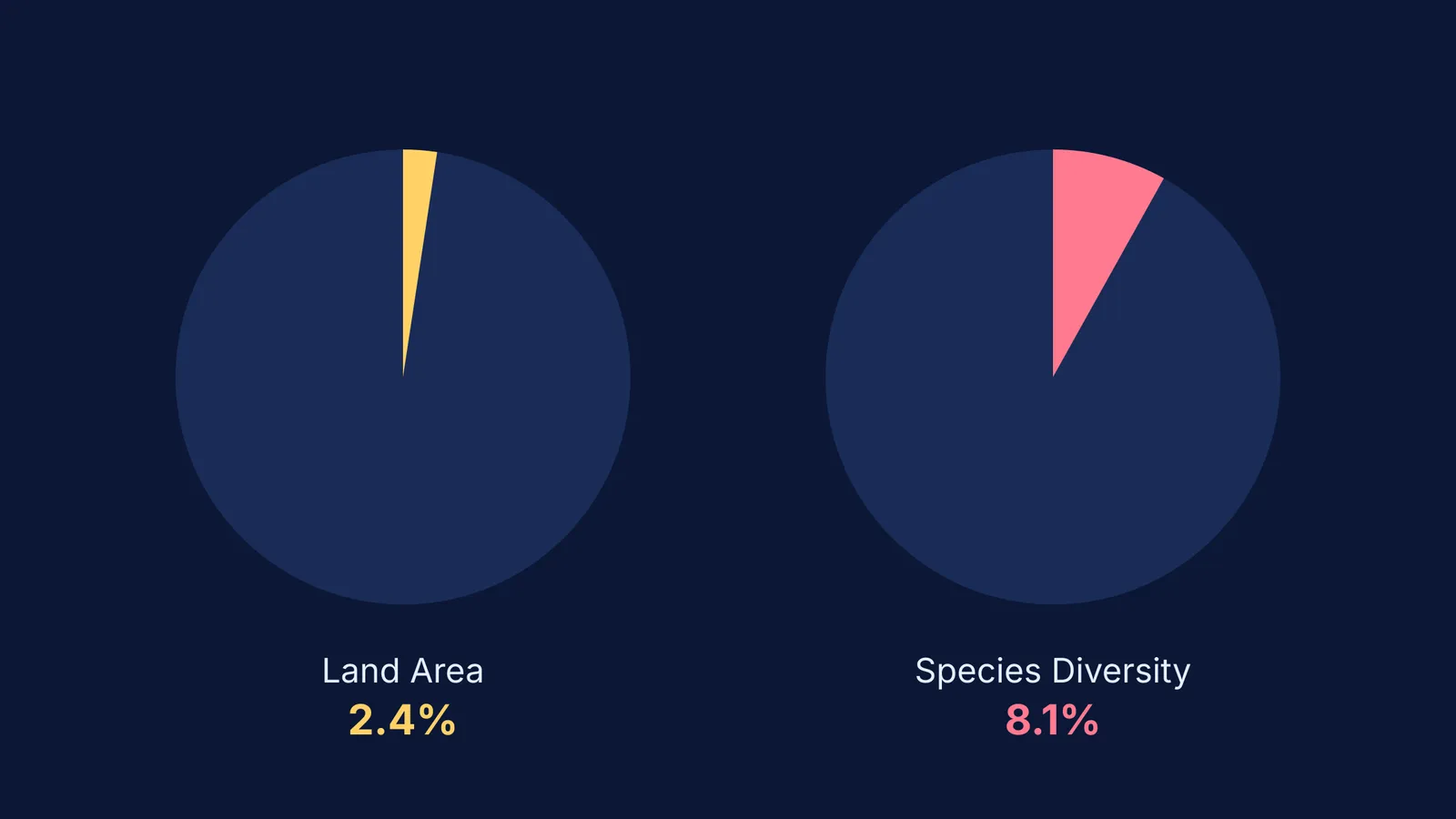
India has only 2.4 per cent of the world's land area (NCERT). However, India's share of the global species diversity is an impressive 8.1 per cent (NCERT).
This disproportionate concentration of life means that despite its relatively small geographical footprint, the nation supports a vast array of ecosystems, from the alpine forests of the Himalayas to the tropical rainforests of the Western Ghats. In examinations like NEET, you will often find questions asking you to contrast these two specific percentages.
If you struggle to recall such exact figures during exam preparation, you are not alone. When you use the Fermi Concept Library, you will find every concept in physics, chemistry, biology, mathematics and computing, each with its own lesson and its place in the map.
Why is India considered a megadiversity country?
Because of its 8.1 per cent share of global biodiversity, India is officially recognised as one of the 12 mega diversity countries of the world (NCERT).
The term "megadiverse" is applied to nations that house the majority of the Earth's species and a high number of endemic species—plants and animals found nowhere else. A significant driver of India's megadiversity is its varied geography and climate, which give rise to distinct biodiversity hotspots.
Beyond just raw numbers, this diversity is concentrated in highly sensitive areas. India hosts three of the 34 globally recognised biodiversity hotspots: the Himalaya, the Western Ghats and Sri Lanka, and the Indo-Burma region (NCERT). Hotspots are areas that not only feature exceptional concentrations of endemic species but are also experiencing significant habitat loss. Learning to name these hotspots is just as important as knowing the percentage values, as they provide concrete examples of where this 8.1 per cent of global diversity actually lives.
For students reviewing Using NCERT lines for NEET biology, understanding the relationship between the 2.4 per cent land area and the "megadiversity" title is a crucial learning objective.
How many plant and animal species are recorded in India?
The raw count of species further illustrates the scale of India's biological wealth. Nearly 45,000 species of plants have been recorded from India (NCERT). Alongside them, researchers have documented roughly twice as many animal species, bringing the total to nearly 90,000 recorded animals (NCERT).
The diversity spans an enormous range of life forms. Among the 90,000 animal species, you will find incredibly diverse groups ranging from tiny insects and amphibians to large mammals. The plant count of 45,000 is similarly broad, capturing everything from microscopic algae to massive angiosperms.
While these numbers are large, they are considered conservative estimates. If we accept Robert May's global estimate—which suggests only 22 per cent of the total species on Earth have been recorded so far—India probably harbours more than 1,00,000 plant species and 3,00,000 animal species yet to be discovered and described (NCERT).
When studying these figures, keep in mind that taxonomy is an ongoing science. Field researchers continuously find new species, especially in the denser, less explored regions of the hotspots mentioned earlier. This means the recorded numbers will slowly tick upwards year by year, inching closer to the theoretical maximum proposed by ecologists.
How to remember biodiversity numbers for exams?
Data-heavy chapters such as Biodiversity and Conservation can be intimidating. Here is a practical checklist you can use to sort and remember the essential facts from the NCERT textbook for your CBSE Class 12 biology paper or NEET:
Link the percentages: Pair 2.4 per cent (land) with 8.1 per cent (diversity). Remembering that the diversity share is more than three times the land share helps you rule out wrong options in multiple-choice questions.
Double the animals: Start with the plant species count (45,000). Memorise the rule that animal species are roughly "twice as many", which quickly gives you the 90,000 figure.
Use the 22 per cent rule: Apply Robert May's 22 per cent recording estimate to realise the true scale of undiscovered species (over 1,00,000 plants and 3,00,000 animals).
Group the hotspots: Remember the three hotspots (Himalaya, Western Ghats and Sri Lanka, Indo-Burma) by mapping them geographically from north to south and east to west. Associating data with a mental map is far more effective than rote memorisation.
Draw the relationship: Creating a simple visual, similar to the pie charts above, cements the disparity in your memory. Practice this alongside NCERT biology diagrams for NEET to build visual recall.
Studying by drawing connections—such as linking a small landmass to high diversity—is exactly how Fermi's AI tutor approaches learning. Most learning tools answer questions, but Fermi teaches—it holds a line of reasoning across a whole session, notices where a student is stuck, and decides whether to explain, ask, or show.
By treating these statistics not as isolated facts, but as a story of an incredibly rich ecosystem crammed into a small physical space, the numbers will naturally stick.


