

On this page
India is one of the most biologically diverse countries in the world, encompassing a wide range of biomes from high mountains to tropical rainforests and islands. Because of this rich but threatened natural heritage, India is home to four of the world's 36 officially recognised biodiversity hotspots (source).
If you are studying ecology for your exams, knowing the names of these hotspots and the strict mathematical criteria they must meet is essential.
What criteria must a biodiversity hotspot meet?
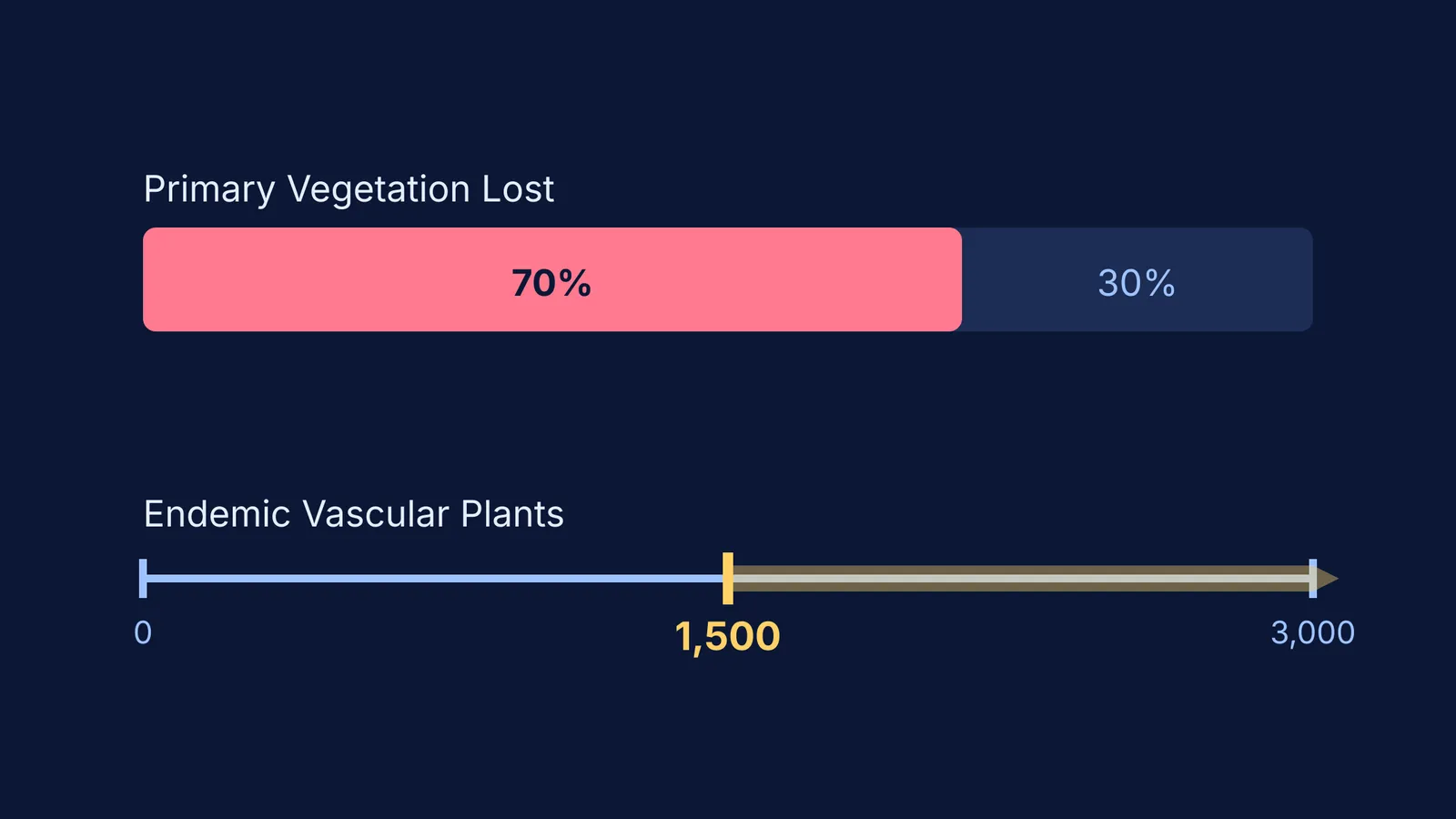
The concept of a biodiversity hotspot was developed by Norman Myers and revised in a landmark paper published in the journal *Nature* in 2000 (source). To qualify as a biodiversity hotspot, a region must meet two strict thresholds:
High Endemism: It must contain at least 1,500 species of vascular plants as endemics (source). This represents more than 0.5% of the world's total plant species. Endemic species are those found nowhere else on Earth.
Severe Habitat Loss: It must have lost at least 70% of its original primary native vegetation due to human activity (source).
Globally, these 36 hotspots host their diverse ecosystems on just 2.4% of the planet's surface, yet they support nearly 60% of the world's plant, bird, mammal, reptile, and amphibian species (source). You can explore more about why certain regions hold so much life in our guide on why the tropics have more biodiversity.
What are the names of the biodiversity hotspots in India?
India officially shares four global biodiversity hotspots with its neighbouring countries (source).
1. The Himalaya
This hotspot spans the entire Indian Himalayan region and extends into Pakistan, Tibet, Nepal, Bhutan, China, and Myanmar. The Himalayas include some of the highest peaks on Earth, including Mount Everest. The dramatic altitudinal gradients create a massive variety of ecosystems, from alluvial grasslands at the base to alpine meadows near the snowline.
2. Indo-Burma
The Indo-Burma hotspot is vast, encompassing 2,373,001 square kilometres of tropical Asia (source). In India, it covers the northeastern states south of the Brahmaputra River. It also extends across Myanmar, Thailand, Vietnam, Laos, Cambodia, and southern China. This region includes the highly biodiverse Lower Mekong catchment and is known for several large mammal discoveries in recent decades, such as the saola and the large-antlered muntjac.
3. Western Ghats and Sri Lanka
This mountain range stretches 1,600 km along the western coast of the Indian peninsula and continues into Sri Lanka (source). Formed during the break-up of the Gondwana supercontinent, the Western Ghats intercept the monsoon winds, creating lush, rain-fed ecosystems. The region is a UNESCO World Heritage Site and provides habitat for at least 325 globally threatened species (source).
4. Sundaland
Sundaland is a biogeographical region of Southeast Asia that was exposed as a massive landmass during periods of lower sea levels. In India, it includes the Nicobar group of Islands. The majority of this hotspot covers Indonesia (including Bali, Borneo, Java, and Sumatra), Malaysia, Singapore, Brunei, and the Philippines.
Why are these regions under threat?
By definition, every biodiversity hotspot has already lost a vast majority of its natural habitat. The Indo-Burma hotspot, for example, is heavily impacted by agriculture, logging, and the damming of rivers for electricity, which transforms aquatic ecosystems and reduces oxygen content in the water.
Understanding the difference between vulnerable native populations and widespread species is a key part of conservation biology; you can read more about this in our breakdown of endemic vs endangered species. When habitats shrink too quickly, species cannot adapt, leading to irreversible losses similar to recent historical extinctions.
For students mapping out these definitions and preparing for ecology chapters, the Fermi Concept Library offers a structured way to review the criteria and examples for biodiversity hotspots step by step.
A simple checklist for exam questions
When answering a question on biodiversity hotspots, check that you have included:
The exact numbers for the criteria (1,500 endemic vascular plants, 70% habitat loss) (source).
The name of the original author (Norman Myers, 2000).
The four regions in India (Himalaya, Indo-Burma, Western Ghats and Sri Lanka, Sundaland).
A clear distinction that these hotspots often cross international borders and are not confined entirely within India.


