

On this page
What is the latitudinal gradient of biodiversity?
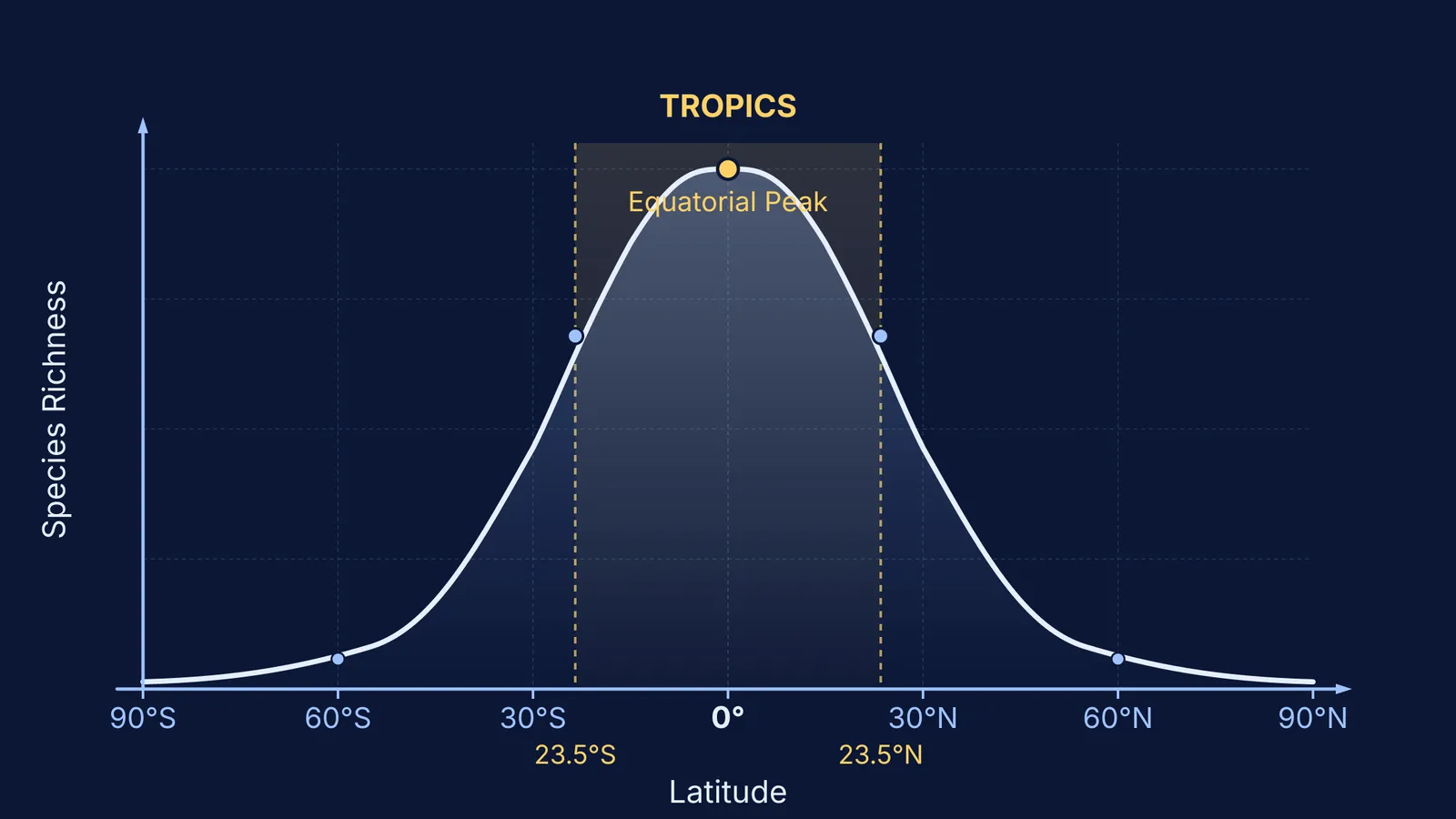
As you travel from the equator toward either pole, the variety of living organisms drops precipitously. This latitudinal diversity gradient is among the most consistent patterns in biology, with equatorial and tropical ecosystems harboring a disproportionate share of global species across almost every major taxonomic group.
Standardized counts documented in NCERT Class 12 Biology, Chapter 15 illustrate this stark contrast: tropical latitudes between 23.5° N and 23.5° S support vastly more species than higher latitudes. Equatorial Colombia hosts roughly 1,400 bird species, and tropical India supports over 1,200. In contrast, New York State at 41° N records 105 species, and Greenland at 71° N records only 56. In plant life, an equatorial forest hectare in Ecuador contains up to 10 times more vascular plant species than an equivalent tract in the American Midwest. Understanding how these patterns scale across geographic areas links directly with biodiversity conservation and species-area sums. Macroecologists explain this pattern using three complementary hypotheses: evolutionary time, climatic stability, and solar energy.
Why does evolutionary time favour tropical ecosystems?
Speciation is fundamentally a function of evolutionary time. Across higher latitudes, the Pleistocene epoch brought repeated continental glaciations. Massive ice sheets repeatedly scoured temperate and polar habitats, driving widespread extinctions and repeatedly resetting the evolutionary clock. Species in these zones had to recolonize bare land following glacial retreat, leaving modern temperate communities with shallow evolutionary histories.
Tropical latitudes, by contrast, remained largely unglaciated over tens of millions of years. This unbroken environmental continuity gave tropical lineages immense time for continuous speciation and diversification without periodic mass die-offs.
Paleontological data confirm this dynamic. In a landmark study in *Science*, Jablonski, Roy, and Valentine (2006) tracked marine bivalve genera over 11 million years. They proved the "Out of the Tropics" model: new lineages preferentially originate in the tropics (acting as an evolutionary cradle) and expand toward the poles while persisting in their tropical origins (acting as an evolutionary museum).
How does climatic stability promote narrow ecological niches?
Temperate and polar organisms face severe seasonal swings between freezing winters and warm summers. Surviving these fluctuations requires organisms to be physiological generalists with broad environmental tolerances.
Tropical environments, by contrast, are far less seasonal, remaining relatively constant and predictable throughout the year. Constant conditions favor extreme specialization:
Narrow physiological tolerances: In his classic 1967 study in *The American Naturalist*, "Why Mountain Passes are Higher in the Tropics", Daniel H. Janzen demonstrated that tropical species adapt to narrow thermal ranges. Even modest elevation changes act as severe dispersal barriers, isolating populations and driving allopatric speciation.
Greater niche packing: Because each species occupies a narrow functional niche, more species can divide available space and food resources without competitive exclusion, reflecting rules that govern organism and population growth models.
Does higher solar energy directly drive species richness?
The equator receives direct, perpendicular solar radiation year-round, generating high ambient temperatures and abundant Net Primary Productivity (NPP).
In *The American Naturalist*, David J. Currie's 1991 study showed that potential evapotranspiration—a measure of atmospheric thermal energy—explains 80% to 93% of the broad-scale variation in terrestrial vertebrate species richness across continental gradients in North America. Solar energy enhances diversity in two ways:
The more-individuals effect: High primary productivity produces greater total biomass, sustaining larger population sizes that are far less susceptible to accidental extinction.
Trophic complexity: Abundant plant biomass supports intricate food webs with specialized frugivores, nectar-feeders, and predators. This tight interdependence mirrors Paul R. Ehrlich's rivet popper hypothesis, where maintaining complex mutualisms prevents systemic ecosystem collapse.
How should students tackle latitudinal gradient questions in exams?
Competitive examinations like NEET-UG frequently test these three hypotheses through assertion-reason questions. Use this three-step diagnostic checklist to match questions to the correct mechanism:
Historical continuity: If the question cites glaciations, millions of undisturbed years, or ancestral persistence, apply the Evolutionary Time Hypothesis.
Constancy and specialization: If the question cites year-round stability, narrow thermal tolerance, or niche packing, apply the Climatic Stability Hypothesis.
Energy and biomass: If the question cites solar insolation, photosynthetic output, or potential evapotranspiration, apply the Solar Energy Hypothesis.
Consider this Assertion-Reason example:
*Assertion (A):* Tropical forests support higher species richness and narrower niche breadths than temperate forests.
*Reason (R):* Tropical environments are relatively constant and predictable, which promotes niche specialization.
*Resolution:* Both statements are correct, and (R) directly explains (A) because environmental constancy allows species to specialize into narrow niches without competitive exclusion.
When revising macroecology, distinguishing ultimate evolutionary history from proximate environmental filters prevents confusion. The Fermi Concept Library covers every concept in physics, chemistry, biology, mathematics and computing, each with its own lesson and its place in the map. For multi-step assertion-reason questions that test whether a factor acts as an ultimate evolutionary cause or a proximate ecological filter, the Fermi Problem Library provides worked problems with a step-by-step solver that explains the reasoning rather than printing an answer.


