On this page
Water potential numericals look like simple arithmetic, but the marks hinge on one decision: which number do you compare?
CBSE's Class XI Biology curriculum for 2025-26 lists photosynthesis, respiration, and plant growth and development under plant physiology, with no transport chapter. State books still teach it: Maharashtra's Class 12 chapter Plant Water Relation covers water potential, osmosis and plasmolysis.
What do solute potential and pressure potential mean?
Water potential (ψw) measures the potential energy in water, in megapascals (MPa), and pure water is zero by definition, according to OpenStax Biology 2e. For a plant cell you need two parts:
Solute potential (ψs): the effect of dissolved solutes. It is negative in a plant cell and zero in distilled water.
Pressure potential (ψp): turgor, the push of cell contents against the wall. Usually positive, it is almost zero in a plasmolysed cell, notes the Wikipedia article on water potential.
So ψw = ψs + ψp. Water moves from the compartment with the higher water potential to the one with the lower water potential, says OpenStax, which gives typical cytoplasm solute potentials of −0.5 to −1.0 MPa. The Maharashtra textbook puts it simply: water flows from less negative to more negative potential.
How do you decide which way water flows between two cells?
Problem 1. Cell A: ψs = −0.9 MPa, ψp = +0.6 MPa. Neighbouring cell B: ψs = −0.7 MPa, ψp = +0.2 MPa. Which way does water move?
Cell A: ψw = −0.9 + 0.6 = −0.3 MPa.
Cell B: ψw = −0.7 + 0.2 = −0.5 MPa.
−0.3 is higher (less negative) than −0.5, so water moves from A to B.
The trap: A has more solute, so it is tempting to send water into A. But A's higher turgor lifts its water potential above B's.
What happens when a cell is placed in a sugar solution?
Problem 2. A flaccid cell (ψp = 0, ψs = −0.7 MPa) goes into 0.1 M sucrose at 27 °C (300 K) in an open beaker. Which way does water move, and what is ψp when it stops?
Find the solution's ψs with the van 't Hoff relation ψs = −iCRT, where i is the number of particles per formula unit (Wikipedia). Sucrose does not ionise, so i = 1. Use C = 0.1 mol/L = 100 mol/m³ and R = 8.314 J mol⁻¹ K⁻¹, the NIST CODATA value.
Solution: ψs = −1 × 100 × 8.314 × 300 ≈ −249,000 Pa ≈ −0.25 MPa.
The beaker is open, so ψp = 0 and the solution's ψw = −0.25 MPa.
Cell: ψw = −0.7 + 0 = −0.7 MPa, which is lower. Water enters the cell.
Movement stops when the cell's ψw also reaches −0.25 MPa. If ψs stays near −0.7 MPa, then ψp = −0.25 − (−0.7) = +0.45 MPa.
Step 4 ignores the slight dilution of the sap; if the question gives a new ψs, use it.
In 0.4 M sucrose the solution's ψs is about −1.0 MPa, so water leaves, turgor falls to zero and the cell plasmolyses, as in a Rhoeo leaf peel plasmolysis practical.
How do you solve a three-cell problem with mixed units?
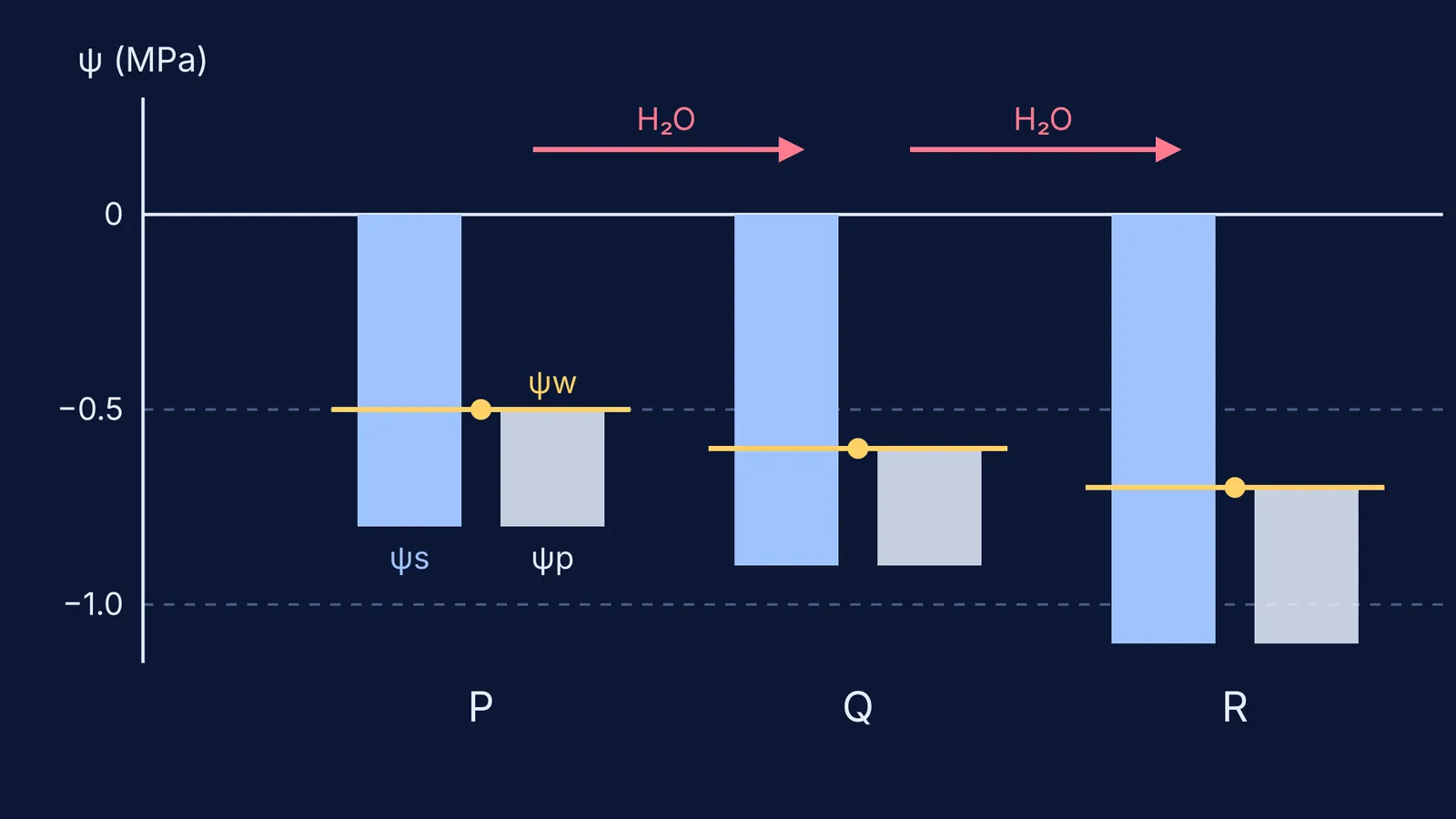
Problem 3. Three cells sit in a row, P, Q and R. P: ψs = −8 bar, ψp = +3 bar. Q: ψs = −0.9 MPa, ψp = +0.3 MPa. R: ψs = −11 bar, ψp = +4 bar. Which way does water move?
Convert first. One bar is 100 kPa, so 10 bar = 1 MPa.
P: ψw = −8 + 3 = −5 bar = −0.5 MPa.
Q: ψw = −0.9 + 0.3 = −0.6 MPa.
R: ψw = −11 + 4 = −7 bar = −0.7 MPa.
Order: P (−0.5) > Q (−0.6) > R (−0.7). Water moves P → Q → R, one wall at a time.
What mistakes cost marks in water potential numericals?
Before drawing the arrow, check:
Did you add ψs and ψp for every cell and for the outside solution?
Is every value in the same unit, MPa or bar?
Is each ψs negative? If not, you slipped a sign.
Did you give a flaccid or plasmolysed cell ψp = 0?
Does your arrow point from the less negative to the more negative ψw?
In ψs = −iCRT, is the temperature in kelvin and is i right for the solute?
If turgor feels abstract, the potato osmosis experiment and why plants wilt when turgor pressure drops make it visible.
For more practice, the Fermi Problem Library has worked problems with a step-by-step solver that explains the reasoning rather than printing an answer, so you can see where a sign or unit went wrong.
Then redo Problem 1 with A's ψp changed to +0.1 MPa and watch the arrow flip.