

On this page
Water a drooping tulsi plant in the evening and by morning its leaves often stand up again. Nothing grew overnight. What came back was pressure inside its cells, called turgor, and it ties the Class 9 cell chapter to your own balcony.
What is turgor pressure?
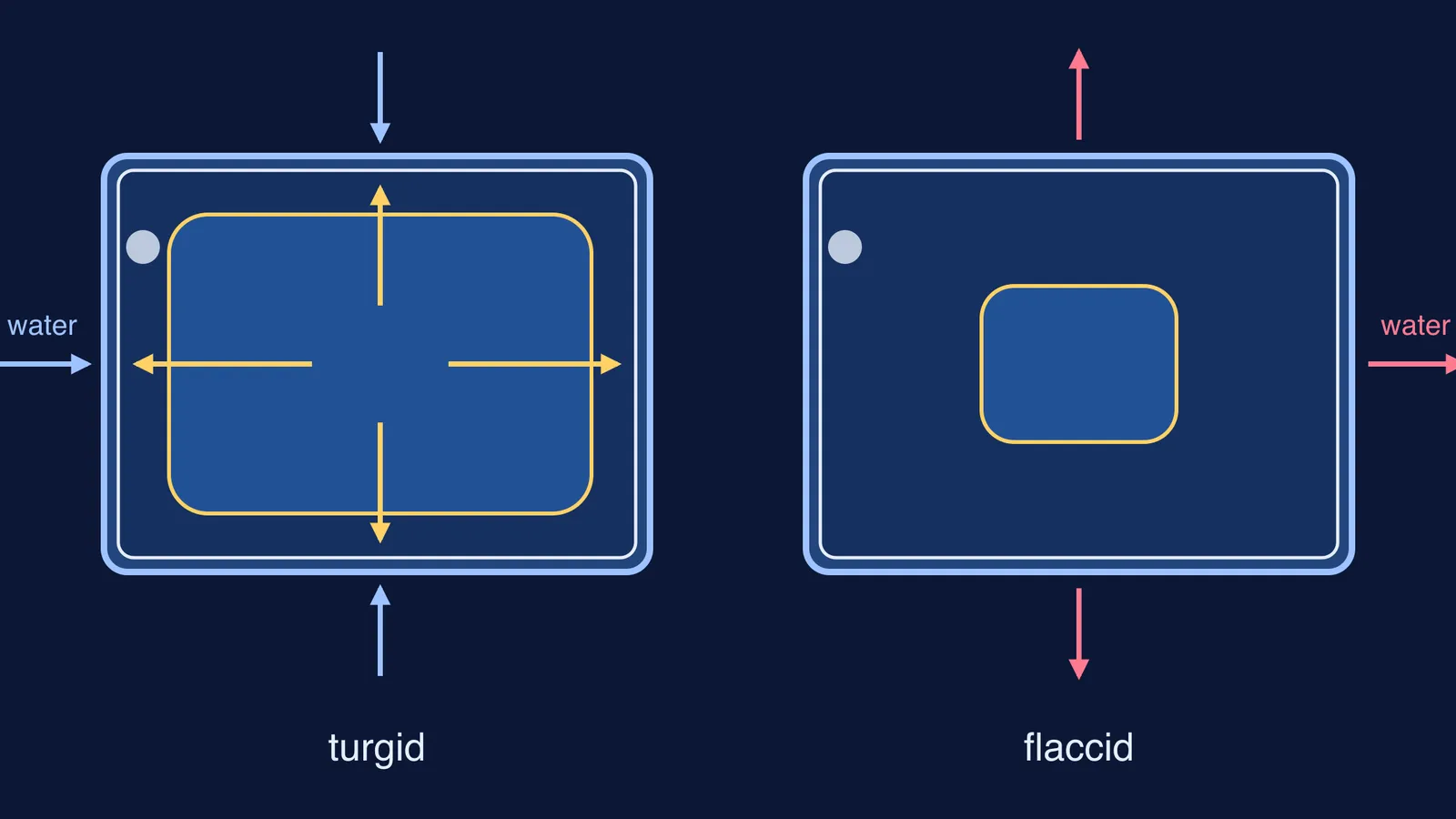
Turgor pressure is the pressure of water inside a plant cell pushing outward against the cell wall. A 2014 review of turgor in Annals of Botany by Léna Beauzamy, Naomi Nakayama and Arezki Boudaoud puts the key point simply: "turgor pressure pushes the plasma membrane against the cell wall."
The same review says turgor "can reach 20 atmospheres, i.e. 2 MPa, a value much higher than the air pressure inside automobile tyres." Many measured values are lower: it reports 0.46 MPa in a soybean stem and 0.18 MPa in arabidopsis leaves. Using the review's own conversion (2 MPa is about 20 atmospheres), the soybean figure is roughly four and a half times the pressure of the air around you.
How does water get into the vacuole?
A mature plant cell usually has one large central vacuole filled with cell sap, a watery fluid holding minerals, sugars and waste, according to Chapter 2 of NCERT's new Class 9 science textbook, Exploration. The same chapter defines osmosis as the movement of water through a selectively permeable membrane, from a dilute solution to a more concentrated one. When the sap is more concentrated than the water around the cell, water moves in.
Picture three layers, from the inside out:
The vacuole takes in water and swells.
It presses the cytoplasm and cell membrane outward.
The cell wall, made mainly of cellulose, stretches a little and then holds firm.
The Annals of Botany review describes the wall stretching "until it settles at a size and shape where the cell wall can stably withhold the internal pressure." A cell in this pressed-out state is called turgid. Many turgid cells together make a leaf stiff, as air makes a football hard.
Why do plants wilt when turgor drops?
When a plant does not get enough water, the vacuole loses water, the cells become less firm and the plant wilts, as the vacuoles section of the NCERT chapter explains, and the leaf loses its support. The review says it directly: tissues "harden when turgor pressure rises and soften and even wilt when turgor falls."
Plant scientists measure the point at which this happens, called the turgor loss point. A meta-analysis of 317 species from 72 studies, by Megan Bartlett, Christine Scoffoni and Lawren Sack in Ecology Letters, found that leaf water potential at turgor loss, or wilting, was strongly correlated with water availability within and across biomes.
Salty water causes a related droop; see why sea water dries out plants.
Where is this in the Class 9 NCERT book?
In the new Exploration textbook, Chapter 2, Cell: The Building Block of Life, builds the idea in three steps (NCERT chapter PDF):
Activity 2.2: a potato piece in plain water swells, while one in 20 per cent salt or sugar solution shrinks.
Cell wall section: in concentrated sugar solution, Rhoeo or onion peel cells keep their size because the rigid wall holds its shape, but the inner content shrinks as the membrane pulls away from the wall.
Vacuoles section: the book asks, "Why do plants look wilted when they do not get enough water?" and answers it through the vacuole.
For the practicals, see our guides to the potato osmosis experiment and plasmolysis in a Rhoeo leaf peel.
How do you explain wilting in an exam answer?
Question: "A potted plant left unwatered droops by afternoon. After watering, it stands upright again by morning. Explain."
A five-step model answer:
Water from the soil enters root cells by osmosis and travels up to the leaves.
In leaf cells, water moves into the vacuole, which swells and presses the cytoplasm and membrane against the cell wall.
The rigid wall resists, so the cell becomes turgid; many turgid cells keep the leaf upright.
Without watering, the plant keeps losing water but cannot replace it. Vacuoles shrink, cells lose turgor and go flaccid, and the leaf droops.
Watering restores the supply, the vacuoles refill, turgor returns and the leaf stands up.
Mistakes that cost marks:
Writing that the cell wall shrinks along with the contents. The rigid wall keeps its shape; it is the vacuole that loses water.
Calling wilting cell death. In a plant that has not been dry for too long, wilted cells are still alive, which is why watering works.
Writing only "diffusion" when water crosses a membrane. NCERT calls that specific case osmosis.
If the chain from osmosis to turgor still feels loose, the Fermi Concept Library gives every concept in biology its own lesson and its place in the map.
Try it tonight: stand a limp coriander sprig in water for an hour, then explain the result using the five steps.


