On this page
You are sitting in a train at a station. The train on the next track starts to roll, and for a second or two you are certain your own train has started. Then you glance at the platform and the feeling flips. Researchers call this the train illusion (Kooijman and colleagues, Royal Society Open Science, 2023), and it is a neat way into the reference-point idea from your Class 9 motion chapter: whether something is moving depends on what you measure it against.
Why does my train seem to move when the other one moves?
First, the physics. A velocity means nothing until you say what it is measured from. The OpenStax University Physics textbook says an object's velocity must be stated "with respect to a given reference frame" (OpenStax University Physics, Relative motion). Through your window, the only thing you can see is the other train. Whether it slides forward or you slide backward, the picture in the window changes in the same way.
Second, the brain. The vestibular system of your inner ear detects only acceleration, so it cannot tell travelling at a steady speed from standing still (Palmisano and colleagues, Frontiers in Psychology, 2015). Sitting in a parked train, your inner ear reports no acceleration, which is also what it would report if you were gliding along smoothly. It has nothing to argue with, so your eyes win. The same review defines vection, the name for this effect, as a visual illusion of self-motion in an observer who is not moving.
Why does the illusion feel so convincing?
The same 2015 review gives two clues (Palmisano and colleagues):
The moving view is big. Vection is generally more compelling when the moving scene is larger. A train right next to yours can fill the whole window.
It builds over a few seconds. It typically takes more than 1 second of moving visual flow to produce vection, generally between 1 and 10 seconds. That fits the feeling arriving a moment after the other train starts.
In virtual reality, at least, the train is not the strongest trigger. In a 2023 study with 29 participants, a cloud of white dots moving towards the viewer produced more compelling vection than a scene copying the train illusion (Kooijman and colleagues, Royal Society Open Science).
How do you draw the two-train sketch?
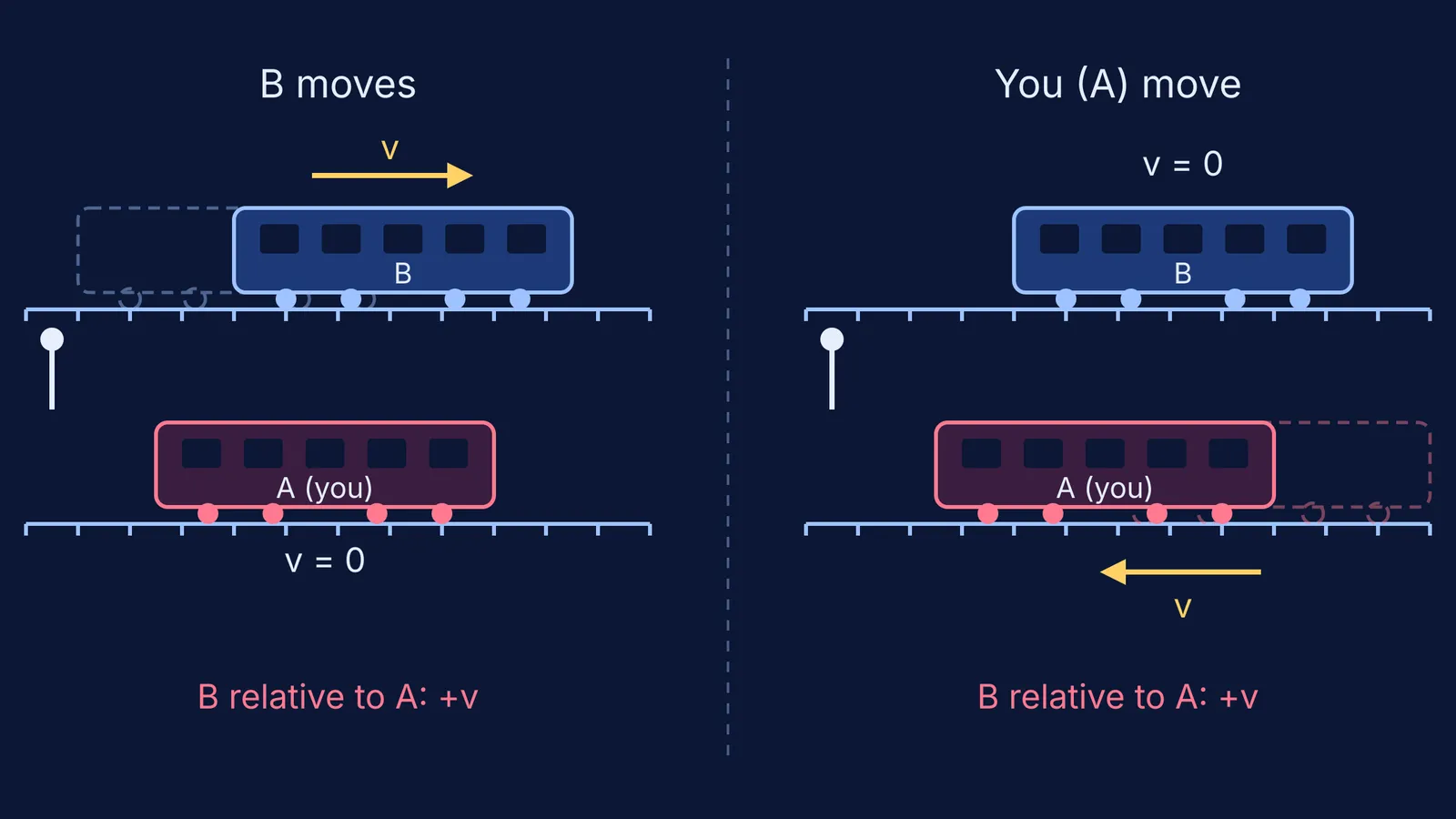
The diagram at the top is the finished version. Draw your own:
Draw two parallel tracks. Label the upper train B and the lower one A (you). Draw a pole on the platform: it is fixed to the ground.
Picture 1, "B moves": draw A once. Draw B dashed where it started and solid a little to the right, with an arrow v. Write v = 0 under A.
Picture 2, "you move": draw B once. Draw A dashed where it started and solid the same distance to the left, with an arrow v pointing left.
In each picture, measure from the front of A to the front of B, at the start and at the end. It changes by the same amount both times. That change is all your window shows you.
Now measure from A to the pole. In picture 1 it stays the same; in picture 2 it changes. The pole settles the question; the other train cannot.
Say train B pulls out at 2 m/s while A stays put. Take the ground as the frame and B's direction as positive: v_A = 0 and v_B = +2 m/s. The velocity of B relative to A is v_B − v_A = 2 − 0 = +2 m/s.
Now swap: B stays put and A rolls the other way at 2 m/s. Then v_B − v_A = 0 − (−2) = +2 m/s. Same answer, same view through the window.
The same rule gives you the time for two trains to pass each other, and it explains why a ball dropped inside a moving train falls straight down for you but traces a curve for someone on the platform.
If holding two frames in your head is still hard, the Fermi Simulation Lab has interactive simulations for the ideas that are easier to see than to read.
How can you tell which train is really moving?
Next time it happens, run this check:
Find something fixed to the ground: a platform pillar, a signboard, the station building. If your distance to it changes, you are moving.
Look out of a window on the other side of your coach.
Notice the start. A real departure means speeding up, which your inner ear may pick up as a gentle push; a neighbouring train leaving gives you no push at all.
Parents: on your next journey, ask your child which train moved and how they know. More everyday ideas are in our guide for when a Class 9 child can't understand motion.
If terms like reference frame and relative velocity still feel slippery, the Fermi Concept Library gives each physics concept its own lesson and shows its place in the map.