On this page
You are on a train rolling through a station at a steady 5 m/s. You hold a ball 1.8 m above the floor and let go. What path does it take, and where does it land? The answer depends on who is watching, and that is the whole lesson.
What path does the ball take inside the train?
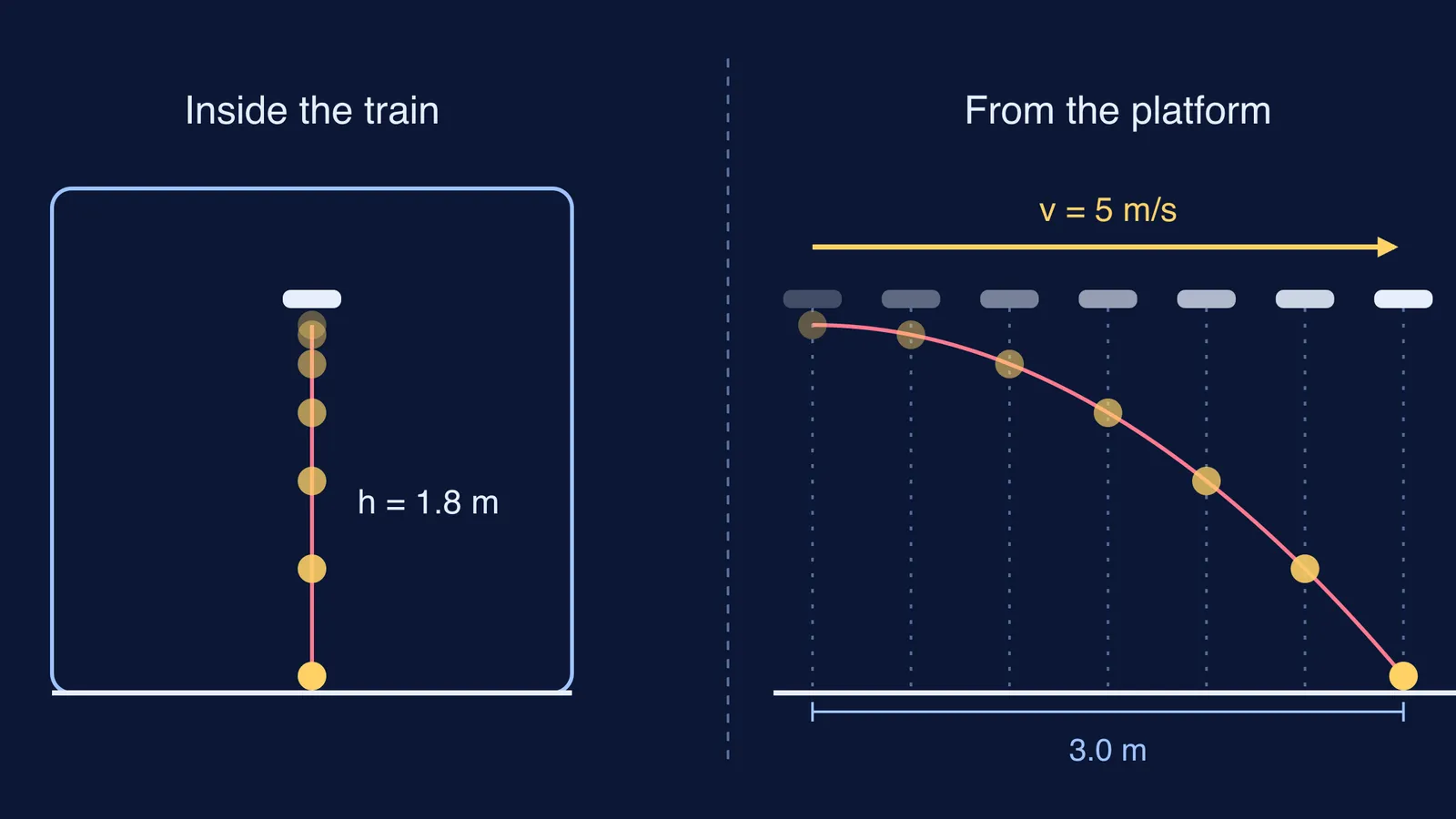
From your seat, the ball falls straight down and lands right below your hand. Before you let go, the ball was already moving forward with you at 5 m/s. Once released, nothing pushes it backwards (the air in a closed carriage moves with you too), so it keeps that forward speed, just like you and the floor. Relative to you, its horizontal velocity is zero. Only a plain vertical fall is left.
The time to fall depends on height alone. With g = 9.8 m/s², the value used in OpenStax University Physics, a 1.8 m drop takes t = √(2h/g) = √(2 × 1.8 / 9.8) ≈ 0.61 s.
What path does someone on the platform see?
Your friend on the platform sees the ball start with a forward velocity of 5 m/s and no vertical velocity. That is a horizontal launch, the classic projectile. OpenStax states the rule that makes it easy: "motions along perpendicular axes are independent and thus can be analyzed separately", and the resulting path is a parabola.
In the platform frame:
Horizontal: x = 5t, steady, with no acceleration.
Vertical: y = 1.8 − 4.9t², the same fall you saw.
Removing t: y = 1.8 − 0.196x², a parabola.
In 0.61 s the ball moves about 3.0 m forward. Your hand moves 3.0 m too, so the ball still lands right below it. The diagram at the top shows both views at the same seven moments: the heights match, only the horizontal positions differ.
Who is right, the passenger or the platform?
Both. OpenStax's section on relative motion puts it plainly: "When we say an object has a certain velocity, we must state it has a velocity with respect to a given reference frame." The velocities link up as v(ball, ground) = v(ball, train) + v(train, ground).
Apply that at any moment of the fall. Inside the train, the ball's velocity points straight down. Add the train's 5 m/s forward and you get the slanted velocity the platform sees. The vertical part is identical in both frames; only the horizontal part changes. That is why the platform path is the straight drop stretched sideways.
Why does "straight down" feel like the right answer?
Many people get this wrong, not just beginners. In a 1983 study, Michael McCloskey, Allyson Washburn and Linda Felch gave pencil-and-paper problems to 177 undergraduates and found that many believed an object dropped by a moving carrier, such as a ball dropped by a walking person, falls in a straight vertical line (abstract, DOI). Two further experiments (120 people, with or without physics training) found the same error in a moving version of the problem and when people dropped a ball while walking. The authors proposed that the belief may stem from a perceptual illusion.
That is the passenger's view, quietly carried over to the platform. The fix is to name the frame before you draw the path.
How do you solve these questions in an exam?
A four-step routine that works for trains, buses, lifts and aircraft:
Name the frame. Write "frame: train" or "frame: ground" at the top of your working.
Write the ball's initial velocity in that frame. Train frame: zero horizontal. Ground frame: the train's speed.
Treat x and y separately. Fall time depends only on height and g; horizontal distance is velocity × time.
Cross-check. Convert one frame's answer to the other by adding the train's velocity. If they disagree, an initial velocity is wrong.
Try it on a faster train. At 20 m/s (72 km/h) the same 0.61 s drop carries the ball about 12 m along the platform, yet it still lands at the passenger's feet.
One twist examiners like: the train speeding up. If the train accelerates while the ball falls, the floor gains speed but the released ball does not, so the ball lands behind the spot under your hand. At 0.5 m/s² for 0.61 s, the gap is ½ × 0.5 × 0.61² ≈ 0.09 m, about 9 cm. "Straight down inside" holds only at steady velocity.
Where can you watch the two paths side by side?
Two paths on paper are easy to misread; motion is easier to trust when you watch it. Our Fermi Simulation Lab has interactive simulations for the ideas that are easier to see than to read; frames of reference are one of them. If a relative-motion numerical still trips you up, the Fermi Problem Library has worked problems with a step-by-step solver that explains the reasoning rather than printing an answer.
Next time your train runs at steady speed, toss a key gently upwards: it comes back to your hand, for exactly the same reason.