On this page
Chapter 10 asks what the recombinant DNA toolkit was used for, and the marking scheme awards marks point by point. For NEET, see our biotechnology applications guide for NEET.
How many marks is Biotechnology and its Applications in Class 12?
The Class XII theory table in the CBSE Biology curriculum 2026-27 prints Unit IX, "Biotechnology and its Applications", at 12 marks out of 70. The unit holds two chapters, Principles and Processes and this one, so they share those 12 marks. The 2026-27 sample paper has 33 questions: 16 of 1 mark, 5 of 2, 7 of 3, 2 case-based of 4 and 3 of 5.
What must you know from NCERT Chapter 10?
Every fact below is from the NCERT chapter, Reprint 2026-27.
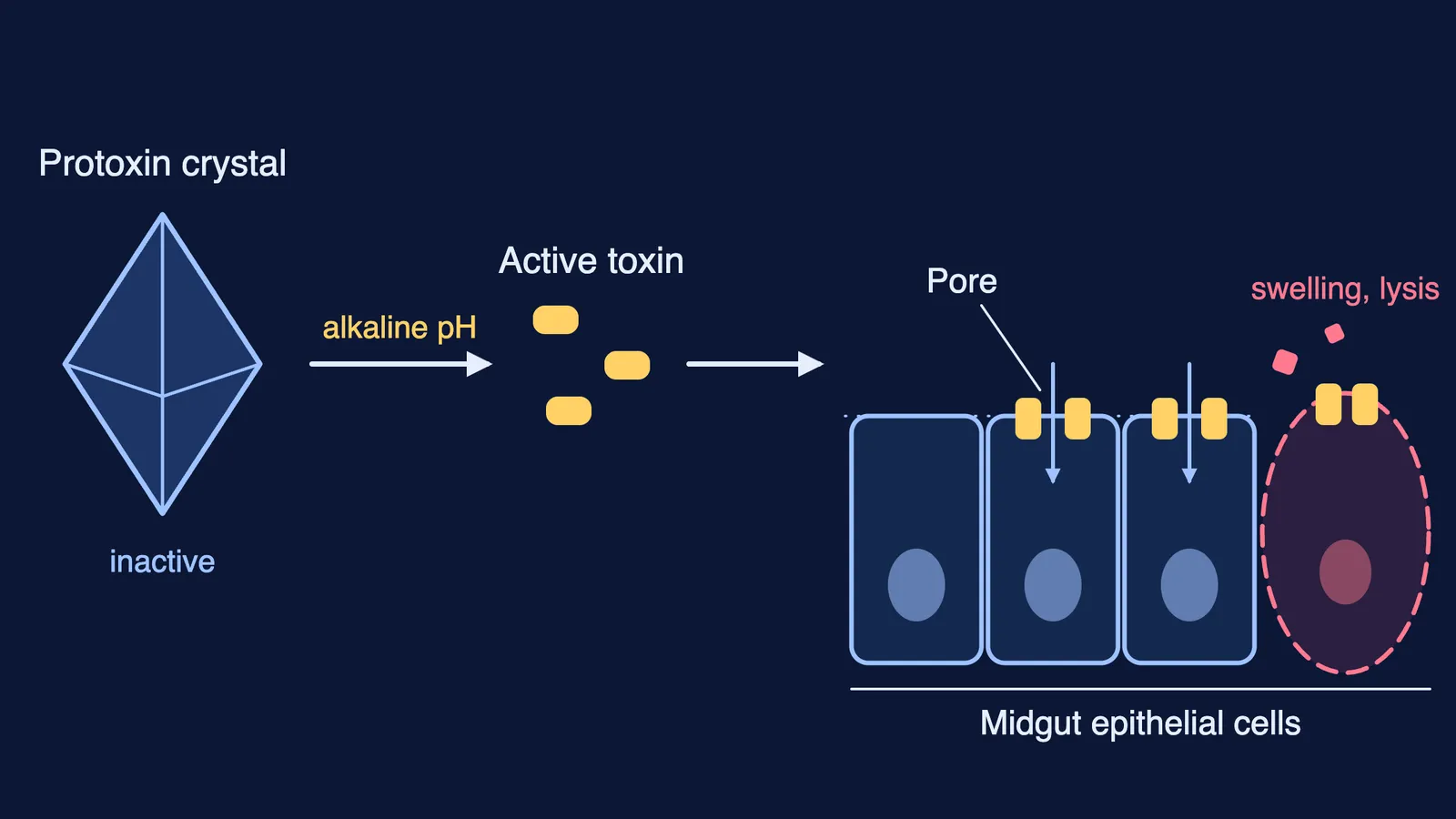
Bt cotton: Bacillus thuringiensis makes Cry proteins, coded by cry genes: cryIAc and cryIIAb against cotton bollworms and cryIAb against corn borer. The bacterium stores an inactive protoxin crystal; the alkaline insect gut solubilises it into active toxin, which binds midgut epithelial cells and makes pores, so the cells swell and lyse and the insect dies.
RNAi tobacco: the nematode Meloidogyne incognita attacks tobacco roots (NCERT prints "Meloidegyne incognitia"). Agrobacterium vectors carried nematode-specific genes so the plant made sense and antisense RNA; these paired into dsRNA, which silenced the nematode's mRNA, and the parasite could not survive.
Insulin: two short chains, A and B, linked by disulphide bridges. Pro-insulin carries an extra C peptide, removed during maturation. In 1983 Eli Lilly put DNA sequences for A and B into E. coli plasmids, made the chains separately and joined them by disulphide bonds.
ADA gene therapy: first used in 1990, on a girl aged four. Her lymphocytes were cultured outside the body, given functional ADA cDNA by a retroviral vector, and returned. They are not immortal, so infusions repeat; the gene in early embryonic cells could be a permanent cure.
Molecular diagnosis: PCR amplifies a pathogen's nucleic acid at very low concentration, before symptoms. A radioactive probe cannot bind a mutated gene, so that clone stays blank on autoradiography. ELISA rests on antigen-antibody interaction; see our explainer on rapid antigen tests and RT-PCR.
Transgenic animals: over 95 per cent are mice. Five uses: normal physiology, disease models, biological products (Rosie, 1997: milk enriched with human alpha-lactalbumin, 2.4 grams per litre), vaccine safety, chemical safety.
Ethics: GEAC decides on GM research and release. In 1997 an American company patented Basmati derived from Indian farmers' varieties. Biopiracy is multinationals or other organisations using bio-resources without permission from, or payment to, the countries and people concerned.
How should you set out 2-, 3- and 5-mark answers?
The 2026-27 marking scheme awards Q27 and Q32A marks per separate correct point, so write points an examiner can tick.
2 marks: a definition, then one example (biopiracy, then Basmati).
3 marks: three numbered points. Q27 gives one mark each to pathogens made into vectors, retroviruses for animals, and Agrobacterium carrying RNAi genes into plants.
5 marks: follow the sub-parts (Q32A splits 2 + 2 + 1) and add a labelled flow diagram where useful, such as protoxin to pores or pro-insulin to insulin.
Worked example: an original assertion-reason question
Assertion (A): a cotton plant given only the cryIAb gene would be protected against cotton bollworms. Reason (R): most Bt toxins are specific to a group of insects. Options, as in the sample paper: A. both true, R explains A; B. both true, R does not; C. A true, R false; D. A false, R true.
Route 1, statement by statement. R is true, per NCERT. A is false: NCERT gives cryIAb against corn borer, and cryIAc and cryIIAb against bollworms. Answer: D.
Route 2, elimination. Options A, B and C all need the assertion true. With it false, only D survives, provided R is true; it is. Answer: D.
Independent check. The trap: R is true and relevant, yet A is false. Sample Q14 has the same pattern (answer D). In Q16 both are true but R only defines totipotency, so B.
What do the sample paper's data questions test?
Reading data: sample Q20, option A, compares alpha-lactalbumin in three milks, then asks for one ethical concern; the scheme accepts points such as loss of genetic diversity. Option B asks what a farmer faces after dropping a GM crop.
Exact names: write Bacillus thuringiensis, adenosine deaminase and GEAC in full once.
If a link in a chain is unclear, the Fermi Concept Library covers every concept in physics, chemistry, biology, mathematics and computing, each with its own lesson and its place in the map.
A seven-day revision plan
Day 1: Bt chain and the three cry genes; draw the protoxin sequence.
Day 2: RNAi tobacco in five steps.
Day 3: insulin diagram (A, B, C peptide) and the 1983 method.
Day 4: ADA therapy; PCR, probes, ELISA.
Day 5: transgenic animals; ethics.
Day 6: Chapter 9 recap (shared marks); try this recombinant DNA steps exercise.
Day 7: write sample Q20, Q27 and Q32A timed, then mark them against the scheme.