On this page
During the COVID-19 years, many Indian families met two tests: a quick nasal swab done at home, and a lab test that took a day or more. They look for different molecules, and that one difference explains much of the gap in their accuracy.
What does a rapid antigen test detect?
A rapid antigen test detects viral proteins (antigens) in a nasal swab using a lateral flow immunoassay, according to the World Health Organization's guidance on antigen detection. The strip carries antibodies that grab one viral protein; if enough of it is present, it collects at the test line and the line appears. For why an antibody fits only one shape, see how antibodies bind antigens so specifically.
There is no copying step: the strip sees only the protein already in the swab. Results usually come in 15 to 30 minutes, says the US CDC's COVID-19 testing page.
What does RT-PCR detect, and why does it need cycles?
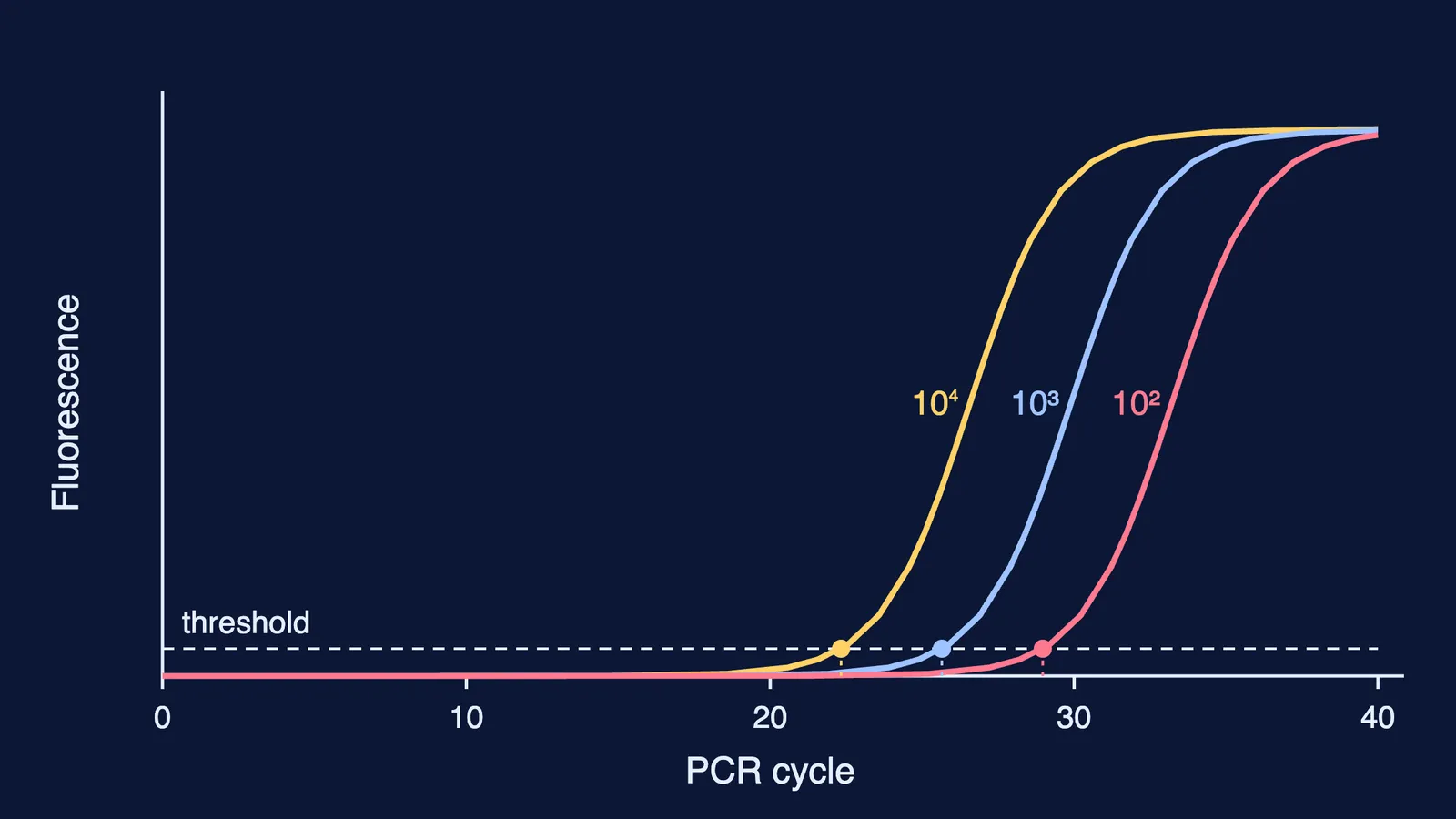
RT-PCR detects the virus's genetic material, its RNA, as Public Health England's guide to cycle threshold explains. The "RT" step, reverse transcription, copies the RNA into complementary DNA. The machine then heats and cools the mixture again and again; in each cycle, primers find the target and an enzyme builds new strands, so the copies double. Why that enzyme survives the heat is its own story: why Taq polymerase is thermostable.
A few strands of RNA give no measurable signal; a fluorescent probe glows brightly enough only once there are vast numbers of copies. The NHGRI fact sheet on PCR says the process is repeated as many as 30 or 40 times, giving more than one billion copies.
Worked example: the doubling maths
Suppose the swab holds 100 copies of the target gene, and each cycle doubles them, as the NHGRI fact sheet describes.
After 1 cycle: 200 copies.
After 10 cycles: 100 x 2^10 = 102,400 copies.
After 30 cycles: 100 x 2^30, about 1.07 x 10^11 copies.
The cycle threshold (Ct) is the cycle at which fluorescence first crosses the detection line, and a typical assay runs at most 40 cycles, according to Public Health England. With perfect doubling, ten times less target needs about 3.3 more cycles, because 2^3.3 is about 10. PHE's rule of thumb is that a 3-point rise in Ct is roughly a 10-fold fall in viral genetic material, and it warns that Ct values from different assays cannot be compared directly.
If exponential growth and logarithms feel shaky, the Fermi Concept Library covers every concept in physics, chemistry, biology and mathematics, so you can revisit both before a PCR numerical.
How accurate is a rapid antigen test compared with RT-PCR?
A 2022 Cochrane systematic review led by Jacqueline Dinnes pooled 152 evaluations covering 100,462 samples, checking rapid antigen tests against lab molecular tests, mainly RT-PCR (Cochrane review). It found:
Rapid antigen tests caught 73.0% of infections in people with symptoms and 54.7% in people without, on average.
Sensitivity was 80.9% in the first week of symptoms and 53.8% in the second.
Specificity was 99.1% with symptoms and 99.7% without, so false positives were rare.
Used as their makers instruct, brands ranged from 34.3% to 91.3% sensitivity in people with symptoms.
Sensitivity also fell steadily as viral load fell. That fits the doubling maths: the strip has no amplification, so a swab a PCR machine flags at a high Ct may hold too little protein to draw a line. The authors concluded that antigen tests are "more suitable for use as triage to RT-PCR testing", and that people who test negative may still be infected.
What does a negative rapid antigen test really mean?
Here is what the US CDC's COVID-19 testing page (updated March 2025) says about results.
Positive antigen test: the CDC calls positive results accurate and reliable.
Negative, with symptoms: a single negative antigen test cannot rule out infection. The CDC cites FDA advice of 2 negative tests, 48 hours apart.
Negative, no symptoms: the same FDA advice is 3 tests, 48 hours apart.
Molecular tests such as RT-PCR: the CDC calls them the "gold standard", though results may take up to 3 days.
In India, follow current ICMR and state guidance, and ask a doctor about any decision on your own health.
Our post on Bayes' theorem and what a positive test result means shows why false positives matter more when few people are infected. The Cochrane review gives real cases. At 5% prevalence, in people in their first week of symptoms, about 1 in 10 positives would be false and about 1 in 5 infections missed. At 0.5% prevalence without symptoms, 2 in 5 to 1 in 2 positives would be false.
To practise Ct and doubling calculations, the Fermi Problem Library has a step-by-step solver that explains the reasoning rather than printing an answer.