On this page
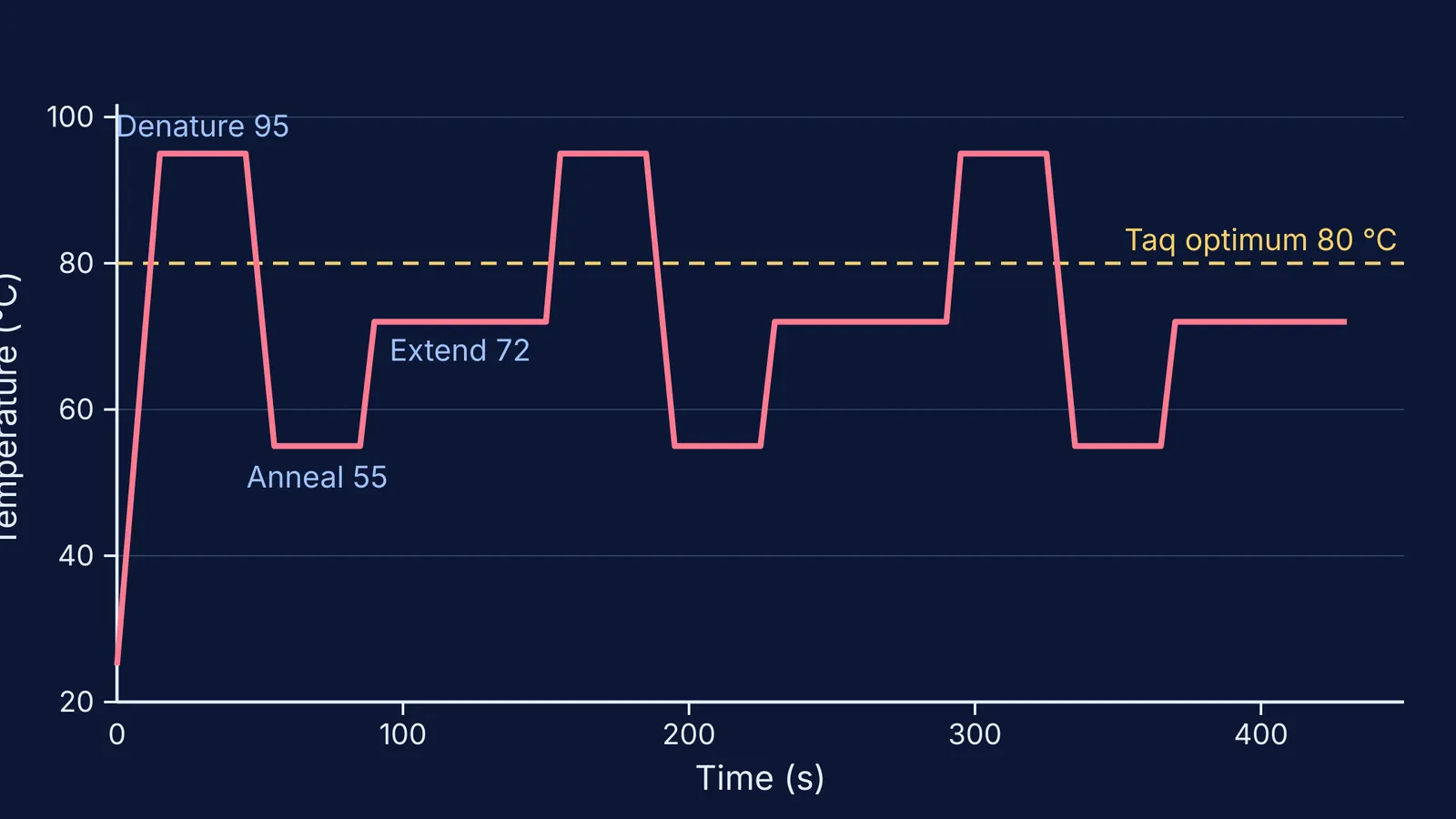
PCR copies a stretch of DNA by cycling the temperature: hot to separate the strands, cooler so primers can stick, then warm so a polymerase can build the new strand. The hot step is the problem. A standard protocol in the Journal of Visualized Experiments starts with 1 minute at 94 to 98 °C, then runs 25 to 35 cycles that each begin with 10 to 60 seconds at 94 °C. Most enzymes are proteins that fall apart long before that. Taq polymerase does not, and that is why it is the enzyme students meet when they learn PCR.
Why is Taq polymerase used in PCR?
Because it is still working after the denaturation step. Taq DNA polymerase, purified in 1976 by Chien, Edgar and Trela, has a temperature optimum of 80 °C. The same paper notes that this high temperature requirement is one of the features that distinguishes it from the DNA polymerase of E. coli.
In 1988 a team including Randall Saiki and Kary Mullis reported using the enzyme in PCR. Their abstract says the thermostable polymerase "greatly simplifies the procedure" and, because the reaction can run at higher temperatures, improves specificity, yield, sensitivity and the length of DNA that can be copied. They amplified single-copy genomic sequences by a factor of more than 10 million and copied segments up to 2000 base pairs.
So Taq gives you two things, not one:
It survives, so you add enzyme once at the start instead of every cycle.
It works hot, so extension can run at 70 to 80 °C, where primers are less likely to stay stuck to the wrong places. Saiki and colleagues credit the higher temperature for the gain in specificity.
What happens to an ordinary polymerase at 95 °C?
An enzyme's job depends on its folded shape. Heat breaks the weak bonds that hold that shape, the protein unfolds, and its active site is gone.
The polymerases used before Taq could not take the heat, so early procedures needed large amounts of enzyme and continuous handling: fresh polymerase had to be added after every heating step. Saiki and colleagues' 1985 sickle-cell study, published before the switch to Taq, still reported a 220,000-fold increase in target DNA, but that era's method was slow and hands-on. With Taq, the whole run happens in one closed tube in a machine.
Where did Thermus aquaticus come from?
In 1969 Thomas Brock and Hudson Freeze described a new bacterium, Thermus aquaticus, isolated from thermal springs in Yellowstone National Park and a spring in California. They reported that it grows best at 70 °C, with a maximum of 79 °C. An organism living that hot needs proteins that stay folded there, and its DNA polymerase is one of them. For the person behind PCR itself, read our piece on Kary Mullis and the invention of PCR.
Does Taq polymerase last forever?
No. Thermostable means slow to die, not immortal. A 1993 study by Lawyer and colleagues measured an activity half-life of 9 minutes at 97.5 °C for full-length Taq. That is why the JoVE protocol warns that an initial denaturation longer than 3 minutes may inactivate the DNA polymerase.
A quick worked example: 30 cycles with 30 seconds of denaturation each is 30 × 30 s = 900 s, or 15 minutes at the top temperature. The JoVE protocol cycles at 94 °C, below the 97.5 °C of that half-life test, so Taq loses activity more slowly than the 9-minute figure suggests. Push the temperature or the hold times up and you start to lose it.
How do you write this in an exam answer?
Board and NEET-UG questions often ask where Taq comes from or why it is used. A three-point answer covers both:
Source: Taq polymerase is a DNA polymerase from Thermus aquaticus, a bacterium of hot springs.
Property: it is thermostable, so it is not denatured at the 94 to 98 °C used to separate DNA strands.
Consequence: it stays active through repeated cycles, so fresh enzyme need not be added each cycle and the process can be automated.
Three mistakes to avoid:
Writing that Taq separates the DNA strands. Heat does that; Taq only extends primers.
Saying Taq works best at 95 °C. It survives 95 °C; it works best near 80 °C.
Forgetting the primer. Like every DNA polymerase, Taq can only add to an existing 3' end, which is explained in why DNA polymerase needs a primer.
For the numericals, our walk-through of how many DNA copies you get after n PCR cycles covers the 2ⁿ formula and its trap.
If enzyme structure or denaturation is the shaky part, the Fermi Concept Library has a lesson for each concept in biology and chemistry, with its place in the map. For practice with numericals, the Fermi Problem Library has worked problems with a step-by-step solver that explains the reasoning rather than printing an answer.