

On this page
PCR (polymerase chain reaction) copies one chosen stretch of DNA again and again. Each cycle has three steps: heat to separate the strands, cool so two short primers stick, then let a heat-stable DNA polymerase build new strands. Exam questions on PCR usually ask for one of four things: total copies, exact-length copies, primers used or time taken.
How many DNA copies does PCR make after n cycles?
The US National Human Genome Research Institute fact sheet on PCR says each new strand can itself be copied, the cycle is repeated as many as 30 or 40 times, and the result can be more than one billion copies. It also notes that Kary Mullis, who created PCR, was awarded the Nobel Prize in Chemistry in 1993; his story is in our piece on Kary Mullis and the maths of copying.
Because the amount doubles every cycle, x starting molecules become x × 2ⁿ double-stranded molecules after n cycles in an ideal reaction. In their chapter on the principle of PCR, Rodríguez-Lázaro and Hernández note that 30 cycles give around 2³⁰-fold amplification, assuming 100% efficiency in every cycle. 2³⁰ is 1,073,741,824, which is why textbooks say "about a billion".
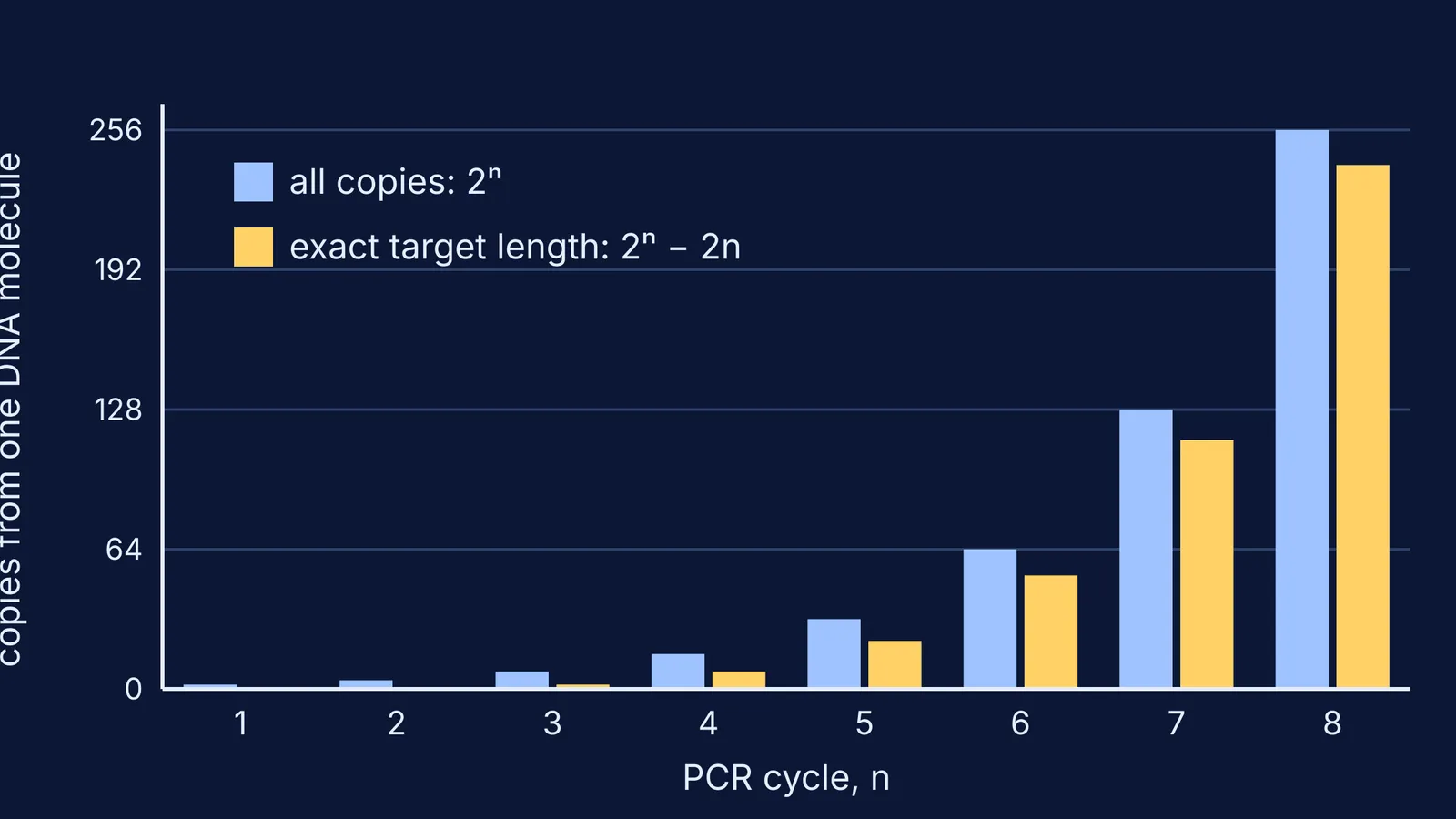
Why are only 2ⁿ − 2n copies exactly the target length?
The primers fix where each new strand starts, but in cycle 1 nothing fixes where it stops, so the polymerase runs on along the long original template. In cycle 2 those long strands are copied from primer to primer, giving the first exact-length strands, each still paired with a longer partner. Only in cycle 3 do two exact-length strands pair up.
Now count. The two original strands never leave the tube, and in every cycle each makes one more long strand, so after n cycles there are 2n long strands. Of the 2ⁿ molecules, 2 hold an original strand and 2n − 2 hold a long strand, which leaves 2ⁿ − 2n that are exact from end to end. The same chapter writes the final number of target copies as (2ⁿ − 2n)x for x starting copies.
From one starting molecule:
After 2 cycles: 4 molecules, 0 of exact length
After 3 cycles: 8 molecules, 2 of exact length
After 4 cycles: 16 molecules, 8 of exact length
After 5 cycles: 32 molecules, 22 of exact length
After 30 cycles: 1,073,741,824 molecules, 1,073,741,764 of exact length
By cycle 30 the difference is 60 molecules out of about a billion, so the simple 2ⁿ is fine for "how many copies" questions.
How many primers does PCR need?
You need two different primers, one for each end of the target. Every new strand starts from one primer, which becomes part of the strand and is used up. So:
In cycle k, one starting molecule gives 2ᵏ new strands, so that cycle uses 2ᵏ primers.
Over n cycles the total is 2 + 4 + … + 2ⁿ = 2ⁿ⁺¹ − 2 primers.
Half are forward and half reverse: 2ⁿ − 1 of each.
So 3 cycles from one molecule use 14 primers: 7 forward and 7 reverse.
If you keep losing track of where a 2n or a 2ⁿ⁺¹ comes from, the Fermi Problem Library has worked problems with a step-by-step solver that explains the reasoning rather than printing an answer.
How long does one PCR cycle take?
For real-world numbers, the US National Institute of Justice DNA amplification course lists typical denaturation as 95°C for 30 seconds or 97°C for 15 seconds, annealing at 55 to 72°C and extension at 72°C. It puts nucleotide incorporation at 72°C at 35 to 100 nucleotides per second, and says one minute of extension is enough for products up to 2 kb.
The enzyme is usually Taq polymerase, first purified from the bacterium Thermus aquaticus by Chien, Edgar and Trela in 1976, who reported a temperature optimum of 80°C. For time: total time = n × (denaturation + annealing + extension), plus any one-off steps the question mentions.
Worked NEET-UG example: all four numbers in one question
A tube starts with 5 DNA molecules. PCR runs 10 cycles at 100% efficiency, each cycle being 30 s at 95°C, 30 s at 58°C and 45 s at 72°C.
Total molecules: 5 × 2¹⁰ = 5 × 1,024 = 5,120.
Exact-length molecules: 5 × (1,024 − 20) = 5 × 1,004 = 5,020.
Primers used: 5 × (2¹¹ − 2) = 5 × 2,046 = 10,230, that is 5,115 of each primer.
Time: 30 + 30 + 45 = 105 s per cycle, and 10 × 105 = 1,050 s, or 17.5 minutes.
For the biology around these numbers, read our guide to restriction enzymes, PCR and cloning vectors for NEET, then see how amplified DNA is checked in gel electrophoresis of DNA fragments. If a term is shaky, the Fermi Concept Library gives each concept its own lesson and its place in the map.


