

On this page
Why can't DNA polymerase start copying on its own?
In molecular biology, a striking asymmetry divides transcription from replication. While RNA polymerase binds a promoter and synthesizes messenger RNA from scratch, DNA polymerase cannot initiate a strand de novo. If you place purified DNA polymerase and deoxynucleoside triphosphates (dNTPs) with bare single-stranded template DNA, no synthesis occurs.
The enzyme cannot join two free nucleotides because its catalytic active site is structurally configured to bind a pre-existing duplex base pair and a free 3'-hydroxyl (3'-OH) group. As demonstrated in classic studies on Arthur Kornberg and the enzyme that copies DNA, DNA polymerase strictly requires an established primer strand annealed to a template. To see how replication enzymes coordinate at the fork, the Fermi Concept Library covers every concept in physics, chemistry, biology, mathematics and computing, each with its own lesson and its place in the map.
How does the 3'-OH chemical mechanism work?
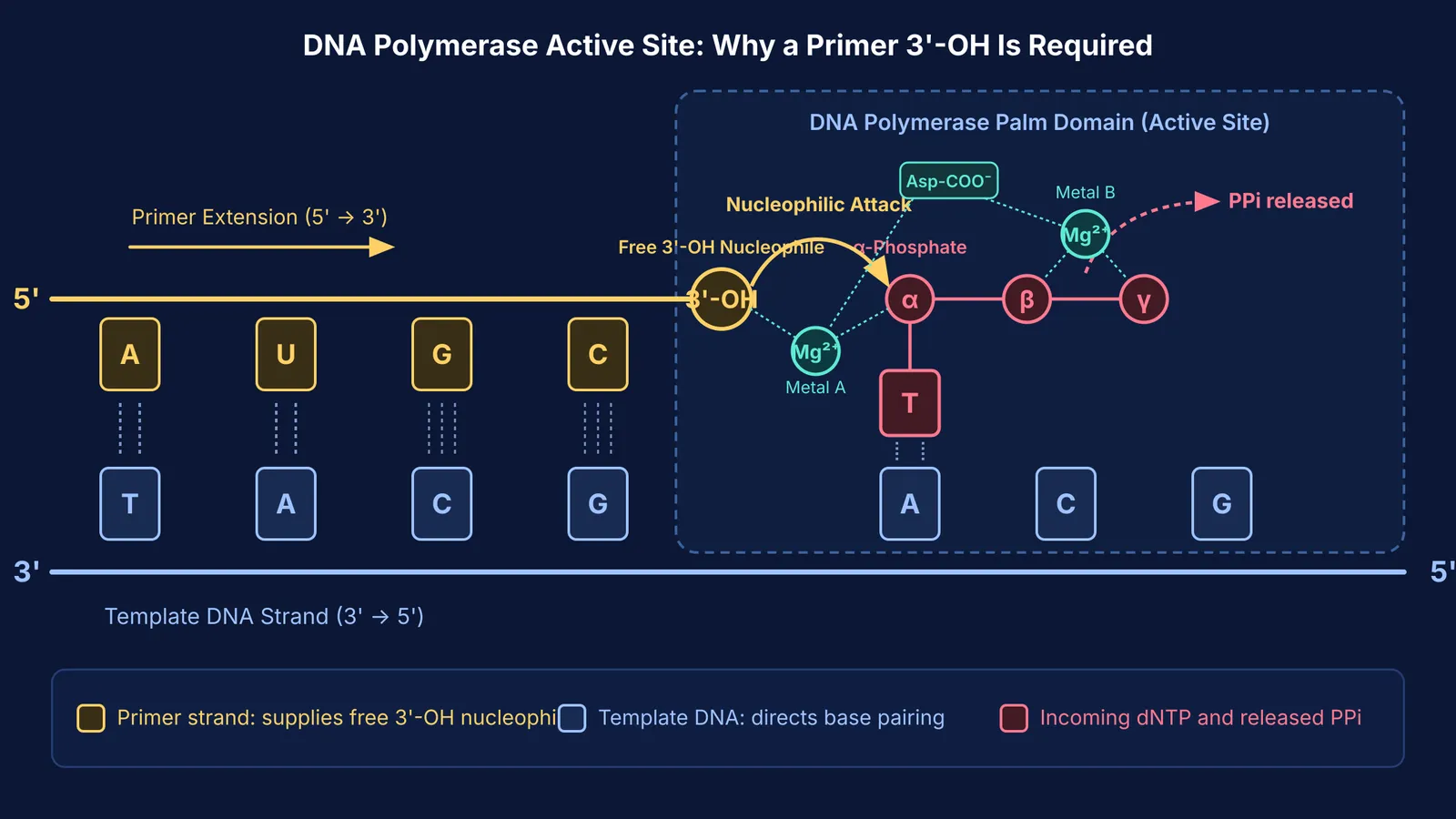
The chemical requirement for a primer stems from the geometry of phosphodiester bond formation. Structural analyses by Thomas A. Steitz in 1999 established that polymerases operate via a conserved two-metal-ion catalytic mechanism in the enzyme's palm domain.
Two divalent magnesium ions (Mg²⁺), held by conserved aspartate residues, drive the catalysis:
Metal ion A activates the primer's terminal 3'-OH group by lowering its pKa, creating a nucleophilic 3'-oxido group.
This nucleophile attacks the alpha-phosphate of the incoming complementary dNTP, forming a covalent phosphodiester bond.
Metal ion B coordinates the beta- and gamma-phosphates and stabilizes the leaving pyrophosphate (PPi).
Subsequent hydrolysis of pyrophosphate by inorganic pyrophosphatase pulls the equilibrium forward. Without an existing 3'-OH group, nucleophilic attack cannot occur, leaving the enzyme inactive.
Why do cells use RNA primers instead of DNA?
If primers are essential, why does nature synthesize them from RNA rather than DNA? The explanation lies in the biological need for fidelity, as detailed by Alberts et al. in Molecular Biology of the Cell.
Starting a polynucleotide chain de novo without an existing double helix is inherently inaccurate because the first base pair lacks stabilizing base-stacking interactions, resulting in an initial error rate around 1 in 10⁴. Yet across the whole genome, proofreading and mismatch repair maintain an accuracy of 1 mistake per 10⁹ nucleotides.
Cells resolve this conflict through enzymatic division of labour:
An RNA polymerase called primase synthesizes a short RNA primer of about 10 nucleotides directly on the template without proofreading.
DNA polymerase extends from this 3'-OH, adding deoxynucleotides with proofreading fidelity.
On the lagging strand, primase synthesizes a new primer for every Okazaki fragment—measuring 1,000 to 2,000 nucleotides in bacteria and 100 to 200 nucleotides in eukaryotes—as explored in Reiji and Tsuneko Okazaki's discovery of lagging-strand fragments.
Ribose sugars and uracil flag the RNA primer as temporary. Repair enzymes remove the primer, and DNA polymerase fills the gap with high-fidelity DNA before DNA ligase seals the nick.
How do PCR primers differ from cellular primers?
In the laboratory, the polymerase chain reaction (PCR) uses a heat-tolerant DNA polymerase such as Taq polymerase to amplify targeted sequences (Saiki et al., 1988). Like cellular enzymes, Taq polymerase requires a primer.
However, PCR replaces biological RNA primers with synthetic single-stranded DNA primers (typically 18 to 25 nucleotides long):
Thermal stability: PCR denaturation steps reach 94 °C to 98 °C. RNA readily hydrolyzes under sustained heat, while DNA oligonucleotides stay stable across dozens of cycles.
Direct incorporation: Synthetic primers are engineered with exact complementarity to flank the target region. Because they already consist of accurate DNA, they do not require removal and remain permanently integrated into the amplified amplicon.
For the history of thermal cycling, read our profile of Kary Mullis and the invention of PCR.
How should you solve primer orientation questions in exams?
NEET-UG and Class 12 board questions frequently test primer polarity. Because DNA polymerase extends only from a 3'-OH group, synthesis strictly runs 5' to 3', meaning the primer must be antiparallel to its template.
Use this 3-step checklist to determine correct primer design:
Identify template orientation: Read the template strand from 3' to 5'. For example, consider the template 3'-T-A-C-G-G-A-5'.
Orient the primer antiparallel: The primer must pair with the 3' end of the template, running 5' to 3' so its free 3'-OH points toward the uncopied region.
Write the sequence: Complementary base pairing gives the primer sequence 5'-A-T-G-C-C-T-3'. The free 3'-OH on the terminal thymine is where DNA polymerase adds the next incoming nucleotide.
If you want to practice polarity problems and enzymatic reaction steps, the Fermi Problem Library has worked problems with a step-by-step solver that explains the reasoning rather than printing an answer.


