On this page
Human Health and Disease is Chapter 7 of NCERT Class 12 Biology (Reprint 2026-27). This guide is about board answers, not NEET MCQs: what to write, in what order, and where marks slip. Every fact below comes from that chapter.
How many marks is Human Health and Disease in Class 12?
Unit VIII, Biology and Human Welfare, carries 12 of the 70 theory marks in the CBSE Biology curriculum 2026-27. That 12 also covers Microbes in Human Welfare, so this chapter has no separate mark.
The 2026-27 sample paper has 33 questions in five sections, from 1-mark MCQs to 5-mark long answers. From this chapter it asks a 1-mark chest X-ray case pointing to pneumonia (Q9) and a 3-mark question on addiction, dependence and tolerance (Q26). The marking scheme gives one mark each to addiction, dependence and why the dose keeps rising.
What must you know from each part of the chapter?
The essentials, from NCERT Chapter 7:
Pathogens: typhoid (*Salmonella typhi*, food and water, Widal test); pneumonia (*Streptococcus pneumoniae*, *Haemophilus influenzae*, alveoli fill with fluid); common cold (rhinoviruses, nose and respiratory passage, not lungs); amoebiasis (*Entamoeba histolytica*, houseflies as mechanical carriers); ascariasis (*Ascaris*, eggs in faeces); filariasis (*Wuchereria*, female mosquito vectors); ringworm (*Microsporum*, *Trichophyton*, *Epidermophyton*). See our NCERT table of diseases and causative organisms.
Malaria: sporozoites enter through an infected female *Anopheles* bite, multiply in liver cells, then burst RBCs; released haemozoin causes the recurring chill and fever. The mosquito picks up parasites, which form sporozoites in its salivary glands. Two hosts; the mosquito is also the vector.
Innate vs acquired: innate is non-specific, present at birth, with physical, physiological, cellular and cytokine (interferon) barriers. Acquired is pathogen-specific and has memory, so the secondary response is stronger than the primary.
Antibody: two light and two heavy chains, written H2L2. B cells make antibodies (humoral response); T cells mediate cell-mediated immunity and graft rejection.
Active vs passive: active means your own antibodies, slow to build (infection, vaccines). Passive means ready-made antibodies (colostrum IgA, placenta, tetanus antitoxin, snake antivenom). Our explainer on pathogens, immunity and vaccines has a quick test for telling them apart.
Allergy and autoimmunity: allergy is an exaggerated response to allergens, with IgE and histamine and serotonin from mast cells. In autoimmunity the body attacks self-cells; rheumatoid arthritis is NCERT's example.
Lymphoid organs: primary are bone marrow and thymus; secondary are spleen, lymph nodes, tonsils, Peyer's patches and appendix.
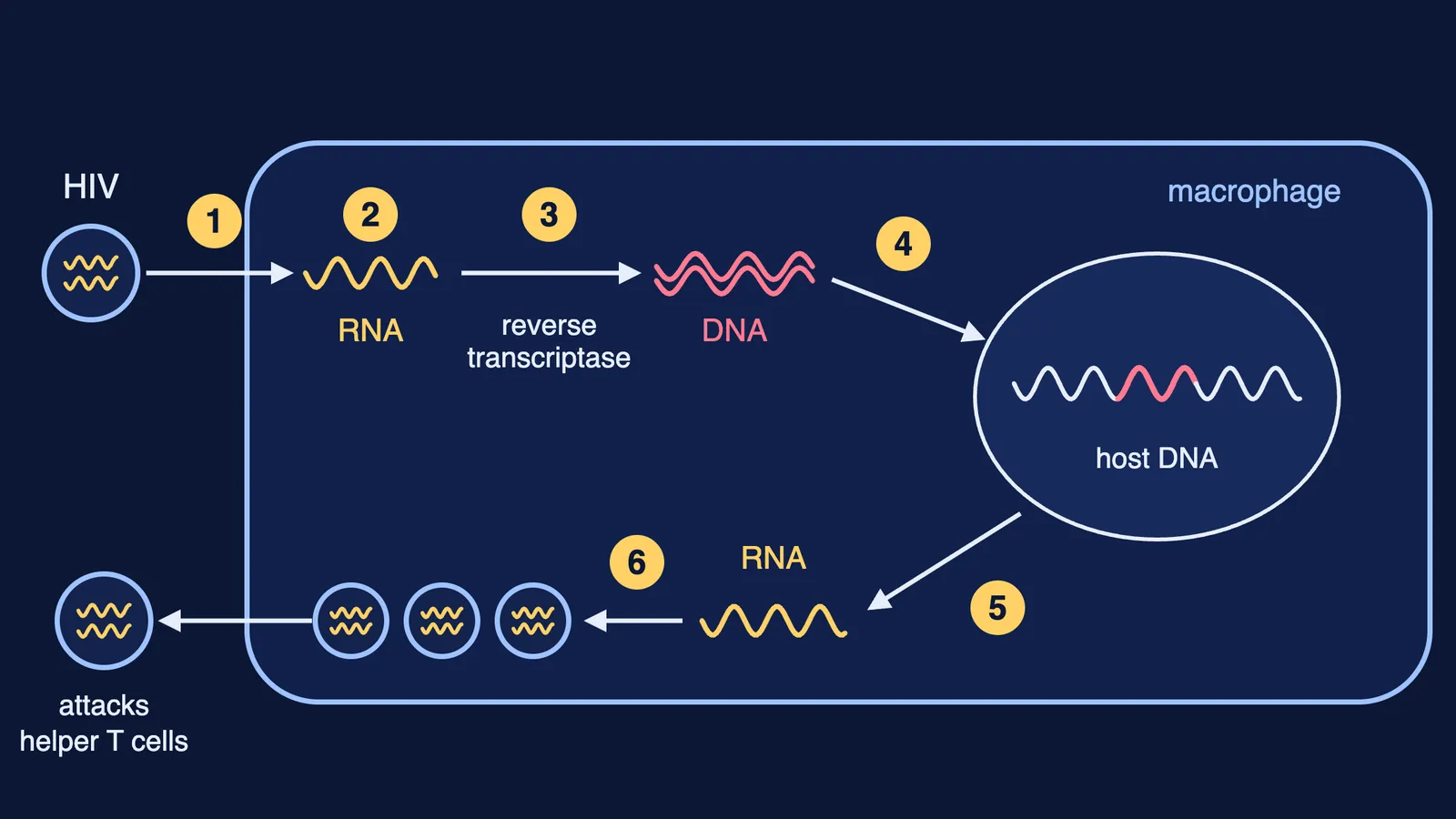
AIDS: HIV, a retrovirus, enters macrophages; reverse transcriptase copies its RNA into DNA; that DNA joins the host genome; macrophages then keep making virus. At the same time HIV enters helper T cells, whose progeny attack more helper T cells, so their number falls. ELISA diagnoses it.
Cancer: loss of contact inhibition; benign vs malignant; metastasis; physical, chemical and biological carcinogens; surgery, radiotherapy, chemotherapy, α-interferon.
Drugs: opioids (heroin), cannabinoids and coca alkaloids (cocaine); addiction is psychological attachment, dependence shows as withdrawal symptoms.
How do you set out 2-, 3- and 5-mark answers?
2 marks: two separate points. For "differentiate", draw a two-column table, one feature per row.
3 marks: three points, one per mark, exactly like Q26's scheme.
5 marks: a labelled diagram (Plasmodium life cycle or HIV replication), numbered steps in NCERT's order, then one line on diagnosis or prevention.
Worked example: which pathogen, checked two ways
Our own question: several hostel students who ate at one canteen have sustained high fever, weakness, stomach pain, constipation and loss of appetite. Name the disease, its pathogen and a confirmatory test (3 marks).
Route 1, from symptoms. That list matches NCERT's typhoid description: *Salmonella typhi*, confirmed by the Widal test.
Route 2, from transmission. A shared canteen means food or water. NCERT names three such diseases: typhoid, amoebiasis and ascariasis. Amoebiasis lists no fever; ascariasis adds internal bleeding, anaemia and intestinal blockage, which the students lack. Only typhoid survives.
Both routes give typhoid, *Salmonella typhi* and the Widal test. If they disagreed, reread the symptoms before writing.
Which assertion-reason and case-study traps cost marks?
Judge A, then R, then whether R explains A. Common traps:
Colostrum gives passive, not active, immunity.
Common cold does not reach the lungs; pneumonia infects alveoli.
Allergy uses IgE; colostrum carries IgA.
The thymus shrinks with age.
An injected antitoxin is still passive immunisation.
HIV enters macrophages and helper T cells at the same time.
A seven-day revision plan
Day 1: pathogen list and the malaria cycle, drawn from memory.
Day 2: innate vs acquired and active vs passive as tables.
Day 3: antibody diagram, lymphoid organs, allergy, autoimmunity.
Day 4: HIV steps and cancer.
Day 5: drugs; answer Q26 and mark it against the scheme.
Day 6: write three assertion-reason pairs of your own.
Day 7: redraw both diagrams; fix gaps.
If a term like interferon still feels vague, the Fermi Concept Library covers every concept in physics, chemistry, biology, mathematics and computing, each with its own lesson and its place in the map. For the rest of the syllabus, use our CBSE Class 12 revision plan for the final 8 weeks.