

On this page
When you prepare for the biology section of NEET or your Class 12 board exams, the "Human Health and Disease" chapter is one of the most reliable sources of marks. Every year, examiners design questions that ask you to match a disease to its pathogen, identify the specific route of infection, or pick out the defining symptom from a clinical description.
While the official textbook provides all these essential details, they are scattered across several dense paragraphs. To help you revise quickly and efficiently, we have compiled the core infectious diseases into a structured list. This format serves as a quick-reference diseases and causative organisms table, making it much easier to read and memorise on a mobile screen without losing any of the critical exam facts.
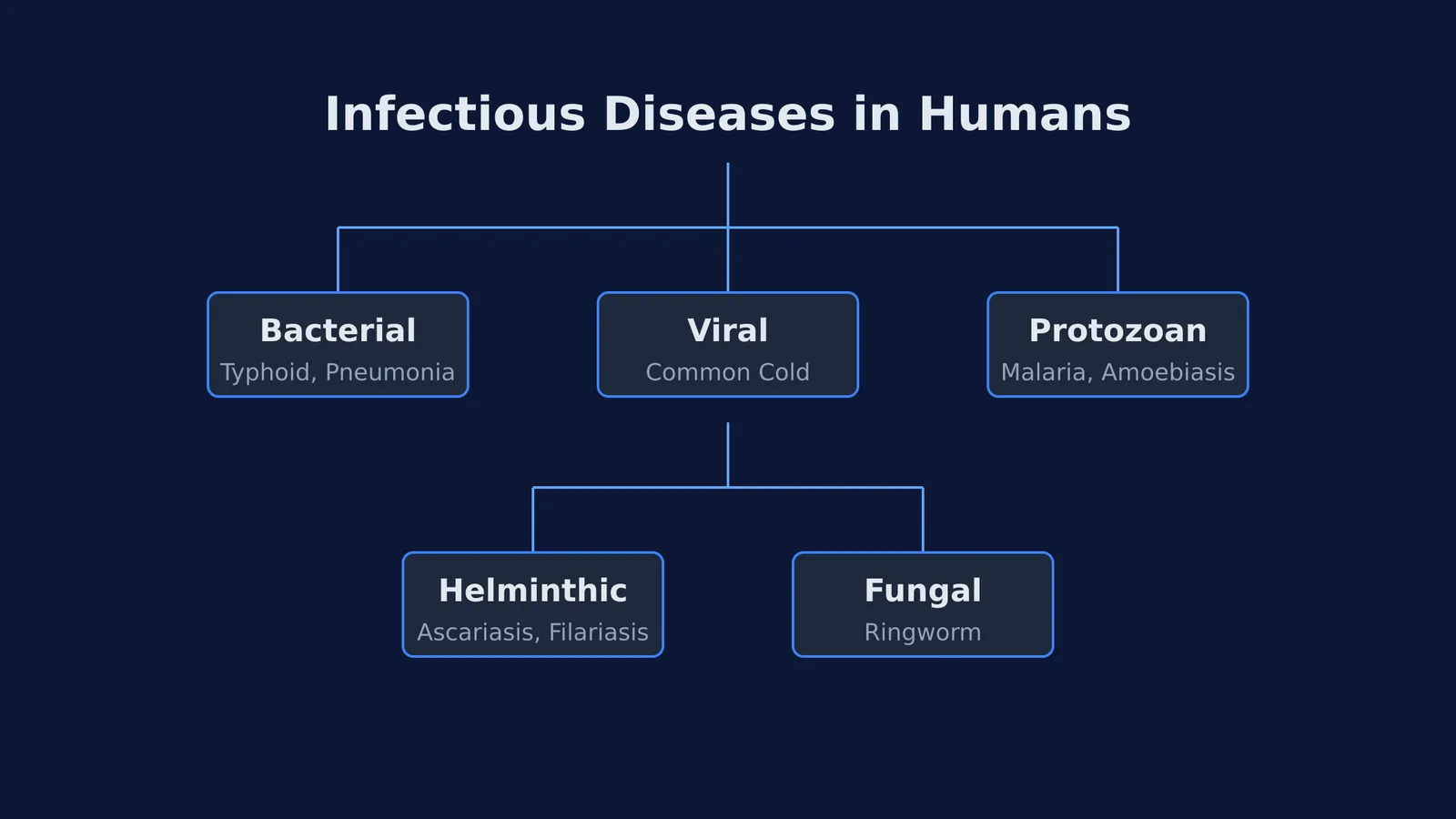
The NCERT Class 12 Biology syllabus formally defines eight major infectious diseases, detailing their pathogens, transmission routes, and diagnostic symptoms.
What are the bacterial and viral diseases in humans?
The first category of pathogens you will encounter in the textbook includes the bacteria and viruses that cause some of the most common everyday illnesses.
1. Typhoid
Causative organism: *Salmonella typhi* (Bacteria)
Infection route: Pathogens generally enter the small intestine through contaminated food and water, then migrate to other organs through the blood.
Key details: Causes sustained high fever, weakness, and stomach pain. In severe cases, intestinal perforation and death may occur. It is confirmed clinically by the Widal test.
2. Pneumonia
Causative organism: *Streptococcus pneumoniae* and *Haemophilus influenzae* (Bacteria)
Infection route: Inhaling droplets or aerosols released by an infected person, or sharing glasses and utensils.
Key details: The bacteria infect the alveoli (air-filled sacs) of the lungs. The alveoli get filled with fluid, leading to severe breathing problems. Symptoms include fever, chills, cough, and headache.
3. Common Cold
Causative organism: Rhinoviruses (Viruses)
Infection route: Droplets from coughs or sneezes, or touching contaminated objects like pens, books, and doorknobs.
Key details: Affects the nose and respiratory passage, but crucially, it does not infect the lungs. Symptoms like nasal congestion, discharge, and sore throat usually last for a few days.
Which protozoan diseases do you need to study?
Protozoans are single-celled eukaryotes, and the syllabus highlights two major diseases caused by these parasites.
4. Malaria
Causative organism: *Plasmodium* species, including *P. vivax*, *P. malariae*, and *P. falciparum* (Protozoan)
Infection route: Transmitted through the bite of an infected female *Anopheles* mosquito.
Key details: The release of a toxic substance called hemozoin causes the recurring chills and high fever. *Plasmodium falciparum* causes malignant malaria, which is the most severe form and can often be fatal.
5. Amoebiasis (Amoebic dysentery)
Causative organism: *Entamoeba histolytica* (Protozoan)
Infection route: Houseflies act as mechanical carriers, transmitting the parasite from the faeces of an infected person to food and water.
Key details: A disease of the large intestine. It causes constipation, abdominal pain, cramps, and stools containing excess mucous and blood clots.
How are helminthic and fungal diseases transmitted?
The final three diseases in the sequence are caused by larger, often multicellular parasites like parasitic worms and fungi.
6. Ascariasis
Causative organism: *Ascaris lumbricoides*, the common roundworm (Helminth)
Infection route: Infection takes place through contaminated water, vegetables, and fruits containing eggs excreted in the faeces of an infected person.
Key details: An intestinal parasite that leads to internal bleeding, muscular pain, fever, anaemia, and the physical blockage of the intestinal passage.
7. Filariasis (Elephantiasis)
Causative organism: *Wuchereria bancrofti* and *W. malayi*, the filarial worms (Helminths)
Infection route: Transmitted to a healthy person through the bite of an infected female mosquito vector, typically *Culex*.
Key details: The worms cause a slowly developing chronic inflammation of the organs they live in for many years, usually the lymphatic vessels of the lower limbs, resulting in massive swelling.
8. Ringworm
Causative organism: Fungi belonging to the genera *Microsporum*, *Trichophyton*, and *Epidermophyton*
Infection route: Generally acquired from soil or by using towels, clothes, or even the comb of an infected individual.
Key details: Results in the appearance of dry, scaly lesions on various parts of the body such as the skin, nails, and scalp, accompanied by intense itching. Heat and moisture help these fungi to thrive.
How to memorise the causative organisms for NEET?
Rote learning a long list of biological names can be frustrating, especially when you are balancing multiple subjects under time pressure. Once you have the categories fixed in your mind, connect each pathogen to the story of how it affects the human body. When you know the historical and scientific context behind these discoveries, they often become much easier to remember. For instance, Alphonse Laveran first identified the malaria parasite in a patient's blood, proving for the first time that a protozoan could cause disease.
If you find yourself struggling to recall the precise differences between an antigen and an antibody, or how helper T cells interact with different viruses in the immune system, it helps to step back and look at the foundational biological concepts. The Fermi Concept Library contains clear, structured explanations for every topic in the biology syllabus. When you are unsure where to begin your revision, Fermi's AI tutor can work out what you already know and build a plan for the session, so you sit down to a clear next step.


