On this page
You have a list of pairs to learn: lichen, cattle egret, Cuscuta, clown fish. You ask an AI chatbot to sort them into mutualism, commensalism, parasitism and the rest, and it answers in seconds. The real question is whether that answer matches the book your exam is set from.
For school boards and exams that follow NCERT Class 12 Biology, that book is Chapter 11, Organisms and Populations. Here is a short routine that uses AI for the sorting and NCERT for the checking, plus the place where the two often disagree.
What do the +, − and 0 signs mean in NCERT?
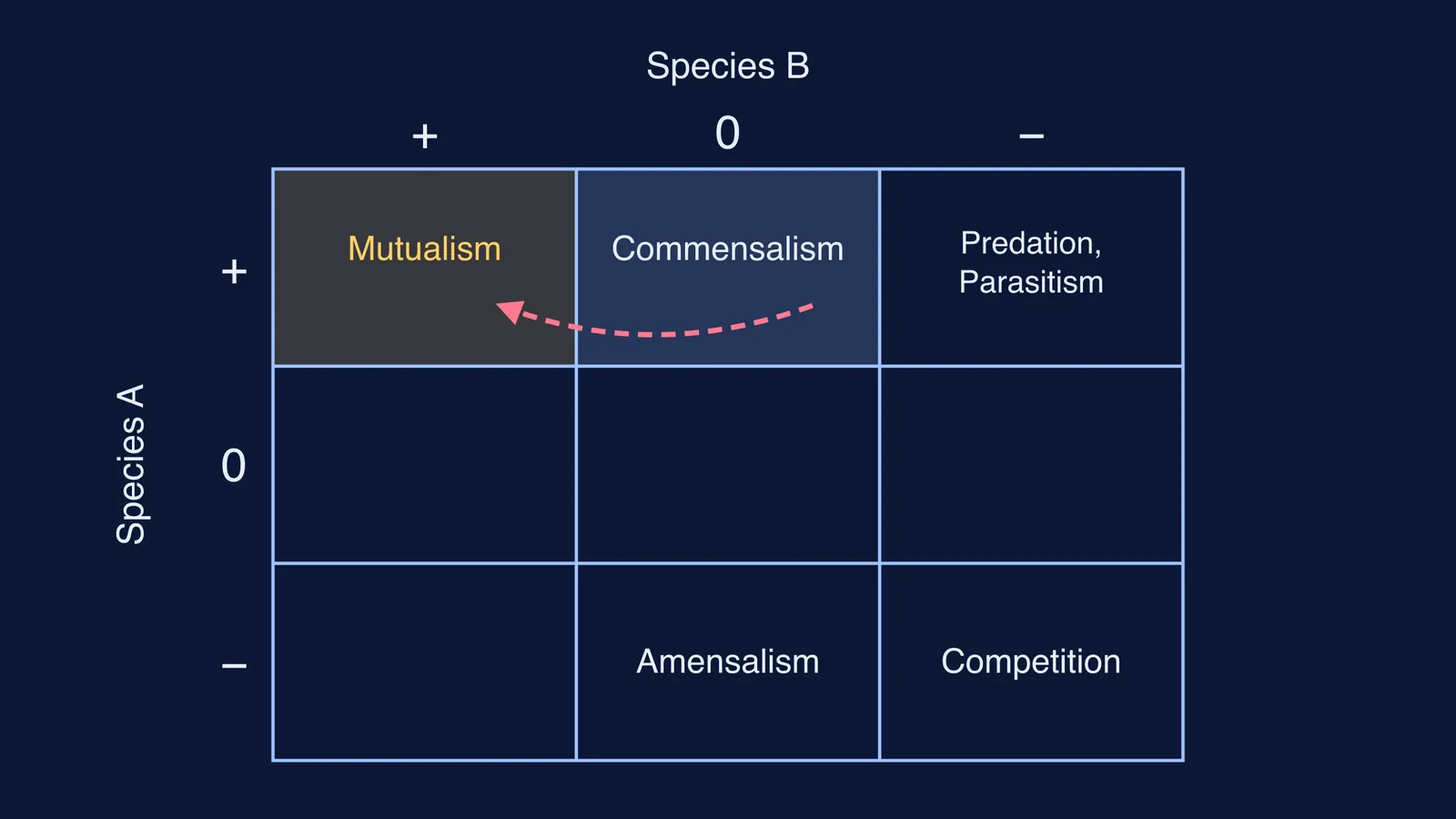
NCERT's Table 11.1 gives every interaction two signs, one for each species: + for a beneficial interaction, − for a detrimental one, and 0 for neutral (NCERT Class 12 Biology, Chapter 11).
Mutualism: +, +
Competition: −, −
Predation: +, −
Parasitism: +, −
Commensalism: +, 0
Amensalism: −, 0
Predation and parasitism carry the same signs, so the signs alone cannot tell them apart; you need the example. For the whole table with a reason for each row, see our population interactions signs table explained.
How do I ask AI to sort interaction examples?
Ask for the signs first and the name second. The name follows from the signs, and a wrong sign is easier to catch than a wrong label. Copy this prompt:
"Here are 12 pairs of organisms. For each pair, give the sign for each partner (+, − or 0), then name the interaction, then write one line on who gains what. Do not add examples of your own. Pairs: lichen fungus and alga; fig tree and fig wasp; orchid growing on a mango branch; barnacles on a whale; cattle egret and grazing cattle; clown fish and sea anemone; Cuscuta and its hedge plant; koel and crow; lice and humans; Balanus and Chthamalus barnacles; flamingos and fish in South American lakes; tiger and deer."
Every pair comes from the NCERT chapter, so you can check each answer.
Where does AI confuse commensalism with mutualism?
NCERT gives four examples of commensalism: an orchid growing as an epiphyte on a mango branch, barnacles on the back of a whale, the cattle egret feeding beside grazing cattle, and the clown fish living among a sea anemone's stinging tentacles (NCERT Chapter 11). On the last pair the book is direct: "The anemone does not appear to derive any benefit by hosting the clown fish."
The clown fish is the pair a chatbot is likely to mark +, +, and there is a reason. A 2016 study calls anemonefishes and their host anemones "iconic mutualists". In its field experiment, which tracked one anemone species and its anemonefish for 3 years, removing the fish had "rapid and sustained negative effects on growth, reproduction and survival of anemones" (Frisch and colleagues, Coral Reefs, 2016). So the AI may be following research papers while your answer key follows NCERT.
The cattle egret is the other one to watch. NCERT's reason is that grazing cattle stir up and flush out insects the egret would otherwise find hard to catch, and it treats the cattle as unaffected. If the AI gives the cattle a benefit, that is not NCERT's story. Our post on commensalism examples from NCERT goes through all four pairs.
Which other NCERT examples trip AI up?
The female mosquito. NCERT says it is not considered a parasite, although it needs our blood for reproduction, and asks you to explain why. An AI may just call it a parasite.
The Ophrys orchid. It appears in NCERT's mutualism section, but the book notes that not all orchids offer rewards: Ophrys gets pollinated by "sexual deceit", tricking a male bee. The fig and wasp is the safer +, + example.
Amensalism. Table 11.1 lists it, but the chapter gives no example. If the AI offers one, it comes from outside the chapter, so check with your teacher before you memorise it.
A 10-minute check routine
Run the prompt above and save the answer.
Open the NCERT chapter at Table 11.1. Cover the AI's interaction names and check only its signs, line by line.
Mark every line where a sign differs from NCERT, or where the one-line reason is not one NCERT gives.
For each marked line, reply: "NCERT calls this commensalism because the other partner is unaffected. Which partner do you think benefits, and what is your evidence?" Its reply can show whether it is pointing to a real scientific debate, like the clown fish, or making a plain slip, but check any new claim against a source.
Write the final list in your notebook in your own words, with NCERT's reason beside each pair.
Sorting is the AI's job here; deciding is yours, and that is the part an exam tests.
If a sign keeps slipping because the idea behind it feels fuzzy, the Fermi Concept Library covers every concept in biology, each with its own lesson and its place in the map, so you can see commensalism next to mutualism and parasitism.