

On this page
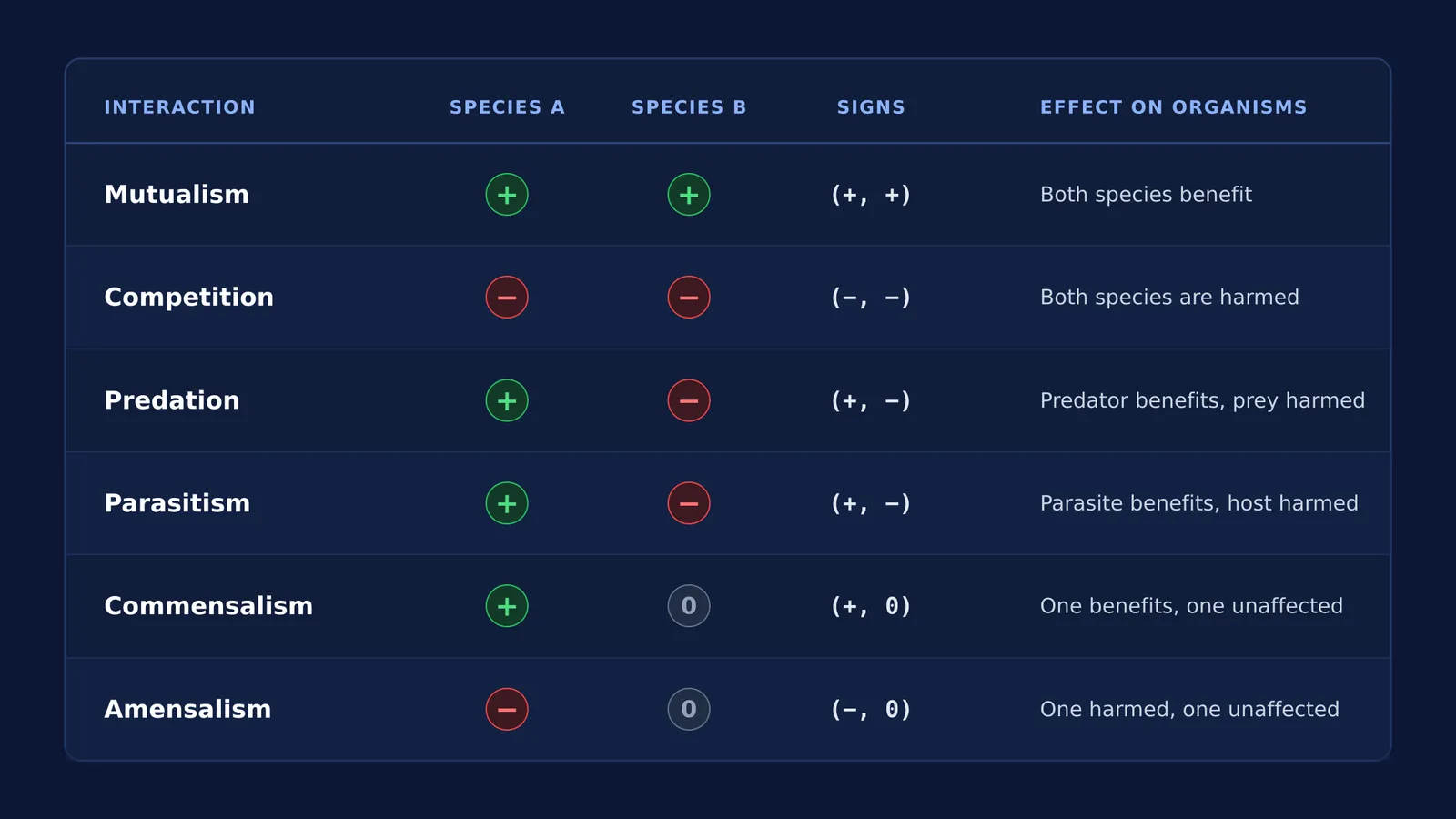
In any ecosystem, no species lives in isolation. Even a flowering plant depends on soil microbes to cycle nitrogen and insects to disperse its pollen. Ecologists classify these relationships using a signs table that tracks who wins, who loses, and who remains unaffected. By assigning a plus (+), a minus (−), or a zero (0) to each species, we can map every population interaction.
This signs table is a foundational framework in community ecology. Understanding the six core interactions—mutualism, competition, predation, parasitism, commensalism and amensalism—makes it straightforward to analyze complex food webs.
What does the population interactions signs table mean?
The signs table reduces ecological relationships to their net effect on survival and reproduction. According to OpenStax Biology, a plus sign (+) denotes that an interaction is beneficial to a species, a minus sign (−) means it is detrimental, and a zero (0) indicates that the interaction is neutral, leaving the organism unaffected.
Every interaction involves two species, designated as Species A and Species B. Combining their signs yields six distinct relationships.
What is the difference between mutualism and competition?
When both species share the same sign, the interaction is either mutually cooperative or mutually detrimental.
Mutualism (+, +): Both species gain a fitness benefit. Lichens are a classic example, pairing a fungus with photosynthesising algae or cyanobacteria. The fungus provides structure and absorbs minerals, while the photobiont produces carbohydrates. Another mutualism occurs between fig trees and pollinator wasps: the wasp pollinates the fig, which in turn offers safe oviposition sites and nourishment for developing larvae.
Competition (−, −): Both species are harmed because they vie for the same limited resources, such as food, water, or territory. Even the prevailing species expends energy and suffers reduced reproductive output. A classic ecological example occurred on Pinta Island in the Galápagos. In Oryx, researchers document how feral goats introduced in 1959 rapidly decimated vegetation through superior browsing efficiency, driving the native Abingdon tortoise population toward extinction.
To see how populations change over time, read our guide to Organisms and populations: growth models and species interactions.
How do predation and parasitism compare in ecology?
In a (+, −) interaction, one organism benefits at the direct expense of another.
Predation (+, −): The predator benefits (+) by killing and consuming the prey (−). While lions hunting zebras are typical examples, ecology defines any organism that eats another as a predator. A sparrow eating a seed acts as a seed predator. Predators transfer energy across trophic levels and prevent dominant prey species from overpopulating communities.
Parasitism (+, −): The parasite benefits (+) while the host is harmed (−). Unlike predators, parasites typically live on or inside their host and rarely kill it quickly, as the living host provides continuous shelter and nourishment. For example, *Cuscuta* (dodder) is a parasitic plant that has lost chlorophyll and leaves, instead tapping the vascular tissue of hedge plants for water and nutrients.
When preparing for questions on subtle biological mechanisms, the Fermi Concept Library covers every concept in physics, chemistry, biology, mathematics and computing, each with its own lesson and its place in the map.
What are commensalism and amensalism?
These relationships are unilateral interactions, where one species is completely unaffected.
Commensalism (+, 0): One species benefits while the other is neither helped nor harmed. An orchid growing as an epiphyte on a tree branch gains sunlight and rain without draining the host tree. Similarly, barnacles on a whale gain access to plankton-rich waters, while the whale remains unaffected.
Amensalism (−, 0): One species is harmed while the other remains unaffected. The mould *Penicillium* secretes the antibiotic penicillin during metabolism, killing surrounding bacteria (−) without gaining any direct benefit (0). In Scientific Reports, ecological modeling shows that these unilateral interactions—where one species is unaffected (0)—stabilize community networks compared to purely symmetric competition or mutualism.
For additional problem types, explore our guide on Ecology for NEET: food chains, pyramids and population questions.
How can you remember the signs table without confusion?
When solving multiple-choice questions, use this three-step rule to identify the correct interaction:
Check for zeros: If one species is unaffected (0), the interaction is unilateral—either commensalism (+, 0) or amensalism (−, 0).
Check for matching signs: If both signs are identical, the interaction is symmetric—either mutualism (+, +) where both gain, or competition (−, −) where both lose.
Differentiate (+, −) pairs: If one benefits and the other loses, examine the outcome. If the consumer kills the victim directly, it is predation. If the consumer lives on or inside the host over time, it is parasitism.
When practicing problems that test these concepts, the Fermi Problem Library has worked problems with a step-by-step solver that explains the reasoning rather than printing an answer. For syllabus revision, consult our CBSE Class 12 biology revision guide.


