

On this page
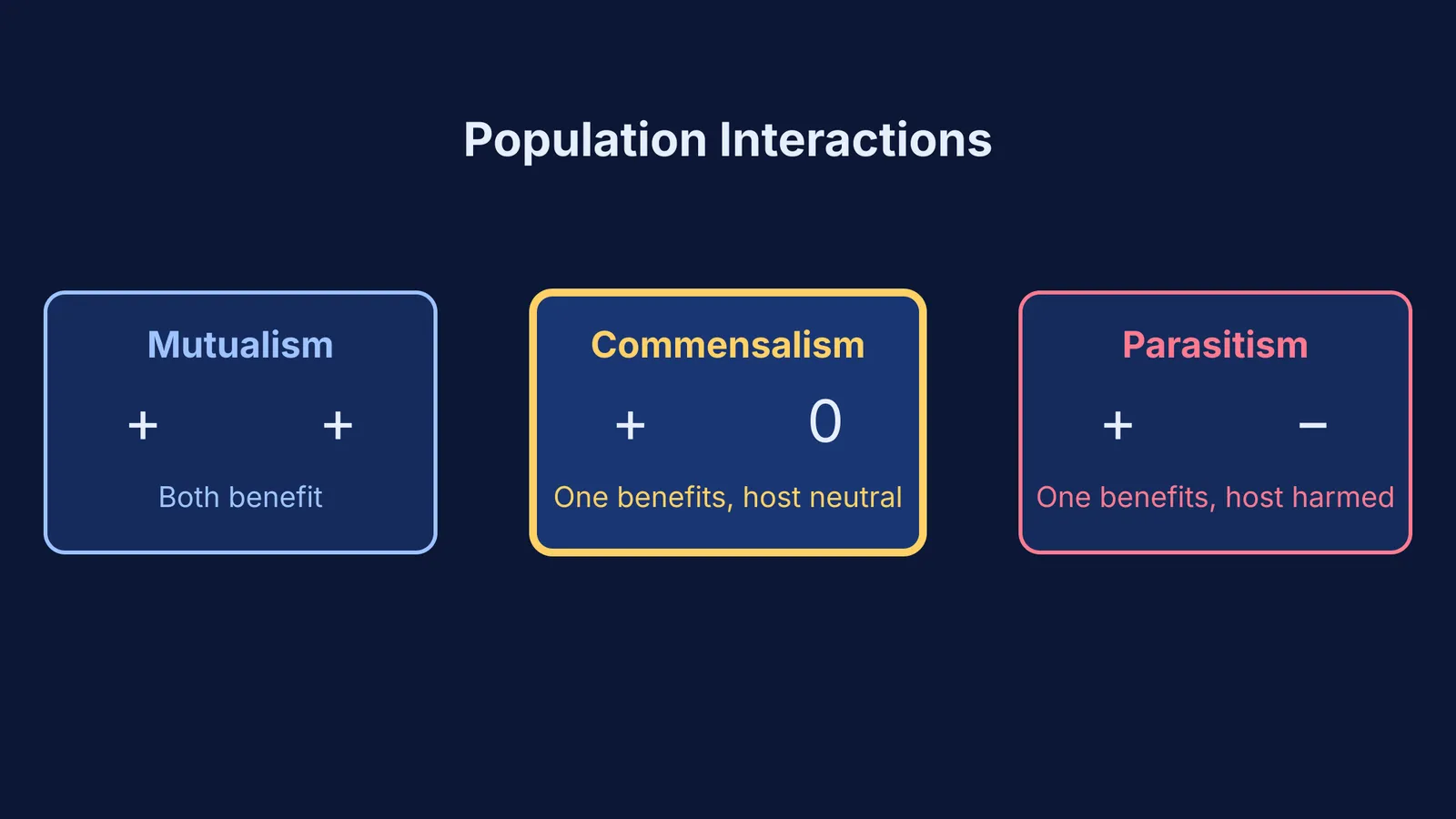
In ecology, population interactions define how different species survive together. While some relationships are destructive, others are remarkably one-sided without causing harm. Commensalism is an interaction where one species benefits and the other is neither harmed nor benefited—often represented as a (+, 0) relationship.
The NCERT Class 12 Biology syllabus highlights four classic examples of commensalism to illustrate how these unbalanced but peaceful relationships work in nature. Here is what you need to know about the orchid, the barnacle, the egret, and the clownfish.
What is an epiphytic orchid on a mango tree?
An epiphyte is a plant that grows on another plant for physical support rather than for nutrients. In tropical rainforests, space and sunlight are at a premium. An orchid growing on the branch of a mango tree uses the tree to reach higher into the canopy where sunlight is plentiful.
The orchid benefits from this elevated position, absorbing moisture and nutrients from the air and rain. The mango tree, however, remains completely unaffected. The orchid does not tap into the tree's vascular system, meaning it steals no food or water. It is a perfect (+, 0) interaction where the host provides scaffolding and nothing more.
Why do barnacles grow on the back of a whale?
Marine ecosystems offer similar hitchhiking arrangements. Barnacles are sedentary crustaceans that permanently attach themselves to hard surfaces. When they anchor themselves to the thick skin of a whale, they gain a significant survival advantage.
As the whale swims, it constantly moves the barnacles through fresh, nutrient-rich waters, giving them a steady supply of plankton to filter-feed. The whale, due to its massive size, barely notices the extra weight or drag. Interestingly, this settlement is highly specialized; a 2006 study found that larvae of the whale barnacle require a specific chemical cue from the host humpback whale's tissue to trigger their settlement on the skin.
Why does the cattle egret follow grazing cattle?
If you have ever seen a herd of cattle grazing in a field, you have likely noticed white birds walking closely beside them. This is the cattle egret, a bird that relies on large herbivores for its meals.
As cattle move through tall grass, their heavy hooves stir up insects and grubs that were hiding in the vegetation. The egrets follow closely, easily catching the flushed-out prey. Without the cattle, the birds would have to expend far more energy searching for food. The cattle receive no benefit from the birds, nor are they bothered by their presence.
Are the sea anemone and clownfish truly commensal?
The relationship between the sea anemone and the clownfish is a frequent exam topic, but it also carries a subtle trap for the unwary student.
Sea anemones have tentacles armed with stinging cells that are deadly to most small fish. The clownfish, however, has a specialized mucus coating that protects it from the stings. By living among the tentacles, the clownfish gains a safe haven from predators.
In classic textbooks and the NCERT curriculum, this is classified as commensalism: the clownfish gets protection (+), and the anemone is assumed to be unaffected (0). However, ecology is an evolving science. Modern research suggests this might actually be a mutualistic (+, +) relationship. For instance, a 2024 review notes that active food-provisioning by clownfish improves the growth of their host sea anemones. For your exams, stick to the syllabus definition of commensalism, but knowing the real-world complexity is a strong sign of active learning.
How does Fermi help with ecological concepts?
When studying ecology for board exams or NEET-UG, the sheer number of examples can blur together. Memorizing lists is less effective than understanding the underlying mechanism.
If you struggle to recall which example belongs to which category, the Fermi Concept Library maps out these population interactions visually. You can trace the logic of why an epiphyte is not a parasite. When you want to test your understanding, the Fermi Problem Library offers worked questions that ask you to classify new, unseen relationships using the (+, 0, -) framework. Rather than just giving you the answer, Fermi's AI tutor works through the problem with you, explaining why the host is unaffected.
For more biology foundations, review our guide on viruses, viroids and lichens and learn how environmental pressures shape species in our walkthrough of stabilising, directional and disruptive selection.


