

On this page
Every fig you eat is the product of an ancient, microscopic exchange. Inside the fruit, a complex life cycle plays out, binding a specific species of wasp to a specific species of fig tree in a perfect evolutionary loop.
This relationship is a textbook example of obligate mutualism: neither the *Ficus* tree nor the agaonid wasp can complete its life cycle or reproduce without the other. A 2021 genomic study published in *Nature Communications* traced this co-evolutionary partnership back approximately 75 million years (doi:10.1038/s41467-021-20957-3). Over these millions of years, the two organisms have shaped each other's physical forms and reproductive schedules.
If you find it hard to keep track of complex life cycles like this one, the Fermi Concept Library explains every concept in biology step by step, drawing the figures and checking your understanding as it goes.
What happens inside the fig during pollination?
A fig is not a standard fruit; it is actually a syconium. A syconium is an inverted, fleshy flower cluster containing hundreds of tiny individual flowers that face inward toward a hollow centre. For pollination to occur, the pollen carrier must physically get inside this sealed chamber.
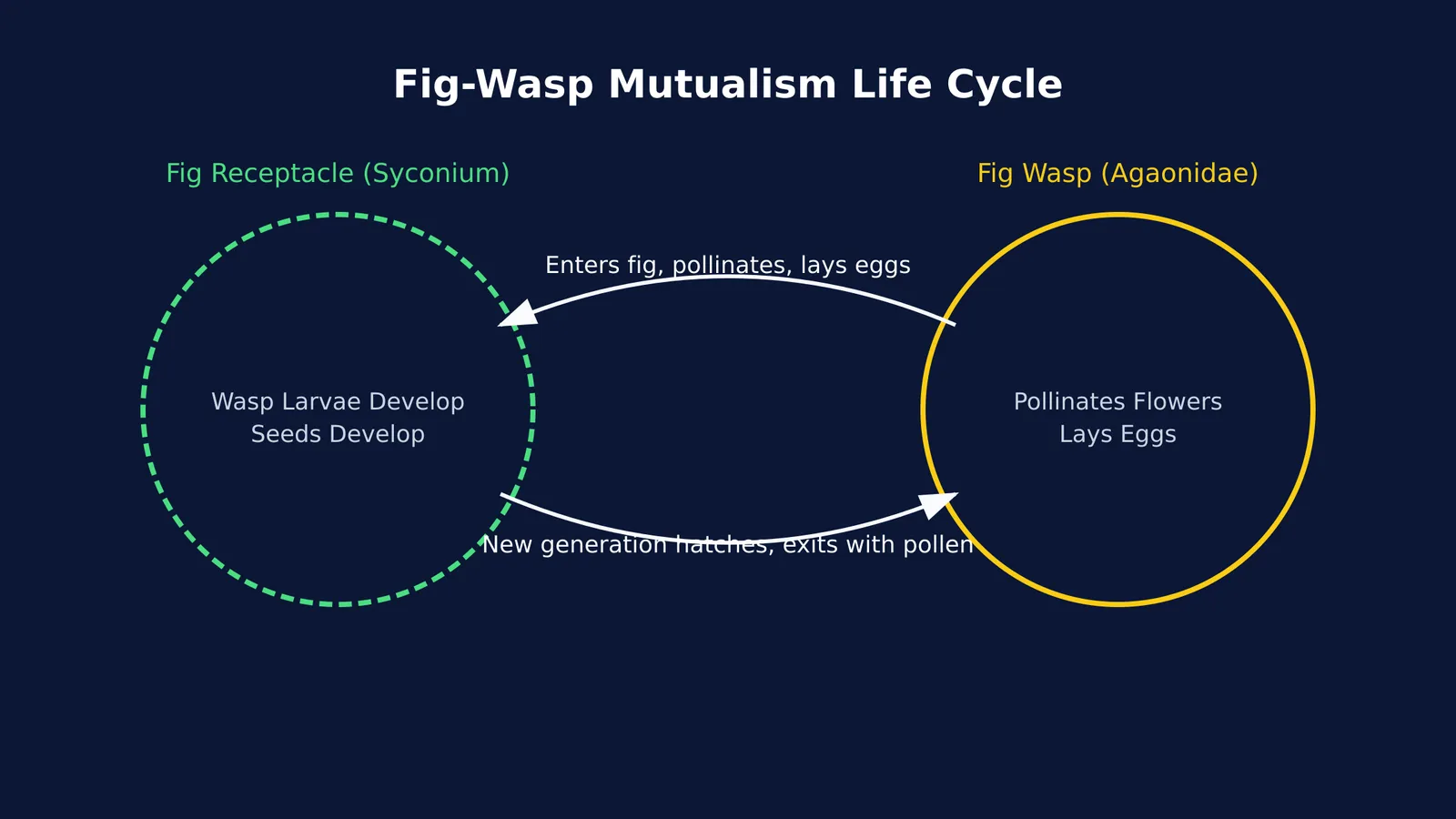
The cycle begins when a pregnant female wasp, drawn by species-specific chemical scents released by the tree, arrives at a young, receptive fig. She squeezes through a tiny, bract-lined opening at the base called the ostiole. This passage is so tight and difficult to navigate that she typically loses her delicate wings and antennae on the way in, committing herself entirely to this single fig.
Once inside the dark chamber, the wasp walks over the bed of flowers, depositing pollen she carried from her birth fig. At the exact same time, she uses her long ovipositor to lay eggs inside the ovaries of the short-styled flowers. These specific flowers react to the eggs by forming galls—safe, nutrient-rich nurseries where the wasp larvae will develop and feed. The long-styled flowers, which her ovipositor cannot physically reach, remain intact and develop into the fig's seeds.
Understanding how floral structures dictate reproduction is a common theme in evolutionary biology; you can read more about how plants manage this in our post on Christian Konrad Sprengel and how flowers recruit insects.
How do the fig and wasp mutualism pollination partners trade benefits?
For an obligate mutualism to last 75 million years, the trade-off must be strictly balanced and fiercely protected against "cheaters."
The fig tree provides the wasp with the only place on Earth its larvae can safely grow, feeding them with its own tissue. In return, the wasp acts as the tree's sole pollinator. If a wasp enters a fig and lays her eggs but fails to pollinate the surrounding flowers, the tree may employ "host sanctions." It does this by dropping the unpollinated fig from the branch early, killing all the wasp's offspring inside. This ruthless mechanism ensures the wasps hold up their end of the bargain.
The wasps' eventual departure is just as highly coordinated as their arrival. The male wasps hatch from their galls first. They are entirely wingless and blind, built for one narrow purpose. They live just long enough to locate and mate with the females, who are still developing inside their own galls. After mating, the males chew exit tunnels through the thick, tough wall of the fig and immediately die inside the fruit.
The fertilized, fully winged females then emerge from their galls. They gather pollen from the fig's male flowers—which have perfectly timed their maturity to match this exact moment—and escape through the tunnels cut by the males to find a new, young fig.
If you are curious about what technically constitutes a fruit when structures like syconia are involved, see our guide to false fruits and parthenocarpy: what counts as a true fruit.
Does every fig species have a single partner wasp?
For decades, biology textbooks taught the strict "one-to-one rule": each of the more than 800 species of *Ficus* had exactly one dedicated pollinating wasp species. However, modern molecular data shows this rule is not absolute. A 2021 study in *Botanical Studies* noted that the specificity frequently breaks down; in southwest China, for example, up to 20% of fig species host more than one species of pollinator (doi:10.1186/s40529-021-00323-8). Sometimes wasps shift to a closely related alternative fig species when their preferred host is unavailable, which can lead to co-pollination and even genetic hybridization between the fig trees.
Checklist: Fig-wasp mutualism in biology exams
Examiners often use the fig-wasp relationship to test your understanding of species interactions, co-evolution, and reproductive strategies. Use this checklist to verify you know the key points for your next paper:
Identify the interaction: It is an obligate mutualism. Neither species can survive or reproduce without the specific services of the other.
State the trade: The wasp provides vital pollination; the fig provides a safe oviposition site and a food source (the gall) for the developing larvae.
Distinguish the floral roles: Short-styled flowers become galls for the wasp eggs; long-styled flowers are pollinated and become the plant's seeds.
Know the sex-specific life cycles: Males are wingless, mate inside the dark fig, and chew the exit hole; females are winged, collect the pollen, and fly away to a new host tree.
Recognize the defense mechanism: Fig trees can selectively abort unpollinated syconia to punish "cheater" wasps that try to lay eggs without delivering pollen.


