

On this page
Organisms and Populations is Chapter 11 of the CBSE Class 12 Biology curriculum for 2026-27, in Unit X, Ecology and Environment. The CBSE 2026-27 sample paper has 2 case-based questions of 4 marks each in Section D. Below are three original cases, easy to hard. Every fact is checked against the NCERT Organisms and Populations chapter (Reprint 2026-27); the scenarios and numbers are invented for practice. For full chapter notes, see our Organisms and Populations Class 12 board exam guide.
Case 1: How do births and migration change a cormorant count?
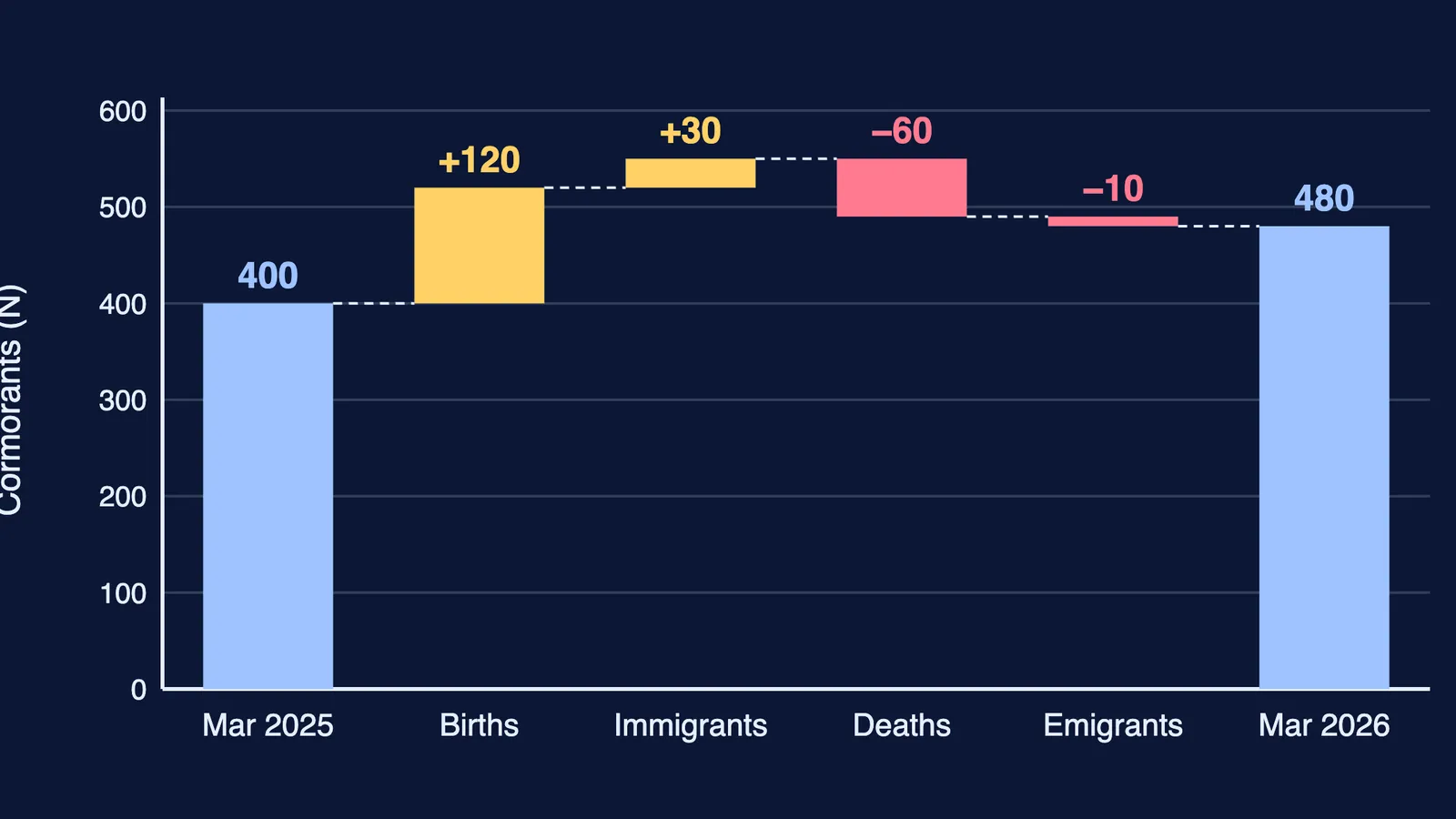
A Mysuru school eco-club counts the little cormorants at a lake every March. In March 2025 they count 400 birds, of which they estimate 220 are female. Over the year they record 120 chicks hatched, 60 deaths, 30 birds arriving from a tank that dried up and 10 ringed birds from the colony leaving to settle at another lake. One member writes: "Each cormorant has a birth rate of 0.3 per year." The teacher circles that line in red.
(i) Name the two processes that add to a population's density.
(ii) Find the per capita birth rate and death rate of the colony for the year.
(iii) What should the club expect to count in March 2026?
(iv) Why did the teacher circle the notebook line? Name two other attributes the club can report for the colony but not for one bird.
Answers.
(i) Natality and immigration.
(ii) Birth rate = 120/400 = 0.3 offspring per bird per year. Death rate = 60/400 = 0.15 deaths per bird per year.
(iii) Nt+1 = Nt + [(B + I) - (D + E)] = 400 + [(120 + 30) - (60 + 10)] = 400 + 80 = 480 birds.
(iv) An individual has births and deaths; only a population has a birth rate, which NCERT defines as per capita births. Two other population attributes: sex ratio (220/400 = 55 per cent female, 45 per cent male) and age distribution, which can be plotted as an age pyramid.
Case 2: What the field trip found on a farm
A Class 12 group from Thrissur visits an organic farm. Goats in a fallow plot graze everything except one weed, Calotropis. Leafless yellow threads of Cuscuta twine over the hedge, weakening the bushes. Near the cowshed, a crow is feeding a chick that is clearly a koel. The farmer releases a predatory insect each season to keep a sap-sucking pest in check instead of spraying.
(i) Goats avoid Calotropis because the plant: (a) has thorns (b) produces cardiac glycosides (c) is camouflaged (d) has no leaves.
(ii) Name the interaction between Cuscuta and the hedge plant, and give one adaptation of Cuscuta to it.
(iii) Why does a crow end up raising a koel chick?
(iv) What ecological principle is the farmer using? Why would a predator that ate every last pest be bad for the farmer in the long run?
Answers.
(i) (b). Calotropis makes highly poisonous cardiac glycosides, so cattle and goats do not browse on it; this is a chemical defence against herbivores.
(ii) Parasitism (+, -), with Cuscuta as an ectoparasite. It has lost its chlorophyll and leaves and takes its nutrition from the host plant.
(iii) Brood parasitism: the koel lays its eggs in the crow's nest and lets the crow incubate them. The koel's eggs have evolved to resemble the host's in size and colour, so the crow does not eject them.
(iv) Biological control rests on a predator's ability to regulate its prey population. An over-efficient predator can drive its prey extinct and then die out for lack of food, leaving nothing to check the next outbreak. That is why NCERT calls predators in nature "prudent".
Case 3: Why did a Paramecium culture stop doubling?
A Pune college student grows Paramecium in two flasks. Flask A gets fresh medium and space daily, and doubles in number every day. Flask B is closed: it starts at 50 cells per mL and she never adds food. Her day 4 count in flask B is about 413 cells per mL. Over the next week growth slows and the count levels off near 800 cells per mL.
(i) What does the level of about 800 cells per mL represent for flask B?
(ii) Use flask A's doubling to find r, the intrinsic rate of natural increase.
(iii) Growing like flask A, what would flask B hold on day 4? Why is the real count lower?
(iv) Using dN/dt = rN(K - N)/K with r from (ii) and K = 800 cells per mL, find the growth rate in flask B at 400 and at 760 cells per mL, and say what the two values show.
Answers.
(i) The carrying capacity, K, the largest population the flask's resources can support; the count levelling off there is the asymptote of the sigmoid curve.
(ii) Nt = N0 e^rt with Nt = 2N0 and t = 1 day gives e^r = 2, so r = ln 2 ≈ 0.693 per day.
(iii) 50 × e^(0.693 × 4) = 50 × 2^4 = 800 cells per mL. Flask B's resources are limited, so individuals compete for them and growth is logistic, not exponential.
(iv) At N = 400: 0.693 × 400 × (400/800) ≈ 139 cells per mL per day. At N = 760: 0.693 × 760 × (40/800) ≈ 26 cells per mL per day. As N nears K, (K - N)/K falls from 0.5 to 0.05, so growth decelerates and the curve flattens towards the asymptote.
How do you answer case-study questions on populations?
Underline every count first. Most sub-questions here hang on one number: births, a doubling time or K.
Say "per capita". A birth rate is births divided by population, in units such as "per bird per year".
Read the resources to pick the model. Unlimited food and space: exponential, J-shaped. A closed habitat: logistic, sigmoid, with K.
Match each organism to NCERT's example: Calotropis to chemical defence, Cuscuta to ectoparasite, koel and crow to brood parasitism, a released predator to biological control.
For a method across chapters, see how to answer case-based questions in board exams, then test the tricky statements with our ecology assertion-reason questions. If the J and S curves still blur together, the Fermi Simulation Lab has interactive simulations for the ideas that are easier to see than to read.


