

On this page
The National Testing Agency (NTA) has shifted away from simple factual recall in biology, replacing multiple-choice items with statement-based logic. The *Organisms and Populations* chapter in the NCERT Class 12 Biology syllabus is a prime target for this format because it is full of interlocking rules.
When you sit down to solve ecology questions, you are not just recalling facts; you are testing your understanding of cause and effect. A frequent pitfall is treating the Reason statement as a standalone fact rather than a causal explanation for the Assertion.
What is the Option B trap in assertion-reason questions?
The most common mistake students make is falling for the "Option B" trap. This happens when both the Assertion and the Reason are correct statements copied directly from the textbook, but the Reason does not actually explain the Assertion.
To beat this, use the independent evaluation method. Read the assertion alone to check its truth. Read the reason alone. If both are true, join them with the word "because".
If you find yourself stuck distinguishing whether a reason explains an assertion or just sits next to it, the Fermi Problem Library has worked problems with a step-by-step solver that explains the reasoning rather than printing an answer.
How do you read the Verhulst-Pearl logistic growth curve?
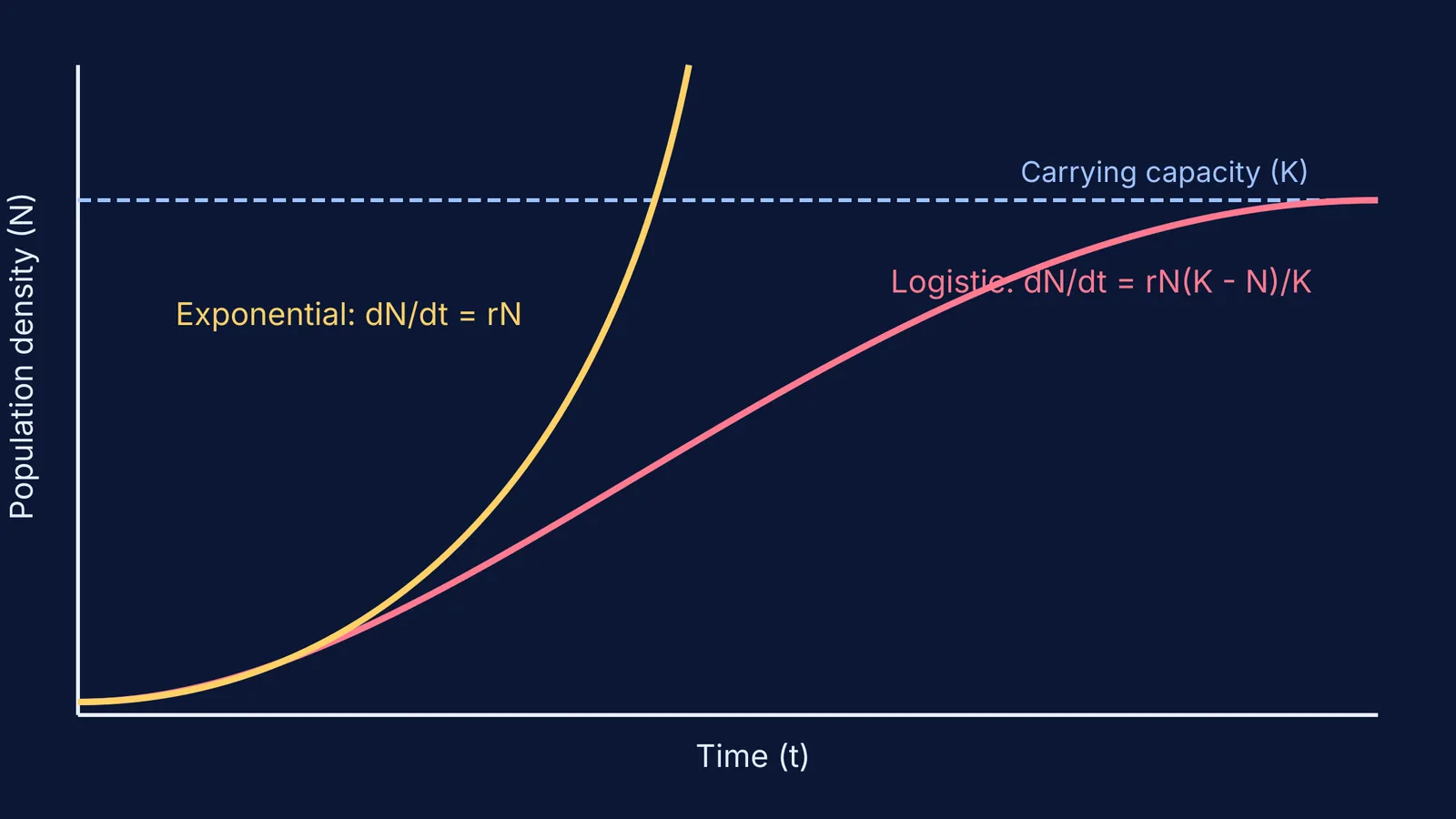
Population growth is a favourite target because it pits two models against each other: exponential growth and logistic growth. The Verhulst-Pearl equation for logistic growth is dN/dt = rN(K - N)/K, where K is the carrying capacity and N is the population density.
Consider this classic question format:
Assertion: The logistic growth model is considered more realistic than the exponential growth model.
Reason: Resources for growth for most animal populations are finite and become limiting sooner or later.
Are both true? Yes. Does the fact that resources are finite explain *why* the logistic model is more realistic? Yes. The (K - N)/K term represents environmental resistance, creating an S-shaped (sigmoid) curve rather than a J-shape. Therefore, the reason is the correct explanation.
If you need to visualise why the curve flattens out as N approaches K or review similar population models, the Fermi Concept Library has every concept in physics, chemistry, biology, mathematics and computing, each with its own lesson and its place in the map.
What are the traps in population interactions?
The population interactions table uses signs (+, -, 0) to denote beneficial, detrimental and neutral outcomes. For instance, mutualism is (+, +), competition is (-, -), and commensalism is (+, 0).
A classic trap plays on the definition of amensalism versus competition.
Assertion: Amensalism is an interaction where one species is harmed and the other is unaffected.
Reason: An example of amensalism is the interaction between *Penicillium* and bacteria, where the bacteria are killed but the fungus remains unaffected.
Both are true. But does the example *explain* the definition? No, it merely illustrates it. This is an Option B answer. The example is not the underlying biological mechanism that dictates the definition.
Another trap involves competition and resource availability:
Assertion: In competition, it is not necessary that resources are always limiting.
Reason: In interference competition, the feeding efficiency of one species might be reduced due to the inhibitory presence of the other species, even if resources are abundant.
Here, the Reason directly explains the Assertion. It is the exact biological mechanism behind the statement, making it an Option A answer.
Another common pitfall involves Gause's Competitive Exclusion Principle, which states that closely related species competing for the same limiting resources cannot coexist indefinitely. An assertion might claim that competition always leads to extinction, while the reason introduces resource partitioning—where species evolve different foraging patterns. If resource partitioning occurs, exclusion is avoided, making the assertion false. Reading every constraint in a rule is critical.
Understanding these interactions is as crucial to ecology as grasping evolution seen through genetics is to biology, or knowing how pesticides build up in food chains is to environmental science.
How do negative keywords change the answer?
Examiners often use extreme keywords like "only," "always," or "never" to turn a true concept into a false statement. For instance, stating that exponential growth "always" occurs in nature is false, even though the mathematical equation is valid.
Similarly, questions using "not" or "except" increase your cognitive load. You must read these statements twice to ensure you are not misinterpreting a double negative.
Consider this example regarding predation:
Assertion: Predators are not prudent in nature.
Reason: If a predator is too efficient and overexploits its prey, the prey might become extinct.
This contradicts the textbook stance that predators act prudently to avoid overexploiting their prey. Here, the assertion is false, but the reason is a true statement describing what would happen if they were not prudent.
When revising, do not just memorise the terms. Focus on why an organism behaves a certain way in its environment and why certain ecological rules hold true.


