On this page
Open a switchboard, or reach the end of the Class 10 magnetism chapter, and you meet three wires. Each has a fixed colour and a fixed job, and board exams ask about both.
What colour are the live, neutral and earth wires?
Section 12.4, Domestic electric circuits, in the NCERT Class 10 Science textbook, Chapter 12, Magnetic Effects of Electric Current, gives the colour code:
Live wire: usually red insulation. NCERT also calls it the positive wire.
Neutral wire: black insulation. NCERT also calls it the negative wire.
Earth wire: green insulation.
The same NCERT chapter says Indian homes receive AC power at 220 V and 50 Hz, and that the potential difference between live and neutral is 220 V. Since the supply is alternating, "positive" and "negative" are only names: the live wire's voltage swings back and forth relative to neutral 50 times a second.
What does each wire actually do?
Live carries the current from the supply to the appliance.
Neutral completes the circuit and carries the current back. India's safety rules call it the "earthed neutral conductor" (CEA Measures relating to Safety and Electric Supply Regulations, 2023, regulation 17). Because it is connected to earth, it stays close to earth's potential.
Earth carries no current in normal use. According to NCERT, it runs to a metal plate deep in the earth near the house and is joined to the metal body of appliances such as an iron, toaster or refrigerator. If current leaks to the body, this low-resistance path keeps it at earth's potential, so the user may not get a severe shock.
NCERT also describes two separate circuits in a typical home: a 15 A circuit for high-power appliances such as geysers and air coolers, and a 5 A circuit for bulbs and fans (NCERT Chapter 12). Appliances on each circuit sit side by side across live and neutral, which is why household appliances are connected in parallel.
Why must the switch sit on the live wire?
Picture changing a bulb with the switch off.
Switch on the live wire. Switching off cuts the bulb off from live. It is now joined only to neutral, which is close to earth's potential, so touching the holder puts almost no potential difference across your body.
Switch on the neutral wire. The bulb goes dark because the circuit is broken on the far side, but the holder is still joined to live. If you are standing on the floor, touching the holder can put nearly the full supply voltage across your body and drive a current through you to the ground.
That is why Indian safety rules allow no cut-out, switch or circuit breaker in the earthed neutral conductor unless it is a linked switch that breaks live and neutral at the same time (CEA Regulations, 2023, regulation 17). The fuse sits on live for the same reason. For what makes a fuse or breaker act, see short circuit versus overloading and why a miniature circuit breaker trips.
How do you draw the labelled circuit in an exam?
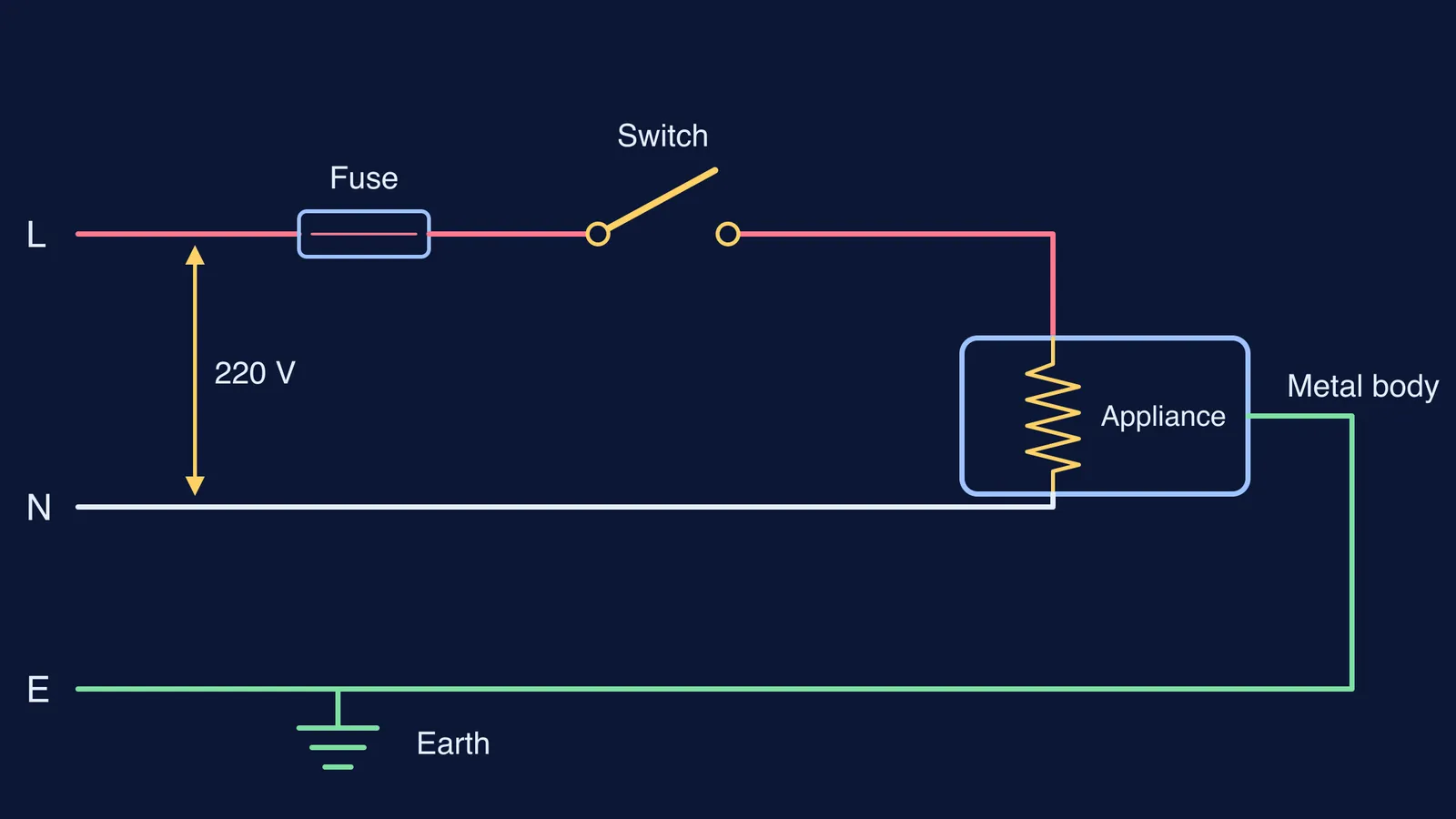
This checklist follows section 12.4 and Figure 12.15 of the NCERT chapter; the diagram above shows steps 1 to 5.
Draw three long horizontal lines and label them live (red), neutral (black) and earth (green). Write 220 V between live and neutral.
Put the fuse in series on the live line, close to the supply.
Put the switch on the live line, between the fuse and the appliance.
Connect the appliance between live and neutral.
Join the appliance's metal body to the earth line, and end the earth line in an earth symbol.
For more appliances, add each one in parallel across live and neutral, with its own switch on live.
Now a quick numerical from the same NCERT chapter: what happens if a 2 kW oven runs on a 5 A domestic circuit at 220 V? The current is I = P/V = 2000/220, which is about 9.1 A, nearly twice the circuit's rating. That is overloading, so the fuse should melt and break the circuit.
Some circuit ideas are easier to see than to read; the Fermi Simulation Lab has interactive simulations for them.
Does every house follow these colours?
Not always. Cables made to the international IEC scheme use brown for live, blue for neutral and green-and-yellow for earth (IEC 60446 colour code on Wikipedia). A colour tells you what a wire should be, not what it is; only an electrician with a tester should decide which wire is live.
One question worth asking at home: does the distribution box have a residual current device? Indian rules say a domestic installation must use one with a residual operating current of no more than 30 mA (CEA Regulations, 2023, regulation 44). A parent can ask the electrician to point it out on the next visit.
If the heating effect of current or Joule's law still feels shaky, each has its own lesson in the Fermi Concept Library.