

On this page
In our homes, electric power arrives through the main supply at a potential difference of 220 V, according to NCERT Class 10 Science. When everything works correctly, appliances draw only the current they need. However, when things go wrong, currents can spike to dangerous levels, causing wires to overheat and potentially start a fire.
Two of the most common electrical faults in domestic circuits are short circuits and overloading. While both result in excessive current and trigger safety devices like fuses, they happen for completely different reasons.
What is a short circuit?
Your domestic supply uses two main wires to deliver power: the live wire (usually with red insulation) at 220 V, according to NCERT, and the neutral wire (black insulation) at zero potential. Under normal conditions, current flows from the live wire, through the resistance of an appliance, and out through the neutral wire.
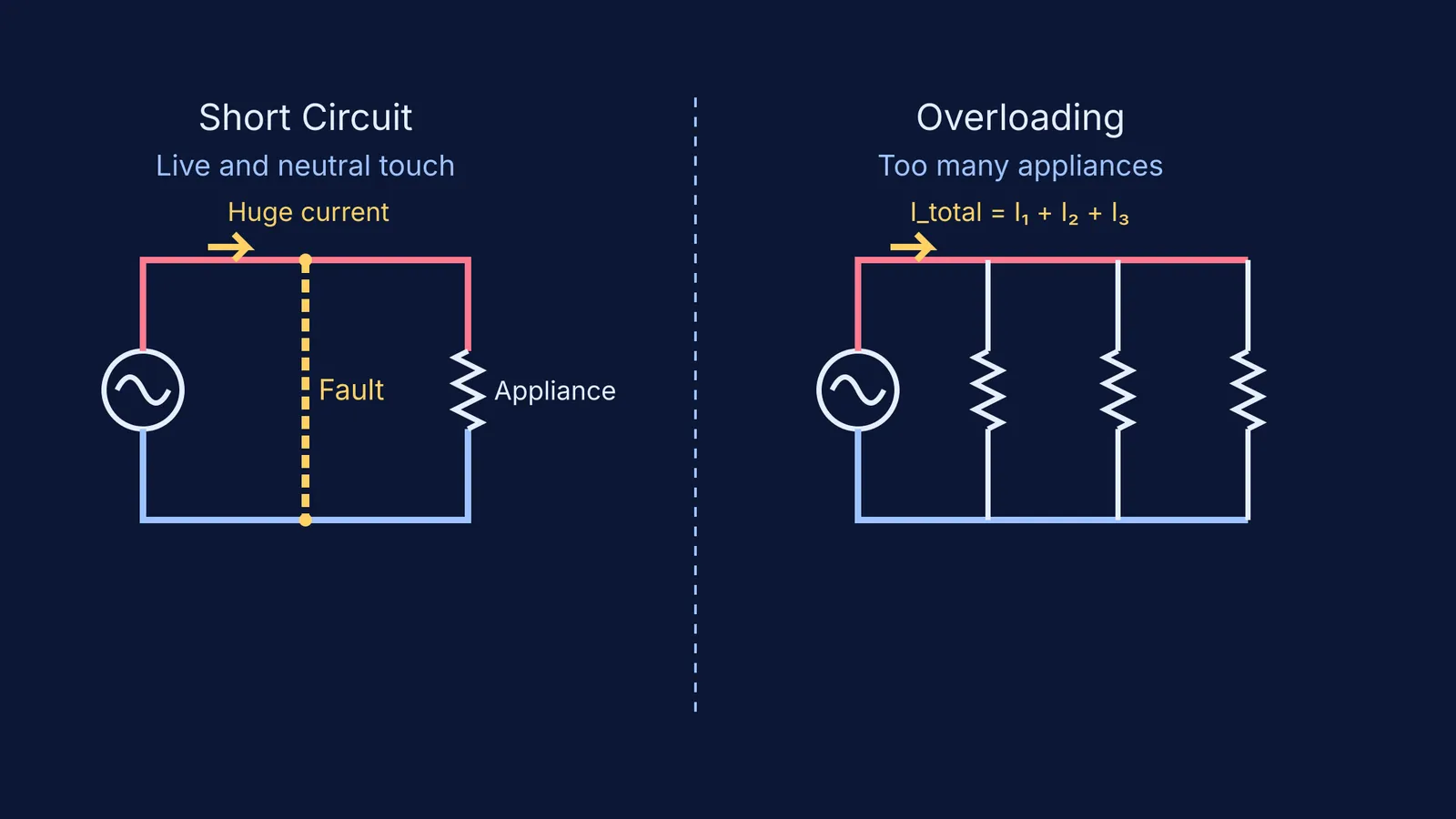
A short circuit occurs when the live wire and the neutral wire come into direct contact with each other. This usually happens because the plastic insulation on the wires is damaged, or there is an internal fault in an appliance. Because the current bypasses the appliance, it faces almost zero resistance.
According to NCERT Class 10 Science, this sudden drop in resistance causes the current in the circuit to increase abruptly. This massive surge of electricity generates intense heat and sparking, which is why short-circuiting is a major cause of electrical fires.
What is overloading?
Overloading is not about wires touching; it is about asking a single circuit to do too much work. In a house, all appliances are connected in parallel so they all receive the full 220 V, as described by NCERT. However, every time you add an appliance in parallel, the total resistance of the circuit decreases, causing the main wire to draw more current.
Domestic circuits are designed to carry a specific maximum current safely. In India, homes typically have a 5 A circuit for low-power items like bulbs and fans, and a 15 A circuit for high-power heating appliances like geysers and air conditioners, as specified by NCERT Class 10 Science.
Overloading occurs when too many electrical appliances of high power rating are switched on at the same time on a single line. The total current drawn from the mains exceeds the safe capacity of the wires. Even though the current does not spike instantly to infinity like it does in a short circuit, it is still high enough to heat the wires to a very high temperature over time.
If you are struggling to picture how adding parallel paths lowers the total resistance, you can explore the Fermi Concept Library, where every concept in physics has its own lesson and its place in the map. You can also see how this works in complex grids by reading about the infinite ladder of resistors.
What is the difference between short circuit and overloading?
While studying for Class 10 boards, keeping the distinctions clear will help you answer both conceptual questions and numericals.
The cause: A short circuit is a physical fault where live and neutral wires touch directly. Overloading is a usage fault caused by connecting too many high-power devices to one socket or circuit.
The resistance: In a short circuit, resistance drops to near zero. In overloading, the resistance decreases as devices are added in parallel, but it remains a finite number.
The current: A short circuit creates a sudden, massive spike in current. Overloading creates a steady current that is simply higher than the wire's safe limit.
If you want to understand how currents distribute when a circuit splits into multiple paths, our guide on solving circuits by assigning voltages is a great place to start.
How do fuses and MCBs protect the circuit?
Both short circuits and overloading lead to dangerous Joule heating in the wires. To prevent damage to the appliances and the house, a safety device called an electric fuse (or a Miniature Circuit Breaker, MCB) is connected in series with the live wire at the start of the circuit.
The fuse contains a thin piece of wire with a low melting point. If the current exceeds the circuit's safe limit—whether due to a sudden short circuit or a gradual overload—the heat generated inside the fuse melts it. This breaks the circuit and stops the flow of electricity instantly. Modern MCBs do the same job by tripping a switch when the current gets too high, allowing you to reset them once the fault is cleared.
A checklist for avoiding overloads
Use the right socket: Always plug geysers, microwaves, and electric irons into the larger 15 A sockets, following NCERT guidelines.
Avoid multi-plugs for heat: Never run multiple heating appliances from a single extension board.
Watch for signs: If a plug feels warm to the touch or a fuse blows repeatedly, you are likely overloading the line.


