

On this page
When too many appliances run at once, or when a frayed wire causes a spark, the lights go out. A switch in your distribution board has flipped. That switch is a Miniature Circuit Breaker (MCB), an essential safety device designed to cut off power before wires melt and start a fire.
An MCB is technically a *thermal-magnetic* circuit breaker. It contains two entirely different physical mechanisms to sense when a current is dangerously high. If you want to see how these forces interact visually, the Simulation Lab offers interactive simulations for the ideas that are easier to see than to read.
Why does an MCB trip and cut off power?
An MCB trips to cut off power because it detects either a moderate but prolonged "overload" or a massive, sudden "short circuit." Because these two electrical faults behave differently, the MCB uses two separate mechanisms: a thermal bimetallic strip for overloads, and a magnetic solenoid for short circuits.
How does the bimetallic strip handle overloading?
An "overload" happens when you draw slightly more current than a circuit is rated for—for example, running a high-power heater, a microwave and a hair dryer on the same line. The current might be 1.5 to 2 times the safe limit (Wikipedia).
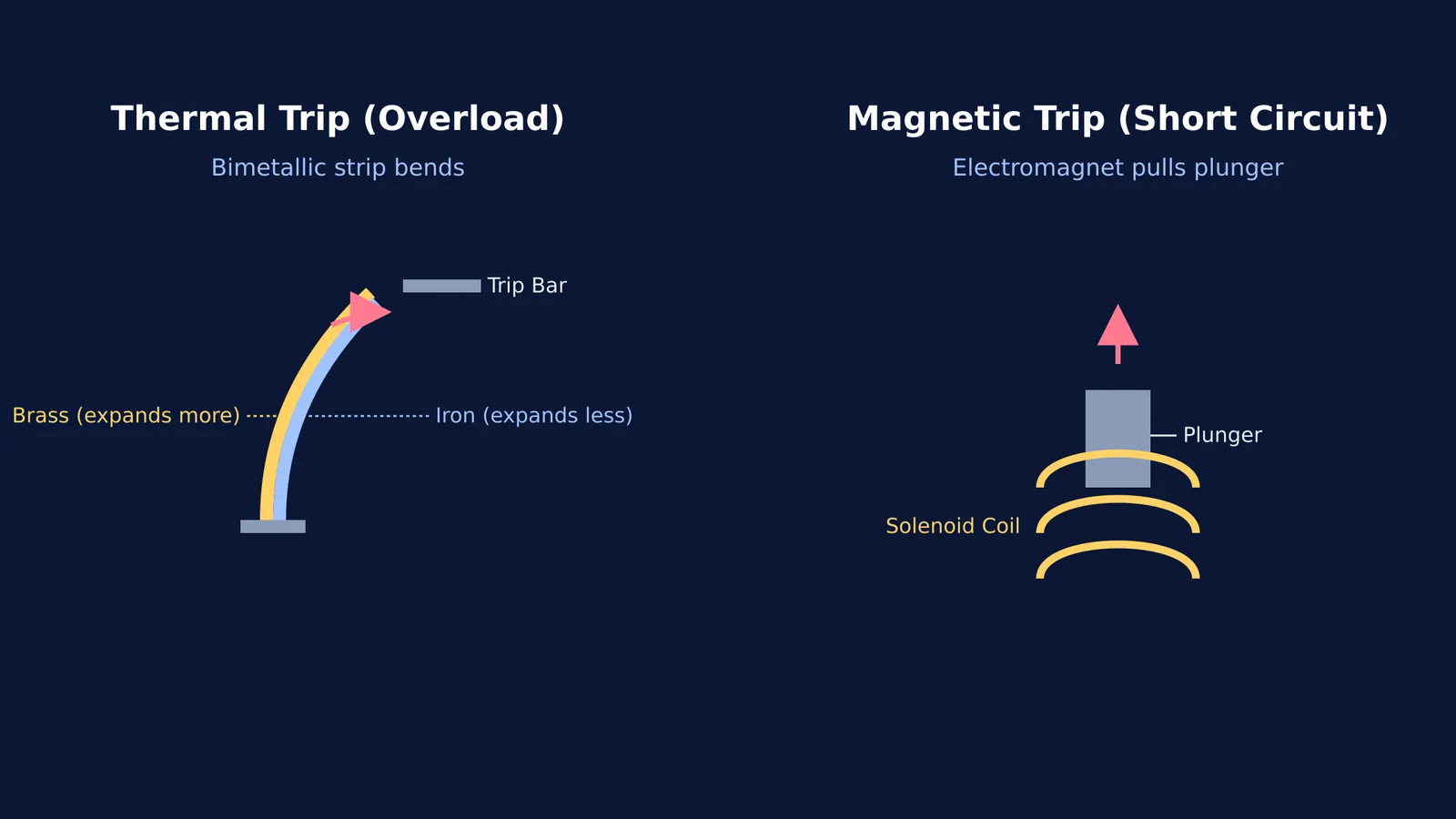
To handle this, the MCB uses a thermal mechanism: a bimetallic strip. This strip is made of two different metals, often brass and iron, welded together. Because metals have different coefficients of linear expansion—a property that also causes a pendulum clock losing time in summer—the brass expands more than the iron when heated (Wikipedia).
As the excess electrical current slowly heats the strip, it begins to curl. Once it bends far enough, it pushes against the trip bar, breaking the circuit.
This is an intentional *inverse-time characteristic*: a small overload takes minutes to heat the strip enough to bend it, while a larger overload takes seconds. This delay is crucial because it allows harmless, temporary spikes in current (like the split-second "inrush" when a refrigerator compressor motor starts) to pass without causing a nuisance trip.
How does the electromagnet stop a short circuit?
A "short circuit" is much more dangerous. It occurs when a live wire touches a neutral or earth wire directly, bypassing the normal resistance of appliances. In an instant, the current spikes to ten or even a hundred times the normal level (Wikipedia).
Waiting for a bimetallic strip to heat up and bend would take too long; the wiring would melt and catch fire. Instead, the MCB relies on its magnetic mechanism: a solenoid (a coil of wire) that acts as an electromagnet (Wikipedia).
The main current flows directly through this coil. The strength of the magnetic field inside a solenoid depends directly on the current flowing through it. Under normal load conditions, the magnetic field is too weak to move the heavy, spring-loaded plunger. But when a short circuit multiplies the current, the magnetic force scales up proportionally. This instantly generates a powerful magnetic field, governed by the same principles as the circulating E-field in a solenoid.
The intense magnetic pull overcomes the spring tension in milliseconds. The moving plunger directly strikes the trip mechanism, forcing the contacts apart and breaking the circuit. Under the international IEC 60898-1 standard, an MCB must clear a short circuit in less than 0.1 seconds (100 milliseconds) (elehub.com).
What happens to the electrical arc?
Even after the contacts are forced open, the danger is not entirely over. When a massive current is interrupted suddenly, the electricity can jump across the small air gap between the separating contacts, creating a superheated plasma called an electrical arc.
To safely extinguish this arc, an MCB contains an arc chute—a series of parallel metal plates. The magnetic field created by the short circuit actually helps blow the arc away from the contacts and into the chute. The plates split the single massive arc into several smaller, cooler arcs, increasing the total voltage required to sustain it until it collapses completely. This entire arc-quenching process happens inside the casing before you even realize the power has gone out.


