On this page
NCERT defines the covalent radius of an element as half the bond length in its own molecule, and uses chlorine as the example: half of 198 pm gives 99 pm. Apply the same rule to fluorine and you get about 71 pm, because the measured F–F bond is 141.2 pm. Yet NCERT's tables give fluorine 64 pm. The two numbers come from two ways of measuring the same atom, and fluorine is the one halogen where they disagree. Here is the check you can do with NCERT's own data, the reason for the gap, and what to write in the exam.
What does NCERT say fluorine's covalent radius is?
In the Reprint 2026-27 of NCERT Class 11 Chemistry, Unit 3 (page 86), the covalent radius is the value calculated from "the distance between two atoms when they are bound together by a single bond in a covalent molecule". The example: "the bond distance in the chlorine molecule (Cl₂) is 198 pm and half this distance (99 pm), is taken as the atomic radius of chlorine."
The numbers that follow:
Table 3.6(b), Group 17: F 64, Cl 99, Br 114, I 133, At 140 pm.
Unit 4, Table 4.4 (covalent radii): H 37, F 64, Cl 99, Br 114, I 133 pm.
Unit 4, Table 4.3 (bond lengths): H₂ 74, F₂ 144, Cl₂ 199, Br₂ 228, I₂ 267 pm.
Double each radius and compare it with the bond length in Table 4.3:
H: 2 × 37 = 74 pm; table 74 pm. Difference 0.
Cl: 2 × 99 = 198 pm; table 199 pm. Difference 1 pm.
Br: 2 × 114 = 228 pm; table 228 pm. Difference 0.
I: 2 × 133 = 266 pm; table 267 pm. Difference 1 pm.
F: 2 × 64 = 128 pm; table 144 pm. Difference 16 pm.
Four elements fit the definition to within 1 pm. Fluorine misses by 16.
What is the real F–F bond length?
The most precise value comes from spectroscopy. The NIST Chemistry WebBook lists the equilibrium bond length of F₂ in its ground state as 1.41193 Å, that is 141.2 pm. NCERT's 144 pm is about 3 pm longer than this, so "about 142 pm" is the safer figure to remember.
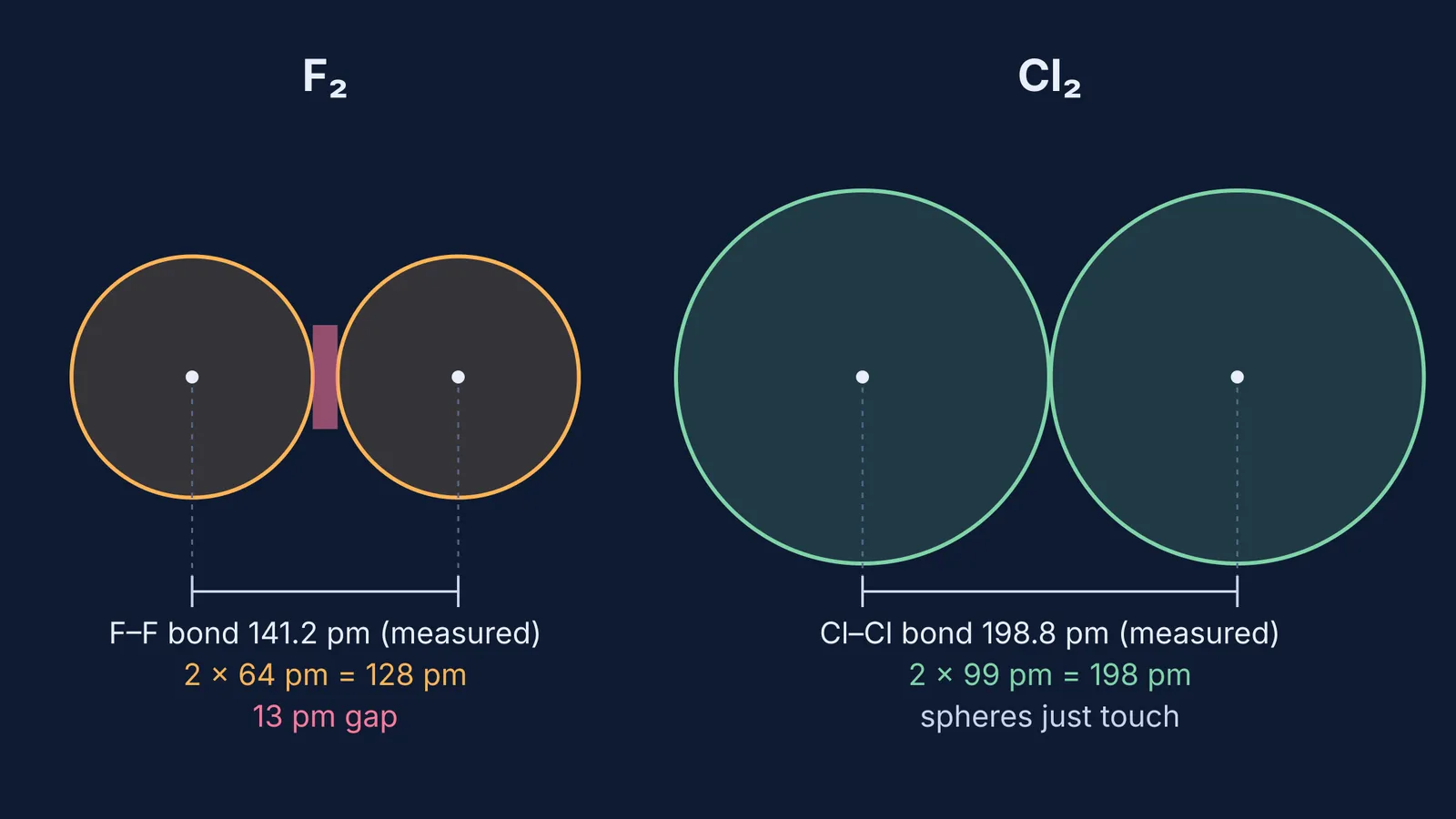
By NCERT's own definition, then, fluorine's radius is 141.2 ÷ 2 = 70.6 pm, about 71 pm. The same check for chlorine works: NIST gives 198.8 pm for Cl₂, and 198.8 ÷ 2 = 99.4 pm, which rounds to NCERT's 99.
The hero diagram draws both to scale: the chlorine spheres just touch, while the fluorine spheres leave a gap of 141.2 − 128 = 13 pm.
Worked example: which radius fits fluorine's other bonds?
A covalent radius is only useful if you can add two of them and predict a bond length. So test both candidate values for fluorine against bonds to another atom. NCERT's Table 4.3 gives the hydrogen halide bond lengths, and Table 4.4 gives H = 37 pm.
Predict each H–X bond from the radii. H–F: 37 + 64 = 101 pm. H–Cl: 37 + 99 = 136 pm. H–Br: 37 + 114 = 151 pm. H–I: 37 + 133 = 170 pm.
Look up the measured values (Table 4.3). HF 92, HCl 127, HBr 141, HI 160 pm.
Find the difference. HF −9, HCl −9, HBr −10, HI −10 pm.
Read the pattern. All four bonds are about 9 to 10 pm shorter than the sum of the radii. Bonds between atoms of different electronegativity often come out a little shorter than the simple sum, so a steady shortfall is expected. The point is that fluorine, with 64 pm, behaves exactly like the other halogens.
Try 70.6 pm instead. H–F would be predicted at 37 + 70.6 = 107.6 pm, and the shortfall becomes about 16 pm. Fluorine now stands out from the group.
So 64 pm describes fluorine well when it is bonded to other atoms. The F–F bond is the odd one out.
Why is the F–F bond longer than two fluorine radii?
The usual explanation is the same one that makes the F–F bond weak. Each fluorine atom in F₂ carries three lone pairs. Fluorine is so small that, at bonding distance, the lone pairs on the two atoms are pushed close together and repel each other. The atoms settle a little farther apart than they otherwise would, and the bond is both longer and weaker than the trend predicts. The bond-energy side of this story is in why the F–F bond is weaker than Cl–Cl.
Chlorine's lone pairs sit in larger 3p orbitals, farther from each other, so Cl–Cl is not stretched and half the bond length is a fair radius. In H–F, hydrogen has no lone pairs, so the crowding disappears and fluorine's smaller radius shows. The same "too small, too crowded" theme explains a third fluorine exception, covered in why chlorine has a more negative electron gain enthalpy than fluorine.
Is NCERT's 64 pm wrong?
No. It is a legitimate covalent radius, and for most purposes a better one. A radius is meant to be added to other radii, and the worked example shows that 64 pm does that job for fluorine much better than 70.6 pm. NCERT does not say how its 64 pm value was obtained, but it clearly was not found by halving F₂.
What does not quite fit is the wording. NCERT's definition, half the bond in the element's own molecule, gives 99 pm for chlorine and about 71 pm for fluorine. Its table uses 64 pm for fluorine. The radius is fine; the definition just does not produce it.
"Atomic radius" is never one fixed number; see covalent, metallic and van der Waals radius: which to use.
If the idea of a radius as something you derive from bond lengths still feels slippery, the Fermi Concept Library gives each chemistry concept its own lesson and its place in the map.
How should you use this in JEE and NEET answers?
In MCQs on the halogen size order, nothing changes: F is still the smallest. Both 64 and 71 pm are well below chlorine's 99 pm.
In "give reasons" questions on F₂, link the long bond and the weak bond to the same cause, lone-pair repulsion. Examiners like answers that connect two facts.
For JEE Main and Advanced practice that tests these trend exceptions alongside the rest of inorganic chemistry, Fermi Test Prep covers both exams with an AI tutor.
Quick checklist
NCERT defines covalent radius as half the bond length in the element's own molecule.
NCERT lists F as 64 pm, but half of the measured F–F bond (141.2 pm) is 70.6 pm.
For H, Cl, Br and I, NCERT's radii double to its bond lengths within 1 pm. Fluorine misses by 16 pm against its own table.
With 64 pm, fluorine fits the H–X bond pattern like the other halogens.
Lone-pair repulsion stretches and weakens the F–F bond.
In exams, use 64 pm for trends and about 142 pm for the F₂ bond length.