On this page
Fluorine is the most electronegative element (4.0 on the Pauling scale in NCERT Class 11 Chemistry, Unit 3), yet in NCERT's electron gain enthalpy table chlorine releases more energy when it gains an electron. The reason is a contest between nuclear attraction and electron-electron repulsion, and it also explains oxygen versus sulfur.
Why does chlorine have a more negative electron gain enthalpy than fluorine?
Electron gain enthalpy (ΔegH) is the enthalpy change when a neutral gaseous atom gains an electron to become a negative ion, X(g) + e⁻ → X⁻(g), as defined in NCERT Class 11 Chemistry, Unit 3. A more negative value means more energy is released.
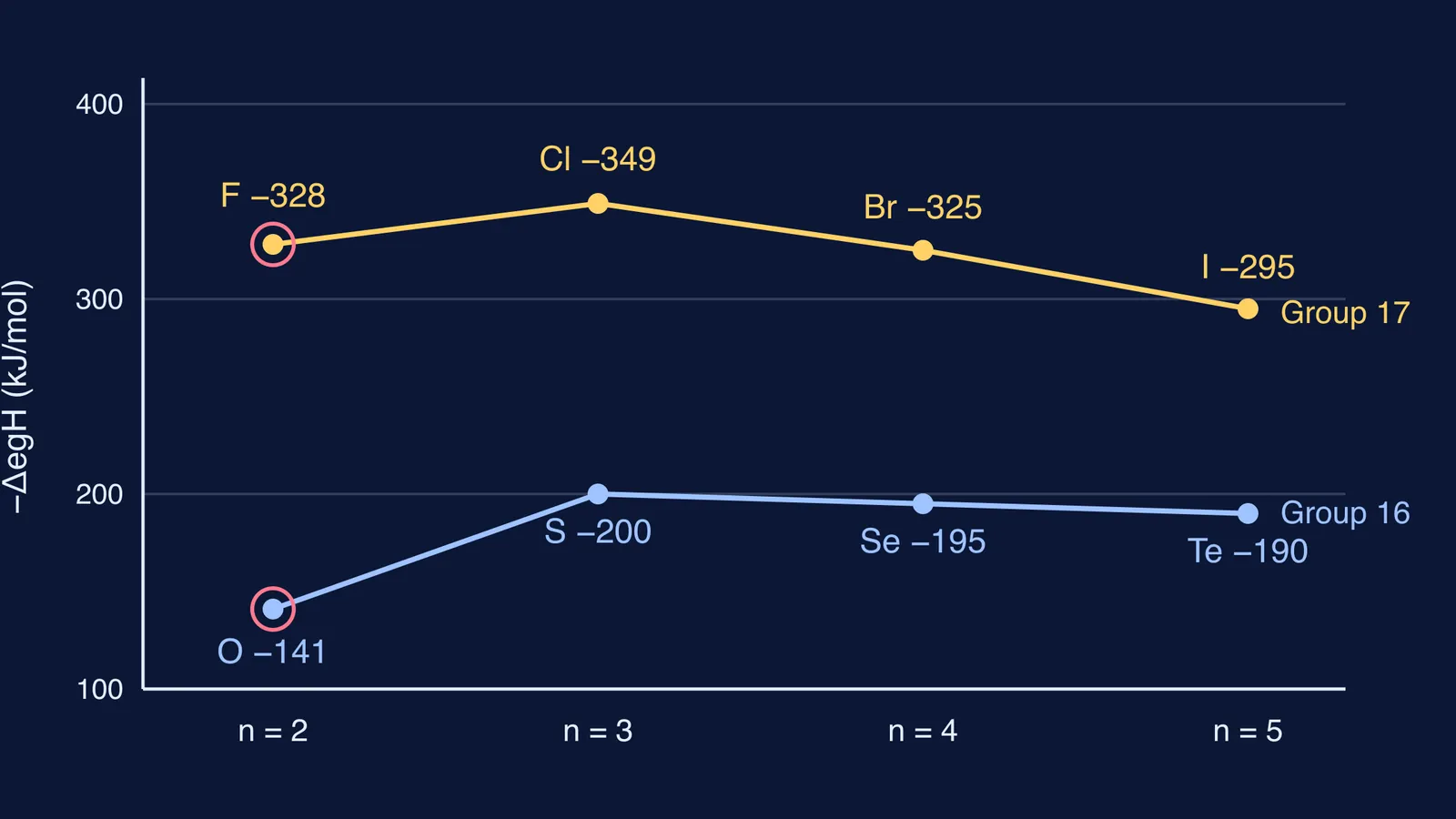
In NCERT's Table 3.7, chlorine's electron gain enthalpy is −349 kJ/mol and fluorine's is −328 kJ/mol (NCERT Class 11, Unit 3). Further down group 17, the same table gives bromine −325 kJ/mol and iodine −295 kJ/mol, which is the normal downward trend.
The general rule says the smaller atom should win, because the incoming electron gets closer to the nucleus. Fluorine (2s² 2p⁵) breaks the rule because its new electron enters the n = 2 shell, which is compact and already holds seven electrons. NCERT says the added electron "goes to the smaller n = 2 quantum level and suffers significant repulsion from the other electrons present in this level." In chlorine (3s² 3p⁵), the electron enters n = 3, where it "occupies a larger region of space and the electron-electron repulsion is much less."
So fluorine's nucleus pulls harder, but the crowding hands part of that energy back; chlorine loses less to repulsion.
Does the same thing happen with oxygen and sulfur?
Yes. NCERT's Table 3.7 lists oxygen at −141 kJ/mol and sulfur at −200 kJ/mol, with selenium at −195 and tellurium at −190. The textbook gives one reason for both pairs: the electron gain enthalpy of O or F "is less negative than that of the succeeding element" because of repulsion in the n = 2 level.
Worked with those numbers:
Fluorine to chlorine: −349 − (−328) = −21, so chlorine releases 21 kJ/mol more.
Oxygen to sulfur: −200 − (−141) = −59, so sulfur releases 59 kJ/mol more.
From period 3 downwards, both groups follow the usual trend: Cl → Br → I and S → Se → Te each become less negative.
In both groups the period-2 element is the odd one out.
If chlorine gains electrons more readily, why is F2 the stronger oxidising agent?
Because oxidising power in water depends on the whole journey from X2 gas to X⁻(aq), not one step. In NCERT Class 12 Chemistry's Table 2.1, the standard electrode potential for F2(g) + 2e⁻ → 2F⁻ is +2.87 V, against +1.36 V for Cl2 (NCERT Class 12, Unit 2).
You can see why by adding up three steps for ½X2(g) → X⁻(aq), using the per-mole figures on Chemguide's page on halogens as oxidising agents:
Split the molecule into atoms (atomisation): +79 kJ/mol for fluorine, +121 kJ/mol for chlorine. The F–F bond is unusually weak.
Add an electron: −328 kJ/mol for fluorine, −349 kJ/mol for chlorine. Chlorine wins this step by 21 kJ/mol.
Surround the ion with water (hydration): −506 kJ/mol for F⁻, −364 kJ/mol for Cl⁻. The tiny fluoride ion attracts water molecules very strongly.
The totals are −755 kJ/mol for fluorine and −592 kJ/mol for chlorine, so fluorine comes out 163 kJ/mol ahead despite losing step 2. This is a simplified enthalpy picture, but it shows which steps decide the result. We look at the first step in why the F–F bond is so weak, and at the whole group in why F2 is the strongest halogen oxidising agent.
How should you write this in a board or JEE answer?
A short answer can follow three steps:
State the data: ΔegH of Cl (−349 kJ/mol) is more negative than that of F (−328 kJ/mol).
Give the cause: fluorine's added electron enters the compact n = 2 (2p) shell and faces strong repulsion from the electrons already there.
Contrast: chlorine's 3p orbitals are larger, repulsion is less, so more energy is released.
If the question asks about F2 versus Cl2 as oxidants, add that the low F–F bond enthalpy and the very large hydration enthalpy of F⁻ outweigh fluorine's less negative electron gain enthalpy.
Two traps to avoid:
Writing "higher" without a sign. Write −349 and −328 so the examiner sees which you mean; our note on the electron gain enthalpy sign convention explains why books differ.
Saying fluorine "attracts electrons weakly". The attraction is strong; repulsion cancels part of it.
If shells or electron configurations still feel shaky, the Fermi Concept Library gives every chemistry concept its own lesson and its place in the map. For practice, the Fermi Problem Library has worked problems with a step-by-step solver that explains the reasoning rather than printing an answer.
Next time a question pairs fluorine with chlorine, or oxygen with sulfur, ask which step it is about before you pick a winner.