On this page
Coal comes out of the mine mixed with shale and stone. Burn it as it is and the rock turns into ash. Coking coal for steel plants has to be cleaned before use, and many coal-cleaning plants, called washeries, do it with a single idea from Class 11 fluids: put the mixture in a liquid whose density sits between coal and rock. The coal floats, the rock sinks. The interesting physics is in what that liquid is, how much powder it takes, and why some pieces take ages to make up their minds.
Why does coal float when stone sinks?
By Archimedes' principle, a piece in a liquid feels an upthrust equal to the weight of liquid it pushes aside. If the piece is less dense than the liquid, the upthrust wins and it floats. If it is denser, it sinks. Shape and size do not change which way it goes, only how fast. (For the same rule applied to timber, see why most wood floats but some sinks.)
The densities are well apart. The Kentucky Geological Survey gives coal a specific gravity of about 1.2 to 1.5 and shale about 2.4 to 2.8. Water, at 1.0, is too light: both would sink. You need a liquid of density around 1.5.
What is the "heavy liquid" in a coal washery?
True heavy liquids exist, but they cost too much and are unpleasant to handle by the tonne. Washeries make a fake one instead: very finely ground magnetite (Fe₃O₄), with a specific gravity of about 5.2 according to the same survey page, stirred into water. The grains are so small that they settle only slowly, and a coal lump the size of a coin feels the mixture as a liquid with the average density. Plants adjust that density by adding or removing magnetite, and recover the magnetite afterwards with magnets so it can be reused.
This is called dense-medium (or heavy-medium) separation. Large lumps go through a bath or drum; smaller pieces go through cyclones, which come up below.
How much magnetite makes a medium of density 1.5?
Let φ be the fraction of the volume taken by magnetite. The mixture's density is the volume-weighted average:
ρ_m = φ ρ_mag + (1 − φ) ρ_w
so φ = (ρ_m − ρ_w)/(ρ_mag − ρ_w)
Worked example, with ρ_w = 1000 kg/m³, ρ_mag = 5200 kg/m³ and a target ρ_m = 1500 kg/m³:
φ = (1500 − 1000)/(5200 − 1000) = 500/4200 = 0.119.
Magnetite in one cubic metre: 0.119 × 5200 = 619 kg.
Water in the same cubic metre: (1 − 0.119) × 1000 = 881 kg.
Check: 619 + 881 = 1500 kg in 1 m³. Correct.
So about 12% of the volume, but over 40% of the mass, is magnetite. Raising the cut to 1.6 needs φ = 0.143, or 743 kg per cubic metre; to 1.8, 990 kg.
Why do some pieces take so long to sort?
Not every piece is pure coal or pure rock. Many are coal with rock grown through them, with densities close to the cut. These are called near-gravity material. Upthrust and weight nearly cancel on them, so they move slowly.
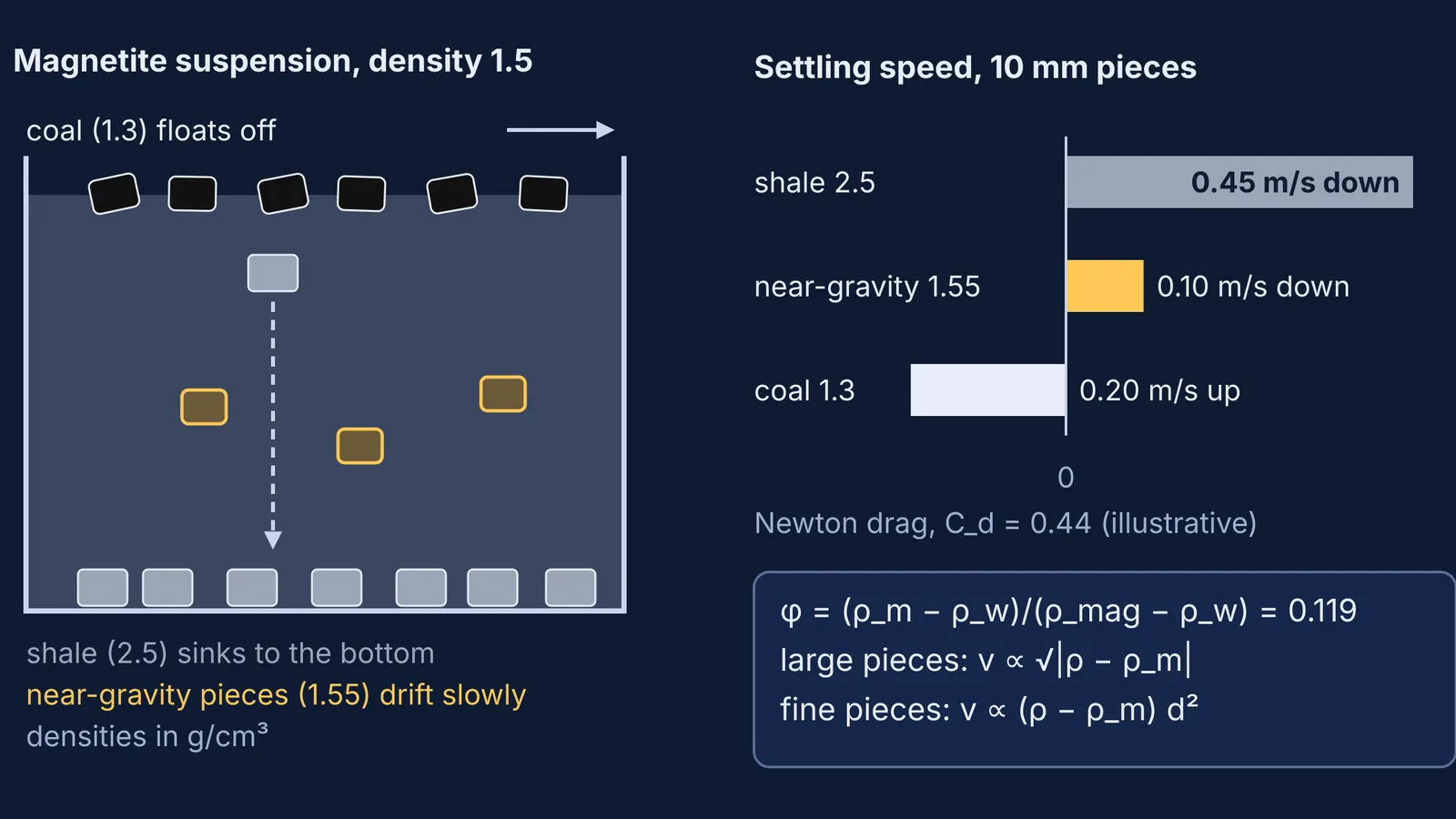
For a lump of about 10 mm moving fast enough for drag to go as v² (Newton's drag law), the terminal speed is:
v = √(4 g d |ρ − ρ_m| / (3 C_d ρ_m))
Take g = 9.81 m/s², d = 0.010 m, ρ_m = 1500 kg/m³ and C_d = 0.44 (an illustrative textbook value for a sphere; real lumps are not spheres):
Shale, ρ = 2500: |Δρ| = 1000 kg/m³, v = √(4 × 9.81 × 0.010 × 1000/(3 × 0.44 × 1500)) = 0.45 m/s, downwards.
Coal, ρ = 1300: |Δρ| = 200, v = 0.20 m/s, upwards.
Near-gravity piece, ρ = 1550: |Δρ| = 50, v = 0.10 m/s, downwards.
Speed goes as the square root of |Δρ|, so the shale moves √(1000/50) = 4.5 times faster than the near-gravity piece. To fall 0.5 m the shale needs about 1.1 s, the 1.55 piece about 5 s. Units: (m/s² × m × kg/m³)/(kg/m³) = m²/s², and the square root gives m/s.
Check the Reynolds number Re = ρ_m v d/μ before trusting this. Taking μ = 0.01 Pa s for the medium (an illustrative value; the real figure depends on how much magnetite there is and how hard it is stirred), Re is about 670 for the shale and 150 for the 1.55 piece. That is in the in-between range where the true drag coefficient is somewhat larger than 0.44, so real speeds are a little lower. The ratios are still a fair guide.
Why are fine coal particles sent to cyclones?
Shrink the pieces to 1 mm and drag becomes mostly viscous, so Stokes' law applies: v = (ρ − ρ_m) g d²/(18μ). The two drag laws are compared in terminal velocity with linear and quadratic drag. With the same illustrative μ = 0.01 Pa s:
Shale: v = 1000 × 9.81 × (0.001)²/(18 × 0.01) = 54.5 mm/s.
1.55 piece: v = 50 × 9.81 × 10⁻⁶/0.18 = 2.7 mm/s.
Coal: 10.9 mm/s, upwards.
Now speed goes as Δρ itself, not its square root, so the near-gravity piece is 20 times slower than shale. The shale's Re is about 8, so Stokes' law overstates its speed, but the near-gravity piece (Re about 0.4) is well inside Stokes' range. A bath would take far too long.
The fix is to replace g with a larger acceleration. In a dense-medium cyclone the slurry spins, and the centripetal acceleration v²/r takes the place of g. A tangential speed of 5 m/s at a radius of 0.05 m (illustrative numbers) gives 500 m/s², about 51 g, so every settling speed in the Stokes range goes up about 51 times. A 2023 study in Minerals describes the dense-medium cyclone as the most efficient equipment for fine coal, and recommends a lower size limit of about 0.2 mm, because smaller particles need much higher feed pressures. Below that, plants use other methods, such as froth flotation, which sorts fine grains by bubbles.
Why does this matter for Indian coal?
India's coking coal washeries are mostly run by public-sector companies. A review in the International Journal of Coal Science and Technology notes that much of their equipment is imported and was designed for coal significantly different from Indian coal, which is of drift origin. The physics above shows why that matters: the more near-gravity material a coal has, the harder it is to make a sharp cut.
To revise upthrust, density and terminal velocity together, the Concept Library explains each idea step by step.
Quick checklist
A piece floats if ρ < ρ_m and sinks if ρ > ρ_m, whatever its size.
Magnetite (about 5.2) in water makes a medium of any density from 1 upwards; φ = (ρ_m − ρ_w)/(ρ_mag − ρ_w).
Density 1.5 needs φ ≈ 0.119, about 619 kg of magnetite per cubic metre.
Large pieces: v ∝ √|Δρ|. Fine pieces: v ∝ Δρ d².
Near-gravity pieces are slow in both regimes; cyclones swap g for v²/r.
Check Re before using Stokes' law.