

On this page
Zinc and copper ore is mostly worthless quartz with a few per cent of metal sulphide mixed through it. To pull the sulphide out, the plant grinds the rock to a powder finer than sand, stirs it into water and blows air bubbles through the tank. The wanted grains ride the bubbles up into a froth; quartz stays behind. This is froth flotation, and the reason it works, and the reason the ore has to be ground so fine, comes from the same surface tension you meet in Class 11.
How does froth flotation separate a mineral from quartz?
Before the air goes in, a chemical called a collector is added. It coats the sulphide grains and makes their surface water-repellent, but leaves quartz alone. The reagent chemistry is a separate story; here we follow the physics.
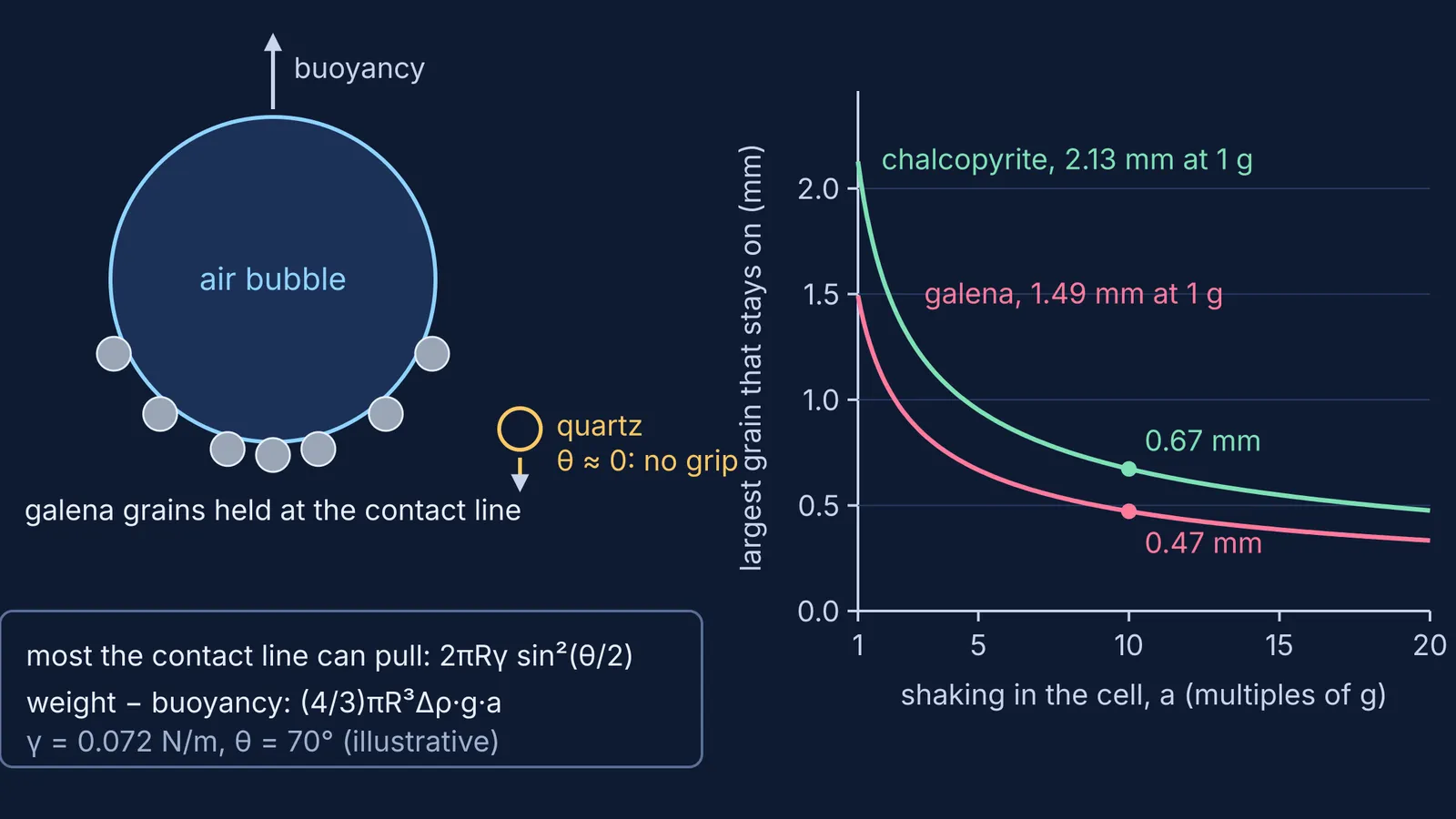
Water does not like to touch a water-repellent surface, so it meets the grain at a large contact angle θ, measured through the water. When a bubble touches such a grain, the water film between them breaks. The grain then hangs from a circle where solid, water and air meet: the three-phase contact line. If you need a refresher on what the contact angle means, see angle of contact and the shape of a meniscus.
Clean quartz is the opposite. Water spreads over it, so θ is close to zero. The bubble never gets a grip, and quartz stays in the pulp however small the grain is.
What force holds a grain on a bubble?
Surface tension γ acts along the air-water surface, at right angles to the contact line, all the way round it. The contact line has radius R sin φ, where R is the grain's radius and φ is how far the air has crept round the grain. The upward part of the pull is 2πR sin φ × γ sin(θ − φ). This is largest when φ = θ/2, which gives
F_max = 2πRγ sin²(θ/2)
This standard result for a sphere comes from the capillary theory of flotation of Scheludko, Toshev and Bojadjiev (1976), and a 2024 paper on capillary flotation states the size limit that follows from it (Cordier et al., 2024). It is the same kind of force that holds up a steel needle floating on water: a line of surface tension pulling on a dense solid. It ignores small pressure terms, so treat it as an estimate.
Pulling the other way is the grain's weight minus its buoyancy in water, (4/3)πR³(ρ_p − ρ_w)g. In a stirred tank we replace g with a·g, where a is the shaking in multiples of g.
Why can a bubble lift a fine grain but not a coarse one?
The grip grows as R, because it acts along a line. The weight grows as R³, because it comes from a volume. Halve the grain and the grip halves, but the weight drops to one eighth. So every mineral has a largest grain that a bubble can hold. Setting the two forces equal gives
R_max = sin(θ/2) × √(3γ / (2Δρ·g·a))
How big a galena grain can a bubble carry? A worked example
Take galena (PbS), density about 7,500 kg/m³, in water at room temperature, γ = 0.072 N/m. Measured contact angles depend on the collector and its dose, so we use θ = 70° as a round illustrative value.
The angle factor. sin²(35°) = 0.329.
Grip on a 100 µm grain. R = 50 µm, so F_max = 2π × (50 × 10⁻⁶ m) × 0.072 N/m × 0.329 = 7.4 × 10⁻⁶ N.
Weight minus buoyancy of that grain. Δρ = 7,500 − 1,000 = 6,500 kg/m³. (4/3)π × (50 × 10⁻⁶ m)³ × 6,500 × 9.81 = 3.3 × 10⁻⁸ N. The grip is about 220 times bigger. The grain is held easily.
A 1.5 mm grain. R = 0.75 mm gives F_max = 1.12 × 10⁻⁴ N and a net weight of 1.13 × 10⁻⁴ N. The grip is just short. Even in perfectly still water this grain falls off.
The limit in still water. R_max = 0.574 × √(3 × 0.072 / (2 × 6,500 × 9.81)) = 0.75 mm, a diameter of 1.49 mm.
The limit in a stirred cell. With a = 10 the limit drops by √10, to 0.47 mm across.
A lighter mineral. Chalcopyrite (CuFeS₂, about 4,200 kg/m³) at the same angle and 10 g reaches 0.67 mm, because its Δρ is about half that of galena.
Units in step 5: (N/m) ÷ (kg/m³ × m/s²) = m², and the root gives metres.
How many can one bubble lift? A 1 mm bubble displaces water weighing (4/3)π(0.5 × 10⁻³ m)³ × 1,000 × 9.81 = 5.1 × 10⁻⁶ N. That is about 150 grains of 100 µm galena at 3.3 × 10⁻⁸ N each, before drag.
What particle sizes float well in a real plant?
Real cells do worse than our simple model. Our 10 g estimate still allows galena grains of almost half a millimetre, yet a peer-reviewed size-by-size study of a copper plant notes that maximum recovery for metallic ores usually comes in the +20 to 120 µm fraction, and that coarse and ultra-fine particles are both harder to recover than medium ones in the 50 to 150 µm range (Kazemi et al., 2023). Two reasons:
Coarse grains are often not fully freed. A large grain is usually part sulphide and part quartz, so less of its surface is water-repellent. The same study found that liberation fell sharply in its coarsest fractions.
Turbulence is violent and uneven. Eddies shake grains far harder than a steady "10 g" suggests. That is why plants grind the ore fine.
Very fine grains have the opposite problem. They have so little inertia that they follow the water round a rising bubble and never touch it. A review of fine-particle flotation explains that fine particles, because of their small mass and momentum, are unable to collide with rising bubbles and float very slowly (Bilal et al., 2022). So flotation has a working window: too fine and grains miss the bubbles, too coarse and they fall off.
India runs this process at scale. Hindustan Zinc's Rampura Agucha mine in Rajasthan reports building its own flotation cells and installing froth cameras to watch the froth (Hindustan Zinc integrated report 2023-24).
How is this related to the lotus leaf and a floating needle?
All three are one idea: a water-repellent surface gives a large contact angle, which lets surface tension pull on a solid. The lotus effect on water-repellent leaves uses it to roll drops off; flotation uses it to lift ore. To revise surface tension, contact angle and excess pressure as one topic, use the Concept Library.
Quick checklist
A collector makes the wanted mineral water-repellent; quartz stays wetted, θ ≈ 0, and gets no grip.
Most a contact line can pull on a sphere: F_max = 2πRγ sin²(θ/2).
Net weight in water: (4/3)πR³(ρ_p − ρ_w)g, times the shaking factor a.
Grip grows as R, weight as R³, so there is a largest floatable grain.
Galena at θ = 70°: about 1.5 mm in still water, about 0.47 mm at 10 g.
Real plants recover most from about 20 to 150 µm; finer grains miss bubbles, coarser ones fall off.


