

On this page
Most objects that are denser than water sink, exactly as Archimedes’ principle of buoyancy predicts. But if you carefully place a steel needle on the surface of a glass of water, it will float. Why does it not sink immediately, and what happens when you add a single drop of soap?
Why does a needle float on water?
The answer is not buoyancy, but surface tension. Water molecules bond strongly to each other through hydrogen bonds. Molecules deep inside the water are pulled equally in all directions by their neighbours, balancing the forces perfectly. However, the molecules at the surface have no water above them. Because they are only pulled by the molecules beside and below them, they pull much more strongly on their neighbours. This uneven force creates a cohesive, elastic "skin" across the surface of the water.
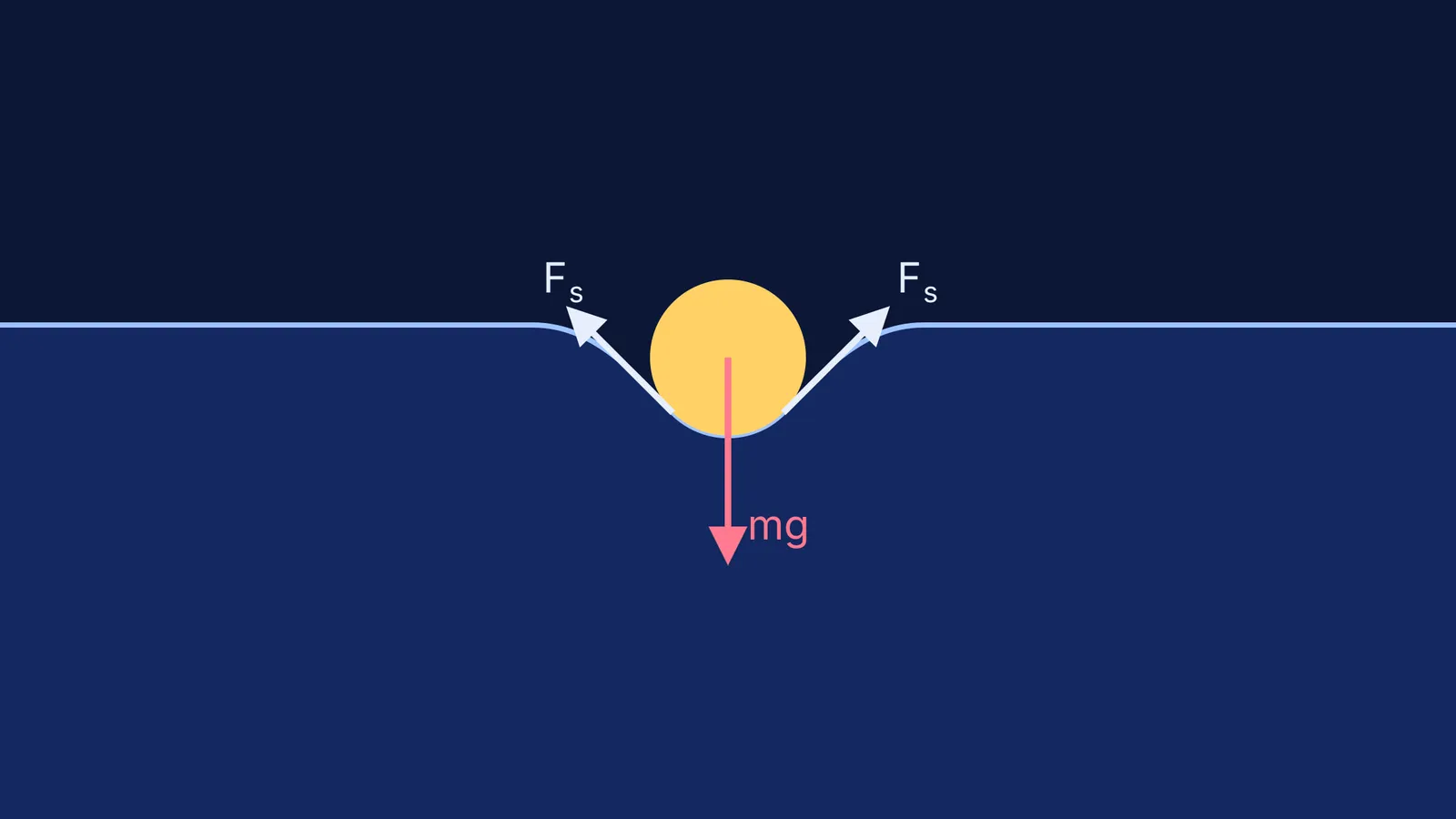
Pure water at 20 °C has a remarkably high surface tension of 72.8 dynes/cm (HyperPhysics). When you gently rest a dry or slightly greased needle on this surface, the water does not break. Instead, the surface dips downwards under the needle's weight, creating a small depression. The surface tension forces act tangentially along this curved surface, pulling upwards and inwards. If the needle is light enough, the upward vertical component of this surface tension perfectly balances the downward pull of gravity, keeping the needle afloat. You can observe a similar effect if you wonder why a steel paper clip floats on water.
Why does the needle sink with soap?
If you take a toothpick dipped in liquid dish soap and touch the water far away from the needle, the needle will instantly sink to the bottom.
Soap molecules are surfactants. They consist of a water-loving (hydrophilic) head and a water-fearing (hydrophobic) tail. When soap touches the water, these molecules quickly spread across the surface, wedging themselves between the water molecules. This disruption breaks the strong hydrogen bonds that gave the water its high surface tension in the first place.
With soap added, the surface tension of the water drops significantly. The weakened surface "skin" can no longer provide enough upward force to counteract the weight of the steel needle. As soon as the surface tension falls below the required threshold, the surface breaks, and the needle sinks into the water.
How do simulations help you learn this?
Reading about surface tension is a start, but science is best learned by testing your intuition. The "Predict-Observe-Explain" (POE) method is one of the most effective ways to learn physics. It was detailed by education researchers Richard White and Richard Gunstone in their 2014 book *Probing Understanding* (Taylor & Francis). By making a prediction first, you expose your own misconceptions. When an observation surprises you, the correct explanation sticks in your memory much better than if you had simply read the answer.
You can run this exact experiment in the Fermi Simulation Lab. Here is how to use the POE method to understand surface tension:
Predict: Before you press play, ask yourself what will happen when the needle touches the water. Then, predict what will happen when soap is added to the system.
Observe: Run the simulation. Watch the water surface depress under the needle, and observe the tension vectors holding it up. Then, add soap and watch the vectors shrink until the needle falls.
Explain: Work out why your prediction was right or wrong based on the forces involved.
Fermi's AI tutor can guide you through this process. It works out what you already know, checks your understanding as it goes, and helps you build the explanation step by step if you get stuck. Once you master how surface tension balances gravity, you can apply the same ideas to other problems, such as calculating the work done in blowing a soap bubble of radius R.


