

On this page
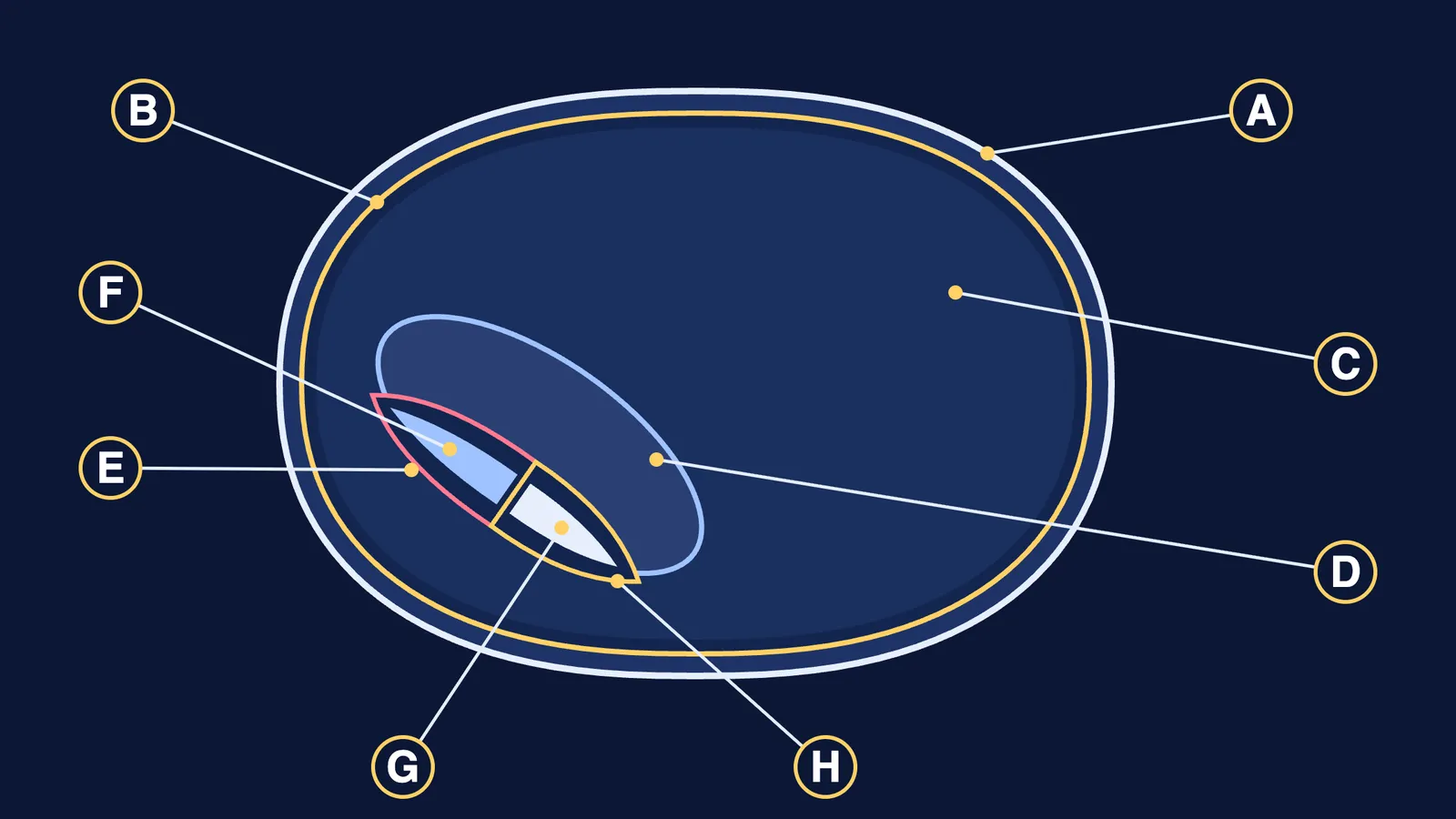
The schematic above shows a maize grain cut lengthwise. Q1 to Q6 use its eight lettered parts, A to H; Q7 to Q14 describe other chapter figures in words.
Which NEET unit covers morphology of flowering plants?
The NMC syllabus notice for NEET (UG) 2026 lists plant morphology, from root to seed, under Biology Unit 2, titled Structural Organisation in Animals and Plants.
Every answer rests on NCERT Class 11 Biology, Chapter 5 (Reprint 2026-27). All 14 questions are our own practice items, not forecasts. For text-only formats, try our morphology statement and match-the-list set.
How should you read a lettered seed diagram?
Read a seed figure from the outside in.
The outermost line is a covering, never a food store.
A thin band hugging the store belongs to the store, not to a second coat.
Split the embryo into its large flat part and its slim axis, then pair each axis tip with the sheath around it.
Can you name parts A to H of the maize grain?
How to attack: name all eight letters before reading any question. In a match item, lock your surest pair and cross out codes that disagree.
Two-statement codes (used for Q3, Q9 and Q13): (1) I and II are right (2) Neither is right (3) Only I is right (4) Only II is right
Q1. Which letter is the scutellum? (1) C (2) H (3) D (4) E
Q2. Match the letters with NCERT's names. List-I: A, B, C, H. List-II: (i) Endosperm (ii) Coleorhiza (iii) Seed coat joined to the fruit wall (iv) Aleurone layer. (1) A-iv, B-iii, C-i, H-ii (2) A-iii, B-i, C-iv, H-ii (3) A-ii, B-iv, C-i, H-iii (4) A-iii, B-iv, C-i, H-ii
Q3. Statement I: F and G are the two ends of one short embryonal axis. Statement II: D is one of two cotyledons; the second is hidden behind it.
Q4. Which statement fits NCERT? (1) The embryo lies in a groove near one end of C (2) The embryo fills most of the grain (3) The mature grain lacks C (4) A lies free of the fruit wall
Q5. Which pair of letters are both sheaths? (1) D and B (2) E and H (3) F and G (4) A and C
Q6. Which letters lie outside the embryo? (1) B, C and D (2) C, E and F (3) A, D and H (4) A, B and C
Answer key for the lettered diagram
A: seed coat fused with the fruit wall. B: aleurone layer. C: endosperm. D: scutellum. E: coleoptile. F: plumule. G: radicle. H: coleorhiza.
Q1: (3). D is the large cotyledon beside the axis, which NCERT calls the scutellum.
Q2: (4). A is the outer covering, B the protein layer edging the endosperm, H the radicle's sheath.
Q3: (3). Plumule and radicle sit on one short axis, and NCERT lists maize among seeds with a single cotyledon.
Q4: (1). NCERT places the small embryo in a groove at the end of the endosperm.
Q5: (2). Coleoptile and coleorhiza are the two sheaths around plumule and radicle.
Q6: (4). The embryo is the scutellum plus the sheathed axis.
Which other morphology figures can be described in words?
How to attack: rough out the described figure before the options, answer from it, then check the example plant is NCERT's own.
Q7. Phyllotaxy figure: more than two leaves arise at each node and form a ring. Type and NCERT example: (1) Opposite, guava (2) Whorled, Alstonia (3) Alternate, Alstonia (4) Whorled, mustard
Q8. Leaf parts: match each with its role. List-I: W. Leaf base X. Stipule Y. Petiole Z. Lamina. List-II: (i) Green blade with veins and veinlets (ii) Joins the leaf to the stem (iii) Small leaf-like outgrowth beside the base (iv) Holds the blade up to the light. (1) W-ii, X-iii, Y-iv, Z-i (2) W-iii, X-ii, Y-iv, Z-i (3) W-ii, X-iv, Y-iii, Z-i (4) W-i, X-iii, Y-iv, Z-ii
Q9. Venation figure. Statement I: Veinlets forming a network is the usual dicot pattern. Statement II: Veins running side by side mark most monocots.
Q10. Fruit figure: a one-seeded drupe whose middle wall layer is fibrous, not fleshy. Fruit and layer: (1) Mango, endocarp (2) Coconut, mesocarp (3) Coconut, endocarp (4) Mango, mesocarp
Q11. Aestivation: match type and NCERT example. List-I: W. Valvate X. Twisted Y. Imbricate Z. Vexillary. List-II: (i) Gulmohur (ii) Pea (iii) Calotropis (iv) Cotton. (1) W-iv, X-iii, Y-i, Z-ii (2) W-iii, X-iv, Y-i, Z-ii (3) W-iii, X-i, Y-iv, Z-ii (4) W-iii, X-iv, Y-ii, Z-i
Q12. In the thalamus figure, the ovary sits centrally and the other parts rise from the thalamus rim at about its level. Type and example: (1) Epigynous, rose (2) Hypogynous, rose (3) Perigynous, mustard (4) Perigynous, rose
Q13. Placentation figure. Statement I: Free central placentation has ovules on a central axis without septa, as in Dianthus. Statement II: Basal placentation in sunflower carries many ovules.
Q14. Seed figure: a gram seed shows two fleshy cotyledons and no separate food-storing tissue. NCERT calls such seeds: (1) Endospermic, like castor (2) Non-endospermous, like castor (3) Endospermic, like gram (4) Non-endospermous, like gram
Answers for Q7 to Q14
Q7: (2). NCERT's whorled example is Alstonia; guava is opposite, mustard alternate.
Q8: (1). NCERT: the leaf base joins the stem, the petiole holds the blade to light, the lamina is the blade.
Q9: (1). NCERT gives reticulate venation for most dicots and parallel venation for most monocots.
Q10: (2). Mango and coconut are both drupes, but only coconut has a fibrous mesocarp.
Q11: (2). These are NCERT's examples for the four types of aestivation.
Q12: (4). Perigynous flowers have a half-inferior ovary, as in rose; mustard is hypogynous.
Q13: (3). In basal placentation one ovule sits on the placenta.
Q14: (4). Gram has no endosperm in the mature seed; castor keeps it.
What should you do after marking this set?
Redraw the grain from memory with names instead of letters.
Tag each miss as a wrong layer, a swapped sheath or a borrowed example.
Retry the misses after three days, then work through our morphology questions with worked solutions.
Which morphology figure still trips you up? Fermi's AI tutor works out what you already know and builds a plan for the session.


