

On this page
A water treatment plant takes muddy river water and lets it stand in long, slow tanks so the silt can sink out. You might expect a deeper tank to catch more silt, since the water stays in it longer. In an ideal settling tank, depth makes no difference at all. What matters is the surface area of the tank compared with the flow through it. This post shows why the depth cancels, works out which grains a real-sized tank catches, and explains why plants add alum.
How does a settling tank remove particles?
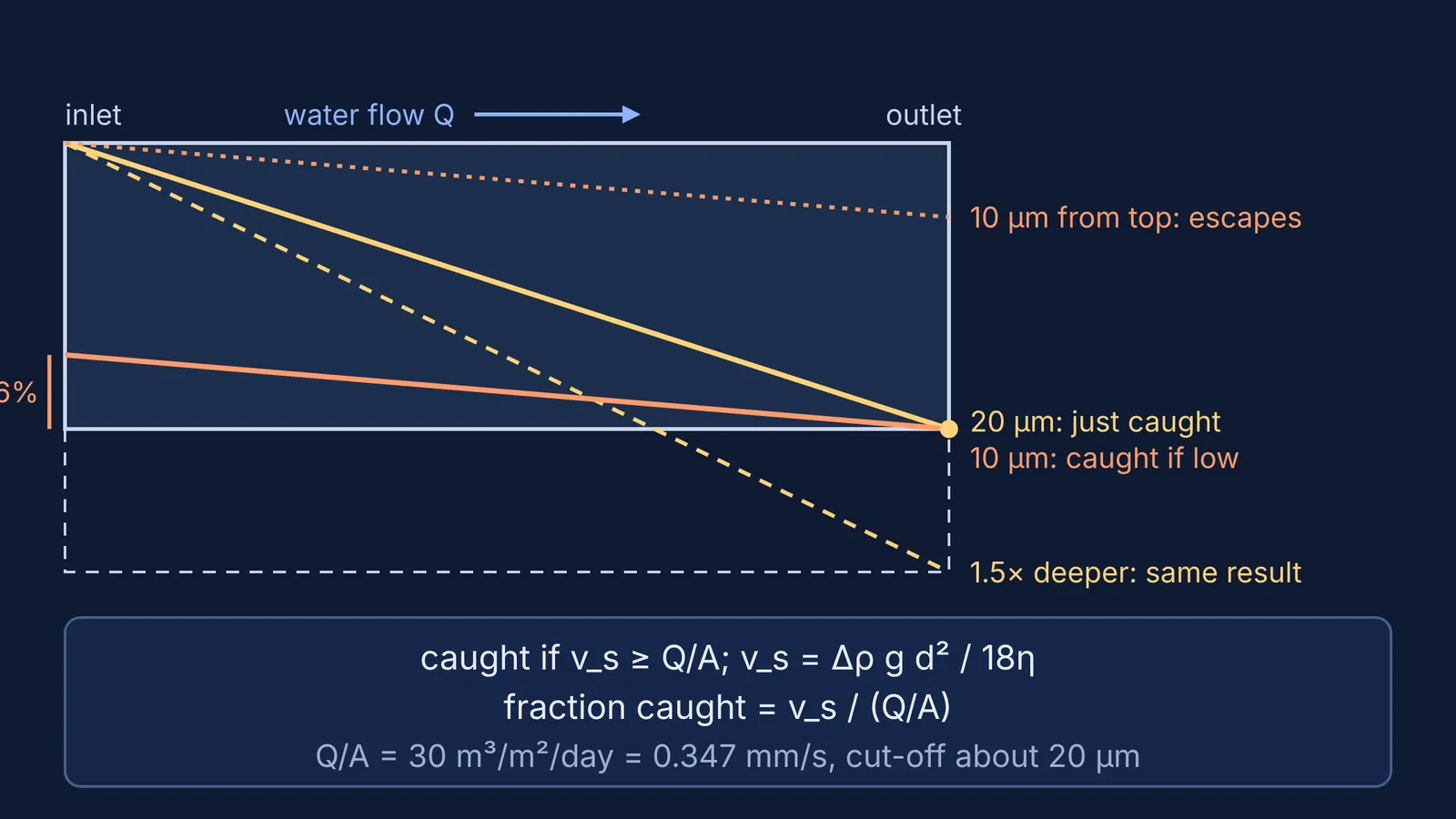
Water enters at one end, flows slowly along the tank, and leaves over a weir at the far end. While it travels, each particle sinks at its own steady settling speed v_s. If the particle reaches the floor before the water carries it out, it is caught.
For small grains the settling speed comes from Stokes' law, set out in the derivation of terminal velocity of a sphere in a viscous fluid:
v_s = Δρ g d²/(18η)
Here Δρ is the density of the grain minus that of water, d its diameter and η the viscosity of water. The d² is why size matters so much, as you see with gold in why gold stays in the pan.
Why does a settling tank depend on surface area, not depth?
Take a rectangular tank of length L, width B and depth H, with flow rate Q. This is the ideal tank of Allen Hazen's theory: the flow is spread evenly, it moves at the same speed everywhere, and a particle that touches the floor stays there.
Time for the water to cross. The tank holds BHL of water, so the water takes t₁ = BHL/Q to pass through.
Time for the worst-placed particle to sink. A particle entering at the surface must fall the full depth: t₂ = H/v_s.
Condition to be caught. t₂ ≤ t₁, so H/v_s ≤ BHL/Q.
H cancels. v_s ≥ Q/(BL) = Q/A, where A = BL is the tank's surface area.
The quantity Q/A is called the surface overflow rate or surface loading. It has units of m³ per m² per day, which is just a speed. Every particle that sinks faster than Q/A is removed completely, wherever it enters.
A deeper tank holds the water longer, but each particle also has further to fall. The two effects cancel exactly. TU Delft's water treatment course notes put it plainly: in theory, settling in a horizontal flow tank is set only by the flow and the surface area, and is independent of the tank's height (TU Delft, Sedimentation, Water Treatment course notes).
What fraction of slower particles is caught?
A particle with v_s smaller than Q/A is caught only if it enters low enough. In the time t₁ it falls a height v_s t₁. So only particles that enter within that height of the floor reach it. If particles are spread evenly over the depth, the fraction caught is:
fraction caught = v_s/(Q/A)
Again the depth cancels.
Which grains does a real-sized tank catch?
Worked example
A town plant treats 10 million litres a day (10 MLD). Take an overflow rate of 30 m³/m²/day as a round illustrative value. Design limits vary by country and tank type. As one example of a published code, Virginia's waterworks regulations limit conventional settling basins to 0.25 to 0.5 gallons per minute per square foot (12VAC5-590-872), which works out to about 15 to 29 m³/m²/day, so 30 is at the top of that range. In India, design values come from the CPHEEO Manual on Water Supply and Treatment, which should be used for real plant design.
Grains: quartz silt with density 2650 kg/m³, so Δρ = 1650 kg/m³, in water with η = 1.0 × 10⁻³ Pa s.
Flow. Q = 10 × 10⁶ L/day = 10,000 m³/day = 0.116 m³/s.
Surface area. A = Q/(overflow rate) = 10,000/30 = 333 m². For example, a tank about 40 m long and 8.3 m wide.
Critical settling speed. v₀ = 30 m/day = 30/86,400 = 3.47 × 10⁻⁴ m/s = 0.347 mm/s.
Critical grain size from Stokes' law. d = √(18ηv₀/(Δρ g)) = √(18 × 10⁻³ × 3.47 × 10⁻⁴/(1650 × 9.81)) = 1.97 × 10⁻⁵ m, about 20 µm.
A 10 µm grain. v_s = 1650 × 9.81 × (10⁻⁵)²/(18 × 10⁻³) = 0.090 mm/s. Fraction caught = 0.090/0.347 = 26%.
A 5 µm grain. v_s is a quarter of that, 0.022 mm/s. Fraction caught = 6.5%.
Check Stokes' law applies. For the 20 µm grain, Re = ρv_s d/η = 1000 × 3.6 × 10⁻⁴ × 2 × 10⁻⁵/10⁻³ = 0.007, far below 1. Stokes' law holds.
So this tank removes all silt coarser than about 20 µm, a quarter of the 10 µm grains and hardly any of the finest silt and clay.
Why don't plants simply build deeper tanks?
In the ideal model, extra depth buys nothing. Doubling the surface area, on the other hand, halves Q/A and halves the critical speed, so the cut-off size falls by √2, from 20 µm to 14 µm. That is why some plants put stacked trays, or tilted plates and tubes, inside the tank: each extra surface is extra settling area in the same footprint. The Virginia code above allows tube settlers a loading of up to 2 gpm/ft² of cross-section, four times its limit for a plain basin.
Real tanks are not ideal. Inflow can short-circuit along one side, warm or muddy water forms density currents, and wind stirs the surface. Depth still matters in practice for storing sludge and keeping the flow calm. And for flocs that grow as they sink, the TU Delft notes point out that depth does affect the result, unlike for the hard grains in our example.
Why is alum added before the settling tank?
Clay and fine silt, a few micrometres across, settle far too slowly for any practical tank: a 2 µm particle has a settling speed 100 times smaller than a 20 µm one. Alum makes these tiny particles clump into flocs. A floc is loose and full of water, so it is much less dense than a solid quartz grain of the same size, but it is many times larger than the particles it gathers, and because v_s ∝ d² the size wins. Flocs reach settling speeds that a tank of reasonable area can catch.
The same d² logic explains why stacked red blood cells settle faster in the ESR test, covered in ESR and Stokes' law. For the ideas underneath, viscosity and terminal speed, see the Concept Library, which covers concepts across physics, chemistry, biology, mathematics and computing.
Quick checklist
A particle is caught completely if v_s ≥ Q/A, the surface overflow rate.
Depth cancels in the ideal model: deeper tank, longer stay, but further to fall.
Slower particles are caught in the fraction v_s/(Q/A).
Stokes' law: v_s = Δρgd²/(18η), valid for Re below about 1.
At 30 m³/m²/day, quartz grains above about 20 µm are all caught; 10 µm grains only 26%.
Alum gathers fine particles into larger flocs that settle fast enough to catch.


