

On this page
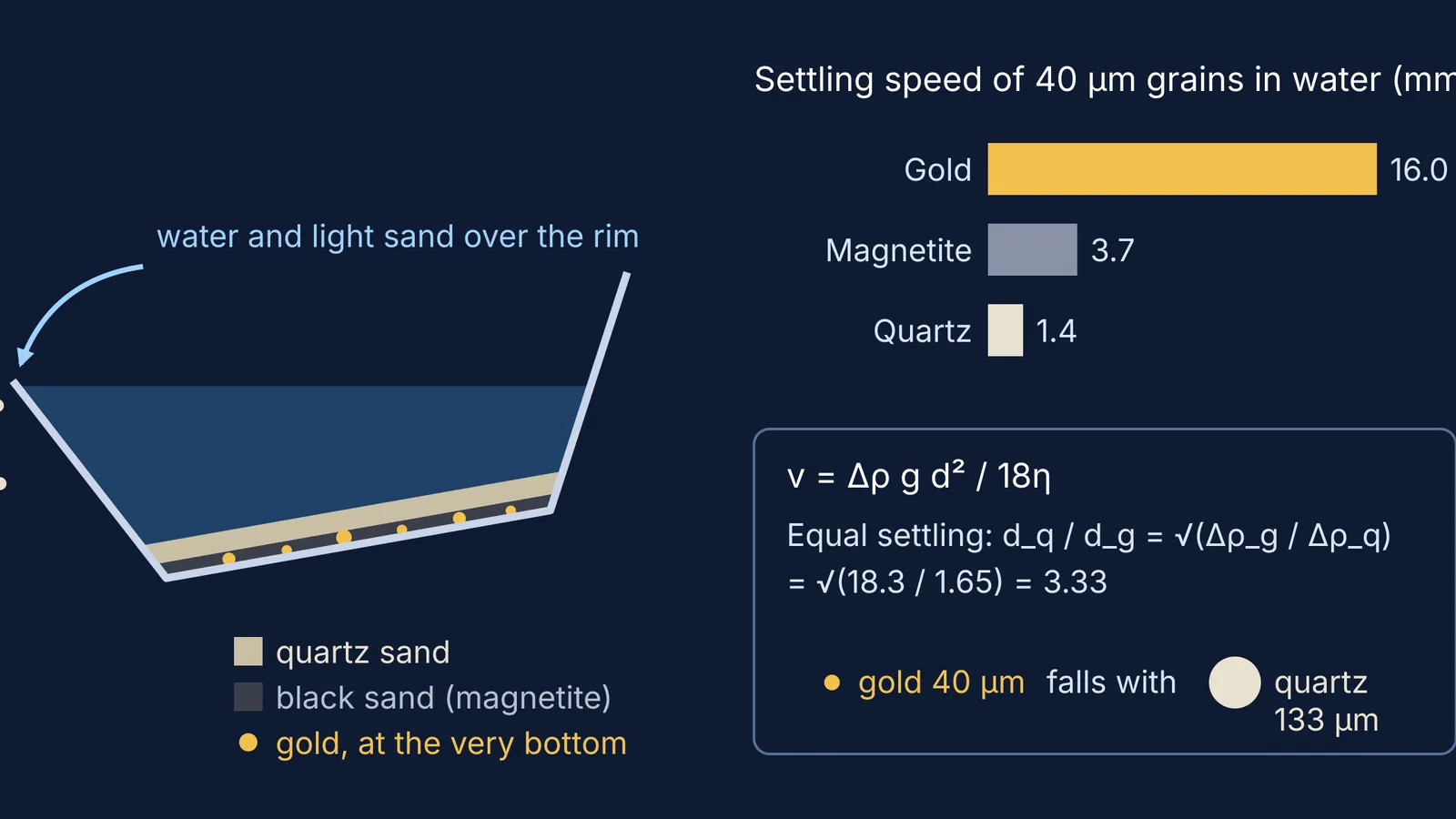
A gold panner swirls river gravel and water in a wide, shallow pan. Sand slops over the rim a little at a time until only a streak of black sand and a few yellow specks are left. Along the Subarnarekha in Jharkhand, whose name means "streak of gold", people still look for gold particles in the riverbed sand. The pan has no moving parts. The sorting is done by one formula you already know from Class 11: Stokes' law.
Why does gold sink faster than sand in water?
A small grain dropped in water quickly reaches terminal velocity, where its weight is balanced by buoyancy and viscous drag. For a sphere of diameter d at low speed, Stokes' law gives
v = (ρ − ρ_w) g d² / 18η
where ρ is the grain's density, ρ_w the water's density and η the water's viscosity. The derivation is in how terminal velocity follows from Stokes' law.
Two things in this formula matter for panning:
Density enters as an excess, ρ − ρ_w. Gold is about 7.3 times denser than quartz (19.3 against 2.65 g/cm³), but in water what counts is 18.3 against 1.65. That is a factor of 11.1, not 7.3. Buoyancy cancels most of quartz's weight but hardly dents gold's.
Size enters as d². A grain twice as wide settles four times as fast. So a big light grain can keep up with a small heavy one.
So panning is not simply "heavy things sink". Rocks on a hillside sort by size alone, because their grains have about the same density; that case is covered in how sand and mud settle into layers. In a pan, size and density compete.
When do a gold grain and a quartz grain settle together?
Grains that settle at the same speed are called "hydraulically equivalent". Set the two Stokes velocities equal; g, 18 and η cancel:
(ρ_g − ρ_w) d_g² = (ρ_q − ρ_w) d_q²
so the ratio of diameters is
d_q / d_g = √[(ρ_g − ρ_w) / (ρ_q − ρ_w)]
This is the same rule a 1968 US Geological Survey study of placers by Harry Tourtelot used to work out which sizes of quartz, magnetite and gold end up deposited together in rivers. For fine grains it uses Stokes' law; for coarse grains, where drag goes as v² instead of v, settling speed goes as √(Δρ d), so the equal-settling condition becomes Δρ_g d_g = Δρ_q d_q and the diameter ratio is the full 11.1, not its square root.
Worked example: a 40 µm gold speck in a pan
Take water at about 20 °C (η = 1.0 × 10⁻³ Pa s, ρ_w = 1000 kg/m³) and spherical grains 40 µm across. Densities: gold 19,300, magnetite 5,200, quartz 2,650 kg/m³.
Density excess. Gold: 18,300 kg/m³. Magnetite: 4,200 kg/m³. Quartz: 1,650 kg/m³.
Settling speed of the gold. v = 18,300 × 9.81 × (40 × 10⁻⁶)² / (18 × 1.0 × 10⁻³) = 1.60 × 10⁻² m/s, or about 16.0 mm/s. Check the units: (kg/m³)(m/s²)(m²) = kg/s², and dividing by Pa s = kg/(m s) leaves m/s.
The other two. Speed scales with Δρ at fixed d, so magnetite settles at 16.0 × 4,200/18,300 = 3.7 mm/s and quartz at 16.0 × 1,650/18,300 = 1.4 mm/s.
Time to fall 5 cm. Gold takes about 3 s. Quartz of the same size takes about 35 s.
Quartz that keeps up. d_q = 40 × √(18,300/1,650) = 40 × 3.33 = 133 µm. A quartz grain more than three times wider sinks as fast as the gold.
Magnetite that keeps up. d_m = 40 × √(18,300/4,200) = 40 × 2.09 = 83 µm. Magnetite only needs to be about twice as wide.
Check that Stokes' law applies. Reynolds number Re = ρ_w v d/η. For the gold, Re = 1000 × 0.016 × 40 × 10⁻⁶ / 10⁻³ = 0.64, inside the Stokes range (below about 1). For the 133 µm quartz, Re = 2.1, slightly outside, so 3.33 is an approximation.
For coarse grains the picture changes. Using a drag coefficient of about 0.44, a 1 mm gold grain and an 11 mm quartz pebble both settle at roughly 0.7 m/s. That 11-to-1 ratio is one reason panners screen out the pebbles first: big stones would sink with the gold and crowd the bottom of the pan.
Why is black sand always the last thing left with the gold?
Magnetite, at about 5.2 g/cm³, has 2.5 times the density excess of quartz, so it stays behind as the sand washes off. A magnetite grain only twice as wide as a gold speck settles just as fast, so black sand and gold end up together. Panners finish by drying the concentrate and lifting the magnetite out with a magnet.
Real panning is not only free settling. Shaking loosens the wet bed so small dense grains slip down through the gaps while light grains ride up and wash away. Engineers call this stratification; jigs and shaking tables use it too. A 2023 review of gravity concentration in Heliyon describes how, on a shaking table, the denser heavy-mineral particles move down while lighter ones rise and are carried off by the wash water, and it stresses that particle size and shape matter almost as much as density.
Why does fine, flaky gold get lost?
Stokes' law assumes spheres. River gold is often hammered into thin flakes, which fall broadside on with far more drag for their weight. Tourtelot's USGS report calculated that a gold flake 30 times wider than it is thick settles at only 12.5% of the speed of a gold sphere of the same diameter. Apply that to our 40 µm speck: 0.125 × 16.0 = 2.0 mm/s, barely faster than a 40 µm quartz sphere at 1.4 mm/s. The advantage has almost gone.
Two more details matter:
Natural gold is an alloy, usually with silver. The same USGS report gives the specific gravity of placer gold as about 15 to 19.3, with 19.3 only for pure gold. At 16 g/cm³ the equal-settling quartz grain is 40 × √(15.0/1.65) = 121 µm instead of 133 µm.
Very fine gold settles so slowly (speed falls as d²) that any stirring keeps it suspended. A peer-reviewed review of mercury use in artisanal gold mining notes that gravity methods such as panning and sluicing typically need relatively large gold grains, and that where the gold is very fine, miners often turn to mercury instead.
Shape and drag also decide why chaff blows away while grain falls during winnowing.
To practise terminal-velocity and equal-settling problems, the Fermi Problem Library has a step-by-step solver that explains the reasoning. For JEE, Fermi Test Prep offers personalised preparation for JEE Main & Advanced with an AI tutor, live classes, adaptive mocks, mentorship and a study plan that updates based on mastery.
Quick checklist
Stokes' law: v = (ρ − ρ_w)gd²/18η, valid for Reynolds number below about 1.
Use the density excess. Gold to quartz in water: 18.3/1.65 = 11.1, not 19.3/2.65.
Equal settling (fine grains): d_q/d_g = √(Δρ_g/Δρ_q) = 3.33 for gold and quartz.
Equal settling (coarse grains): d_q/d_g = Δρ_g/Δρ_q = 11.1.
Flakes settle far slower than spheres of the same width, so fine flaky gold is the hardest to keep.


