On this page
Ask why graphite is a dry lubricant and every textbook gives the same answer: its carbon atoms sit in flat layers held together by weak forces, so the layers slide over each other. That answer is true, and it is the one to write in your exam. But it leaves out a condition. Put graphite in a vacuum or in perfectly dry gas and it stops being slippery: friction roughly triples and the graphite wears away as dust. A thin film of adsorbed water is what keeps it working. Here is the evidence, the numbers, and how to use them.
Why is graphite used as a lubricant?
In graphite each carbon atom bonds to three others in a flat sheet of hexagons. Inside a sheet the C–C bond length is 142 pm; the sheets are 335 pm apart and are held together only by weak van der Waals forces. That is the picture behind why diamond is hard and graphite conducts, and behind the soft grey mark of a pencil, which is graphite mixed with clay, as explained in why pencil lead is actually graphite.
Because the sheets shear apart easily, graphite is used as a dry lubricant and as the brushes that carry current to the spinning parts of motors and generators. The structure explains why layers can slide. It does not explain everything about two graphite surfaces rubbing.
What happens to graphite in a vacuum?
In 1948 Robert H. Savage of the General Electric Research Laboratory in Schenectady, New York, published the paper that changed the picture (Savage, Journal of Applied Physics 19, 1, 1948). His abstract begins: "The slipperiness of graphite is not inherent in the crystal structure alone but depends upon adsorption films, especially water, which cover the carbon atoms and provide surfaces of low cohesion."
What he saw was dramatic. In vacuum, his graphite rods and brushes seized on a moving copper or graphite surface and wore away as a fine dust. Letting in a little of certain vapours, such as water, benzene or ammonia, stopped the wear and the high friction straight away. Remove the vapour and the problem returned, because the film on the surface is held by reversible adsorption.
How much does the friction change?
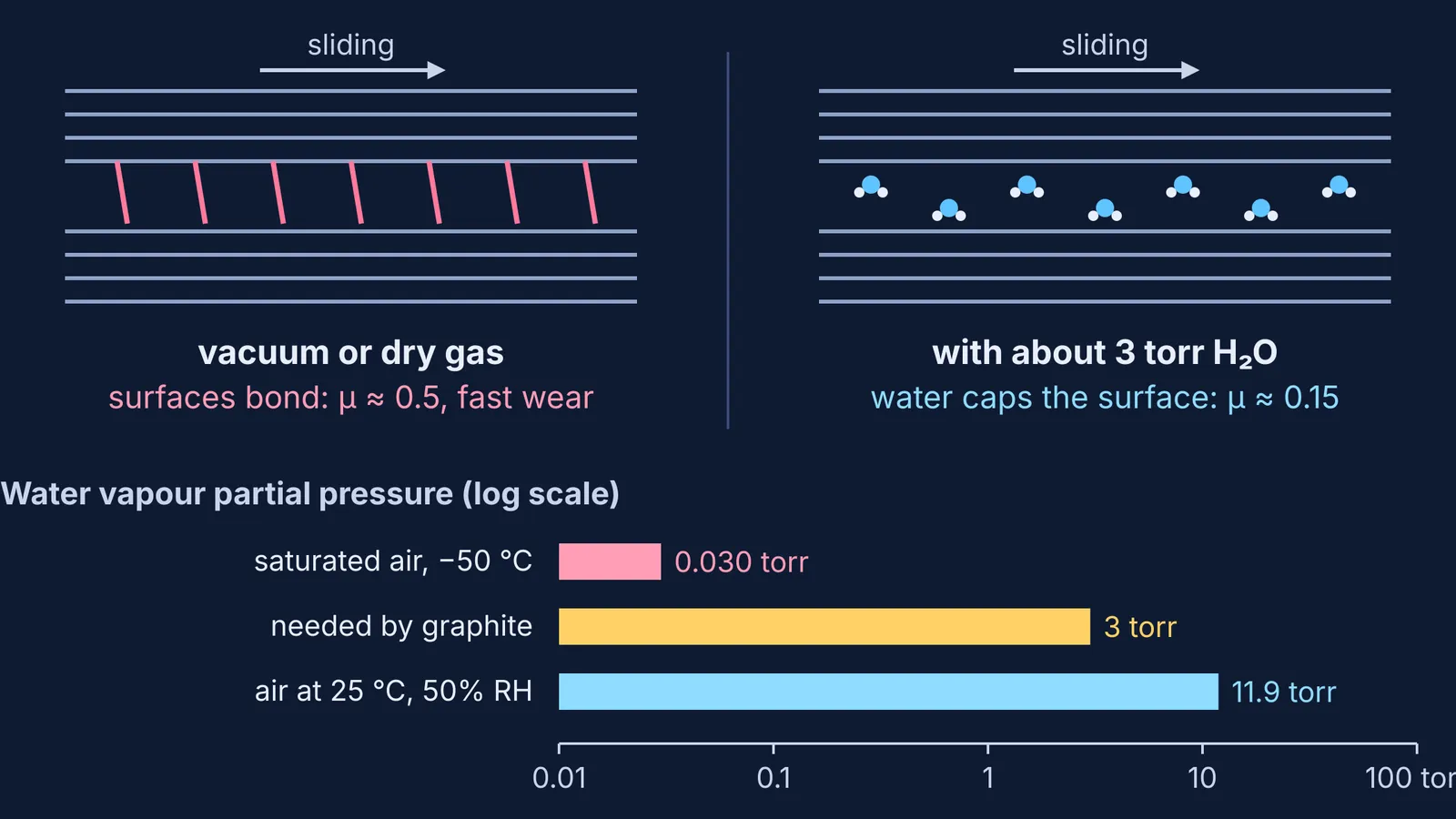
Twenty years later, R. D. Arnell and D. G. Teer summed up what was by then well established (Arnell and Teer, Nature 218, 1155, 1968). Below about 1 torr, they wrote, the friction coefficient of graphite on itself and on other materials rises from its usual value of about 0.15 to about 0.5 or even higher, and the wear rate becomes very high. Small partial pressures of condensable vapours, for example about 3 torr of water vapour, restore the low friction and low wear.
Treat these as approximate, rounded values; the exact coefficient depends on materials, load and speed. Pulling a 10 N graphite block needs about 1.5 N at μ ≈ 0.15 but about 5 N at μ ≈ 0.5.
Why does a water film make graphite slippery?
The layers inside the crystal still slide easily in a vacuum. The trouble is at the rubbing surfaces. Where sheets are torn or broken, especially at their edges, carbon atoms are left with unsatisfied bonds. Two such surfaces pressed together can bond to each other, a kind of cold welding, and then the graphite tears and sheds dust instead of sliding.
Water stops this. Adsorbed water molecules cover the reactive sites and can supply H and OH groups that cap them, so the surfaces have nothing to bond with. A 2022 study combining experiments and simulations (Morstein and colleagues, Nature Communications 13, 5958) found that less than a single layer of water can prevent cold welding, with water acting both as the source of the capping groups and as a spacer between the surfaces. The same paper notes that an older idea, water slipping in between the layers and pushing them apart, was ruled out by X-ray diffraction. The finer details of the mechanism are still being studied, so the safe summary is: water and other vapours adsorb on the rubbing surfaces, especially at the reactive edges, and stop them bonding to each other.
Worked example: three numbers behind the story
(a) How open is the layer structure? Graphite's hexagonal unit cell has a = 246.1 pm and c = 670.8 pm, with 4 atoms per cell (values from Wikipedia's graphite entry).
Volume V = (√3/2)a²c = 0.8660 × (2.461 × 10⁻⁸ cm)² × (6.708 × 10⁻⁸ cm) = 3.52 × 10⁻²³ cm³.
Density = ZM/(N_A V) = (4 × 12.011)/(6.022 × 10²³ × 3.52 × 10⁻²³) = 2.27 g/cm³.
The cell holds two layers, so the interlayer spacing is c/2 = 335 pm, about 2.4 times the 142 pm C–C bond. That wide gap is why the sheets separate so easily. For more practice with this formula, see density of a unit cell, worked both ways.
(b) How much water is 3 torr? The saturation vapour pressure of water at 25 °C is about 23.8 torr. So 3 torr is 3/23.76 = 0.126, about 13% relative humidity. Ordinary room air at 50% humidity carries about 11.9 torr, four times what graphite needs.
(c) Could air ever be too dry? Take air at about 10 km altitude, near −50 °C. The most water it can hold is the vapour pressure of ice. Use the Clausius–Clapeyron equation with the triple point of water (611.657 Pa at 273.16 K) and ΔsubH ≈ 51 kJ/mol:
ln(p/611.657) = −(ΔsubH/R)(1/T − 1/273.16) = −(51 000/8.314)(1/223.15 − 1/273.16) = −5.03.
p ≈ 611.657 × e⁻⁵·⁰³ ≈ 4.0 Pa, which is 0.030 torr.
Even saturated air at −50 °C carries about 100 times less water than the 3 torr graphite needs. At −40 °C the figure is about 0.097 torr, still around 30 times too little.
The estimate assumes ΔsubH is constant, so call it "about 4 Pa". Warming that air later does not add water to it.
What should you write in the exam?
Standard answer: layered structure, weak forces between layers, layers slide, so graphite is soft, slippery and a dry lubricant.
If asked when graphite fails as a lubricant: in vacuum or very dry gas, because the adsorbed water film is missing; the surfaces bond to each other, friction rises (about 0.15 to about 0.5) and graphite wears fast.
Do not write that graphite fails at high temperature in general, or that water goes between the layers.
If Clausius–Clapeyron or unit-cell density still feel shaky, the Fermi Concept Library gives each concept its own lesson and shows what it rests on. To practise numericals like parts (a) and (c), the Fermi Problem Library has worked problems with a step-by-step solver that explains the reasoning.
Quick checklist
Graphite layers: 142 pm bonds within, 335 pm between, weak forces across.
Savage (1948): slipperiness depends on adsorbed films, especially water.
Arnell and Teer (1968): μ about 0.15 normally, about 0.5 or more below 1 torr; about 3 torr of water restores it.
Water caps reactive surface sites so the surfaces cannot bond.
3 torr is only about 13% humidity at 25 °C, but far more than cold, high-altitude air holds.