

On this page
Diamond and graphite are both pure carbon, yet the Class 10 NCERT chapter Carbon and its Compounds calls diamond “the hardest substance known” and graphite “smooth and slippery”. Its short “More to Know” box on allotropes covers the ideas behind “give reasons” questions on this topic. Here is the explanation, then model answers you can adapt.
What makes diamond and graphite different if both are pure carbon?
NCERT puts it in one line: “Both diamond and graphite are formed by carbon atoms, the difference lies in the manner in which the carbon atoms are bonded to one another” (NCERT Class 10 Science, Chapter 4). Different forms of the same element are called allotropes.
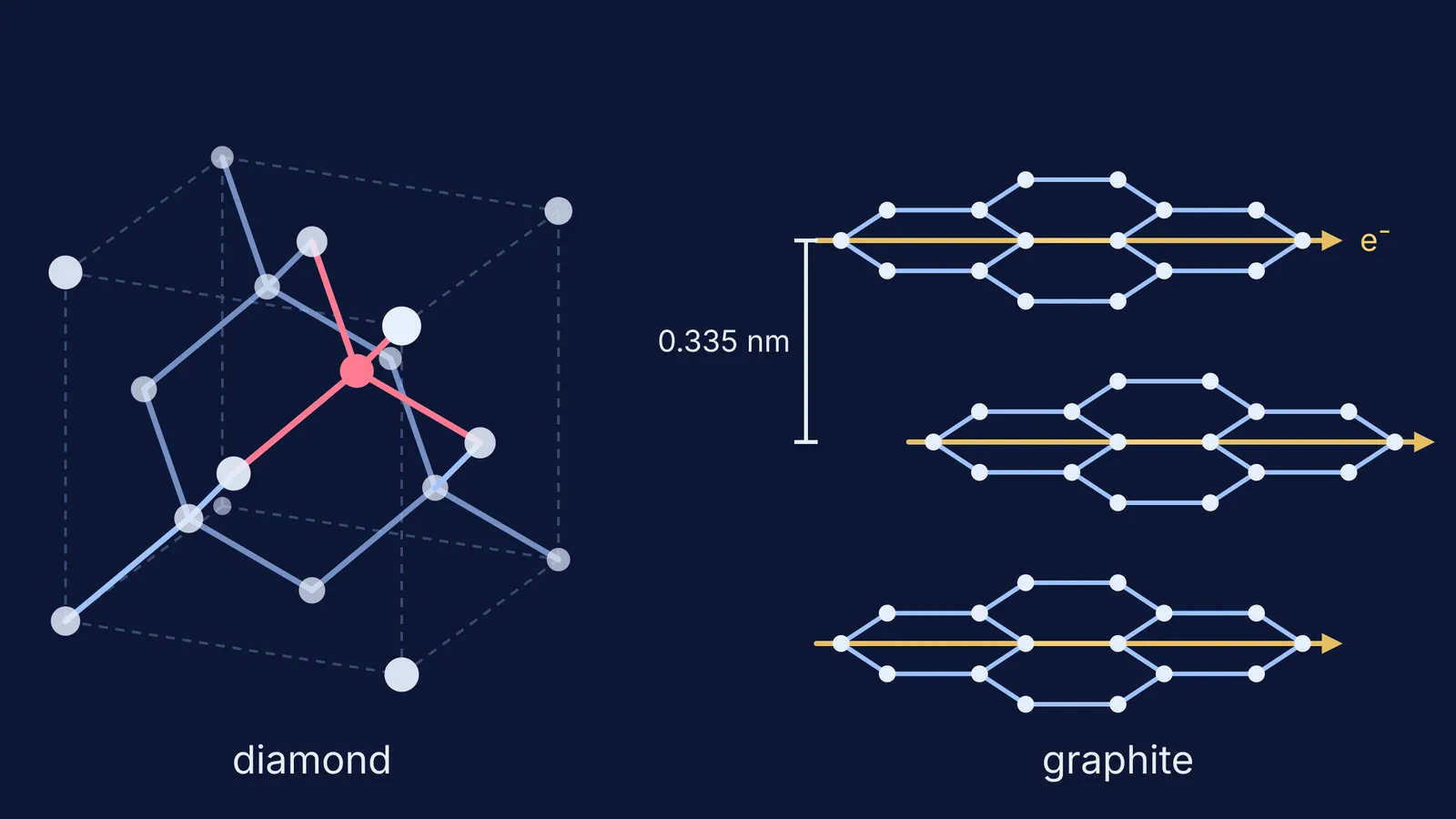
In diamond, each carbon atom is bonded to four other carbon atoms, forming a rigid three-dimensional structure.
In graphite, each carbon atom is bonded to three others in the same plane, giving hexagonal sheets stacked in layers.
The same box notes that their chemical properties are the same while their physical properties differ widely. The structure changes how the solid behaves, not what the atoms are.
Why is diamond so hard?
Every carbon atom in diamond forms four single covalent bonds pointing to the corners of a tetrahedron, and every neighbour does the same, so the network runs unbroken in three dimensions (Wikipedia: Diamond). Diamond is very hard because of the need to break very strong covalent bonds operating in three dimensions (Chemguide: giant covalent structures). There is no weak direction to slide along.
Diamond defines 10, the top of the Mohs hardness scale (Wikipedia: Diamond). Its lattice constant is 0.3567 nm, which puts neighbouring carbon atoms about 0.154 nm apart (√3/4 of the lattice constant, as the same page gives).
Diamond does not conduct electricity because all its electrons are held tightly between the atoms (Chemguide). To see how shared pairs are drawn in simpler molecules, start with our guide to electron dot structures in Class 10.
Why does graphite conduct electricity?
In graphite, each carbon atom uses three electrons to bond to its three neighbours in the layer. The fourth electron is delocalised over the whole sheet and free to move through it, which is why graphite conducts (Chemguide). NCERT calls graphite “a very good conductor of electricity unlike other non-metals” (NCERT Chapter 4).
Within a layer, carbon atoms are 0.142 nm apart; the layers are 0.335 nm apart (Wikipedia: Graphite). The sheets are held together only by van der Waals dispersion forces (Chemistry LibreTexts/14%3A_The_Group_14_Elements/14.04%3A_Allotropes_of_Carbon/14.4A%3A_Graphite_and_Diamond_-_Structure_and_Properties)). Each sheet is strong, but the sheets slide over each other like cards in a pack, which gives graphite its soft, slippery feel (Chemguide).
What are fullerenes?
Fullerenes are a third family of carbon allotropes. The first identified was C-60, with carbon atoms arranged in the shape of a football, named after the US architect Buckminster Fuller because it looked like his geodesic domes (NCERT Chapter 4). It was reported in Nature in November 1985 by H. W. Kroto, J. R. Heath, S. C. O'Brien, R. F. Curl and R. E. Smalley (Kroto et al., Nature 318, 162-163). Curl, Kroto and Smalley shared the 1996 Nobel Prize in Chemistry “for their discovery of fullerenes” (Nobel Prize in Chemistry 1996). Carbon also forms tubes; read how they were found in our post on Sumio Iijima and carbon nanotubes.
How do you answer allotrope questions in the board exam?
Use one chain every time: bonds per atom, then shape of the network, then the property. A strong answer links structure to property instead of only naming the property.
Why is diamond hard? Each carbon atom is covalently bonded to four others, forming a rigid three-dimensional network. Scratching it means breaking many strong covalent bonds in every direction, so diamond is very hard.
Graphite is a non-metal, yet it conducts electricity. Why? Each carbon atom bonds to only three others in a flat hexagonal layer. The fourth valence electron is delocalised and free to move along the layer, so it carries current.
Why is graphite slippery while diamond is hard? Graphite's layers are held by weak forces and slide over one another; diamond has no layers, only strong covalent bonds in three dimensions.
Before you finish, check that your answer has:
the number of bonds per carbon atom (four or three)
the shape (three-dimensional network, or flat hexagonal layers)
the property, joined to the structure with “so” or “therefore”
for conductivity, the words “free” or “delocalised” electrons
If you can recite these answers but cannot say why four bonds make a solid hard, the gap is in the concept, not the wording. The Fermi Concept Library gives every concept in chemistry its own lesson and its place in the map, so you can trace allotropes back to covalent bonding. For written practice, the Fermi Problem Library has worked problems with a step-by-step solver that explains the reasoning rather than printing an answer.
For the rest of the chapter, see our revision guide to carbon compounds in Class 10.


