On this page
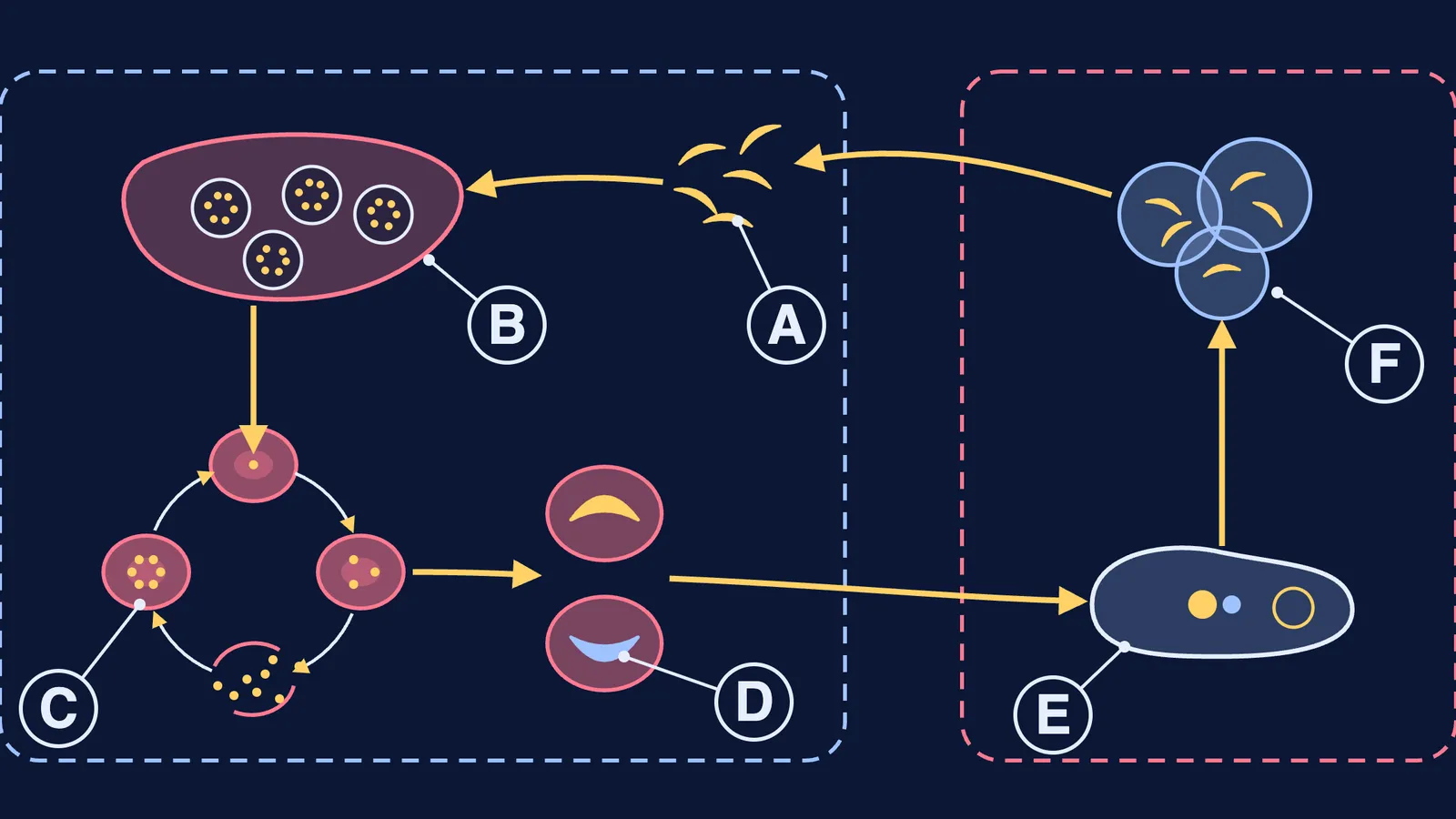
In NCERT's Class 12 Biology, Human Health and Disease is the seventh chapter; the NMC's 2026 NEET (UG) syllabus lists it under Unit 8, Biology and Human Welfare. Here are 13 original questions: Q1 to Q6 use the lettered malaria cycle above, and Q7 to Q13 describe other chapter figures in words. None is a past-paper or predicted question; every answer comes with a short NCERT-based reason.
Diseases appear here only in NCERT's terms. This is a study summary, not medical advice.
What does a lettered life-cycle figure test?
A cycle figure tests place and order more than names:
Trace the arrows before reading any letter: where does the cycle start, and which way does it turn?
Sort the letters by host. Wrong options often put the right event in the wrong body.
Decide whether the stem wants a stage, a site or an event.
For a figure given in words, jot down NCERT's labels for it first.
Every two-statement item here uses one option set: (1) Only Statement II is valid (2) Both are valid (3) Only Statement I is valid (4) Neither is valid.
Parts A to F: six questions on the malaria cycle
Attack note: settle the host boundary first; Q4 and Q6 turn on it. Reasons come from section 7.1 and Figure 7.1 of NCERT Chapter 7.
Q1. Form A enters a person with the bite of an infected female *Anopheles*. It is called: (1) gametocyte (2) haemozoin (3) sporozoite (4) zygote
Answer: (3). NCERT calls sporozoites the infectious form.
Q2. Where does the parasite first multiply inside the human? (1) C (2) D (3) E (4) B
Answer: (4). Liver cells come before red blood cells.
Q3. Statement I: Bursting of the cells at C releases haemozoin, linked to recurring chill and high fever. Statement II: Parasites freed from C go on to infect new red blood cells.
Answer: (2). Figure 7.1 shows freed parasites entering fresh red blood cells.
Q4. Pair each letter in List-I with a role in List-II. List-I: (P) F (Q) B (R) E (S) D. List-II: (I) Fertilisation and development (II) Store of sporozoites (III) Sexual stages formed inside red blood cells (IV) Asexual multiplication in liver cells. (1) P-III, Q-IV, R-I, S-II (2) P-II, Q-IV, R-I, S-III (3) P-II, Q-III, R-IV, S-I (4) P-I, Q-IV, R-II, S-III
Answer: (2). Salivary glands, liver, gut, gametocytes.
Q5. A female *Anopheles* takes up which lettered stage with its blood meal? (1) D (2) A (3) B (4) F
Answer: (1). Gametocytes enter the mosquito with the blood.
Q6. Statement I: Parts E and F lie in the host that also acts as the vector. Statement II: Plasmodium can finish its whole life cycle in the region holding B, C and D.
Answer: (3). NCERT says the parasite needs two hosts, human and mosquito.
Answer key for the lettered diagram
A: sporozoites
B: liver (liver cells)
C: red blood cells, where asexual multiplication repeats
D: gametocytes (male and female) inside red blood cells
E: mosquito's gut
F: mosquito's salivary glands
Can you solve antibody, lymph node and HIV figures from a description?
Attack note: sketch the figure from the stem and label it before reading the options. Reasons come from sections 7.1 to 7.5 of NCERT Chapter 7.
Q7. A cartoon shows an antibody as a Y of four chains, with an antigen binding site at each arm tip. Which statement is correct? (1) The two short chains are heavy chains (2) The free ends at the base of the stem are N ends (3) Each arm is made of heavy chain alone (4) The molecule is written as H2L2
Answer: (4). Two light and two heavy chains; Figure 7.4 marks the stem ends C.
Q8. Same molecule. Statement I: Because these molecules are found in blood, the response is called cell-mediated. Statement II: T-cells secrete no antibodies but help B cells make them.
Answer: (1). The antibody response is humoral; CMI is the T-lymphocyte response.
Q9. A body outline shows lymph nodes along lymphatic vessels and a thymus in the chest. Which pair are both secondary lymphoid organs? (1) Lymph nodes and tonsils (2) Thymus and spleen (3) Bone marrow and lymph nodes (4) Thymus and Peyer's patches
Answer: (1). Bone marrow and thymus are the primary lymphoid organs.
Q10. Same figure. Statement I: Antigens trapped in lymph nodes activate the lymphocytes present there. Statement II: The thymus drawn in the chest grows larger after puberty.
Answer: (3). The thymus shrinks with age, becoming very small by puberty.
Q11. A flow figure shows a retrovirus infecting an animal cell. Order these steps: (W) viral DNA joins the host genome (X) viral RNA enters the cell (Y) the infected cell makes new viral RNA (Z) reverse transcriptase makes viral DNA. (1) X, W, Z, Y (2) Z, X, W, Y (3) X, Z, Y, W (4) X, Z, W, Y
Answer: (4). RNA in, DNA made, DNA inserted, new RNA made.
Q12. Statement I: In this figure, reverse transcriptase copies the RNA genome into DNA. Statement II: Progeny viruses from helper T-lymphocytes attack other helper T-lymphocytes, steadily cutting their number.
Answer: (2). Both follow section 7.3.
Q13. Match each described figure with its NCERT link. List-I: (P) One lower limb swollen by chronic inflammation (Q) Dry, scaly lesions on skin (R) Opium poppy (S) Leaves of *Cannabis sativa*. List-II: (I) Latex from which morphine is extracted (II) Filarial worms living in lymphatic vessels (III) Plant whose inflorescences give natural cannabinoids (IV) Fungi such as *Microsporum* and *Trichophyton*. (1) P-II, Q-IV, R-I, S-III (2) P-IV, Q-II, R-I, S-III (3) P-II, Q-IV, R-III, S-I (4) P-II, Q-I, R-IV, S-III
Answer: (1). As NCERT describes Figures 7.2, 7.3, 7.8 and 7.10.
How should you check your work on this set?
Redraw the malaria cycle with names instead of letters and check it against the key.
Tag each miss "misread figure" or "forgot fact", and reread only that NCERT paragraph.
Then try the chapter's two-statement and match-the-list practice and its assertion-reason set on diseases and immunity.
Still mixing up which stage belongs to which host? Fermi's AI tutor works out what you already know and builds a plan for the session.