On this page
Here are six assertion-reason items and four Statement I / Statement II pairs, each block running from easy to hard. Every statement was checked against Chapter 7, Human Health and Disease, of NCERT Class 12 Biology (reprint 2026-27), and the chapter's topics sit in Unit 8, Biology and Human Welfare, of the NMC NEET (UG)-2026 syllabus.
How do you answer assertion-reason questions on human health and disease?
Use these keys throughout.
Assertion-reason:
(A) Both A and R are true and R is the correct explanation of A.
(B) Both A and R are true but R is NOT the correct explanation of A.
(C) A is true but R is false.
(D) A is false but R is true.
Statement pairs:
(A) Both statements are correct.
(B) Both statements are incorrect.
(C) Statement I is correct, Statement II is incorrect.
(D) Statement I is incorrect, Statement II is correct.
Judge A alone, then R alone, and only if both are true ask, "Is R the reason NCERT gives for A?"
For the whole chapter, with board-style answers and a revision plan, start with our Human health and disease Class 12 guide.
Assertion-reason questions on human health and disease
Q1 (easy). Assertion (A): A person with malaria gets chills and high fever that recur every three to four days. Reason (R): When infected red blood cells rupture, they release a toxic substance called haemozoin.
Answer: (A). Both are true, and NCERT names haemozoin, released when RBCs rupture, as the cause of the recurring chill and fever. Trap: choosing (B) because R does not mention the three-to-four-day timing.
Q2 (easy). Assertion (A): Houseflies help spread amoebiasis. Reason (R): *Entamoeba histolytica* must multiply inside the housefly before it can infect a human.
Answer: (C). A is true. R is false: NCERT calls houseflies mechanical carriers that move the parasite from faeces to food, not a host where it multiplies. Trap: mixing up the housefly with the mosquito, which is a true host in malaria.
Q3 (medium). Assertion (A): Typhoid fever can be confirmed by the Widal test. Reason (R): *Salmonella typhi* generally enters the small intestine through contaminated food and water.
Answer: (B). Both are true, but the route of entry says nothing about how the disease is confirmed. Trap: picking (A) because both lines are about typhoid.
Q4 (medium). Assertion (A): AIDS is a congenital immune deficiency. Reason (R): HIV can pass from an infected mother to her child through the placenta.
Answer: (D). A is false: "acquired" in AIDS means the deficiency arises during a person's lifetime, and NCERT states that it is not a congenital disease. R is true; it is one of the four routes NCERT lists. Trap: letting a true R about mother-to-child spread make "congenital" feel right.
Q5 (hard). Assertion (A): A person with HIV starts suffering from infections the body could otherwise have overcome, such as those caused by *Mycobacterium* and *Toxoplasma*. Reason (R): The number of helper T-lymphocytes falls progressively in an HIV-infected person.
Answer: (A). Both are true, and NCERT gives the falling helper T-cell count as the direct reason for these infections. Trap: choosing (B) because you expect the reason to be "HIV destroys antibodies", which the chapter never says.
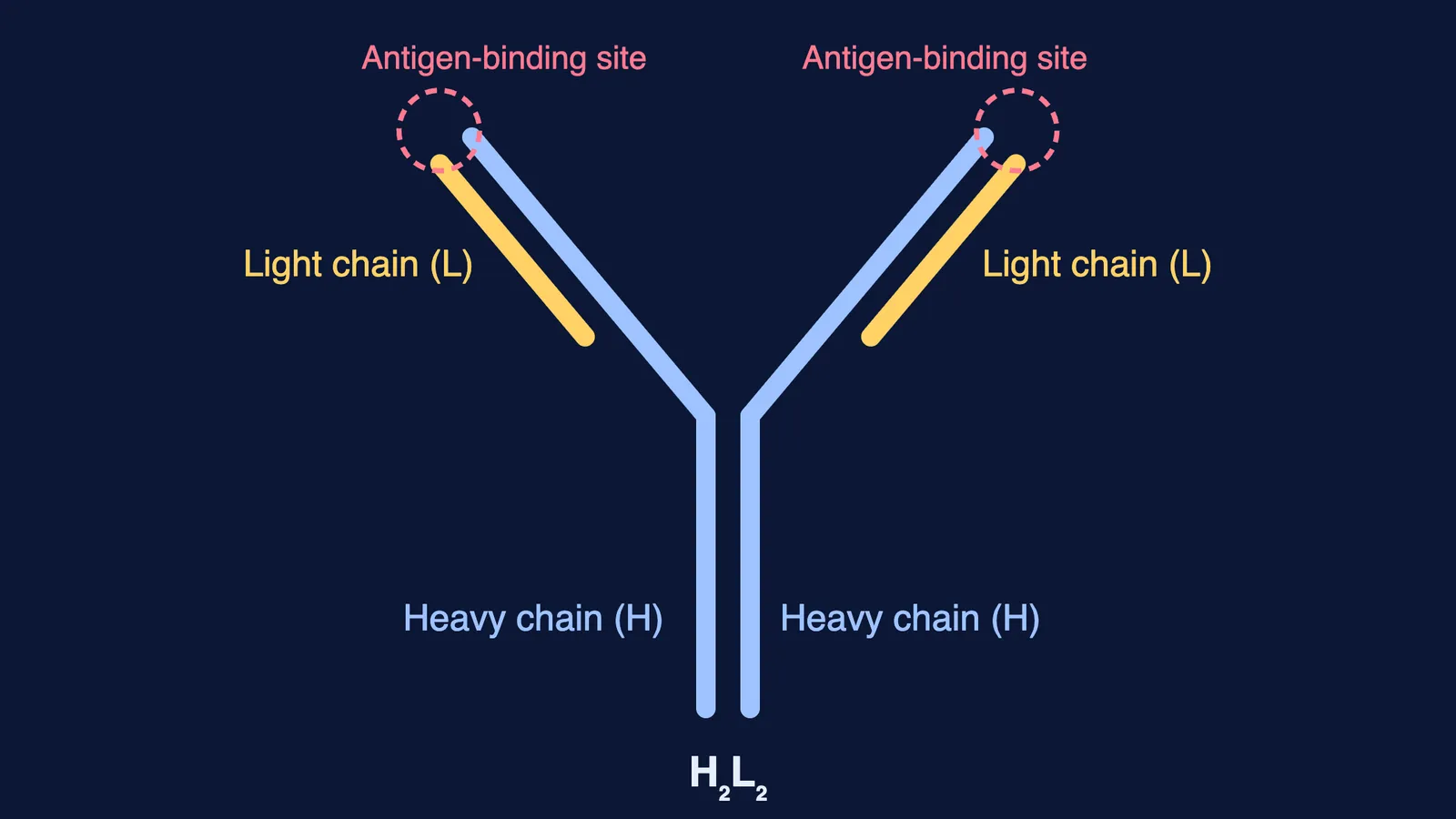
Q6 (hard). Assertion (A): The antibody-mediated response is also called the humoral immune response. Reason (R): Each antibody molecule has two heavy and two light peptide chains, so it is written as H2L2.
Answer: (B). Both are true. The name "humoral" comes from the antibodies being found in the blood, as NCERT explains; the chain structure is a separate fact. Trap: both lines describe antibodies, so they feel linked.
Statement I and Statement II questions on human health and disease
Q7 (easy). Statement I: Ringworm is caused by fungi of the genera *Microsporum*, *Trichophyton* and *Epidermophyton*, which grow well in heat and moisture. Statement II: Ringworm lesions are moist and painless, with no itching.
Answer: (C). Statement I is correct. Statement II is wrong on every point: NCERT describes dry, scaly lesions with intense itching. Trap: "heat and moisture" in Statement I makes "moist" sound consistent.
Q8 (medium). Statement I: Benign tumours spread to distant parts of the body through blood. Statement II: Normal cells show contact inhibition, a property that cancer cells appear to have lost.
Answer: (D). Statement I is incorrect: benign tumours stay confined to their original location; spreading through blood, called metastasis, belongs to malignant tumours. Statement II is correct. Trap: treating "tumour" as one category.
Q9 (hard). Statement I: The spleen filters blood by trapping blood-borne micro-organisms and holds a large reservoir of erythrocytes. Statement II: Mucosa-associated lymphoid tissue (MALT) makes up about 50 per cent of the lymphoid tissue in the human body.
Answer: (A). Both match NCERT section 7.2.7. Trap: marking Statement I false because you link erythrocyte storage only with the liver or bone marrow.
Q10 (hard). Statement I: Heroin is obtained by acetylation of morphine and is a stimulant that speeds up body functions. Statement II: Cocaine interferes with the transport of the neurotransmitter serotonin.
Answer: (B). Both are incorrect. Heroin is diacetylmorphine, but NCERT calls it a depressant that slows body functions. Cocaine interferes with the transport of dopamine, not serotonin. Trap: the first half of Statement I is right, so the wrong drug class slips through.
How should you use this set?
Do all ten in 12 minutes without notes, writing T or F above each line before choosing a key.
Score yourself, then sort every miss: a wrong fact (fix it in NCERT) or a wrong link (re-run the because test).
Redo the misses two days later, and write a false version of each true statement.
If a miss comes from a concept gap, such as the difference between humoral and cell-mediated immunity, the Fermi Concept Library has every concept in biology with its own lesson. To revise the pathogen tables first, read our pathogens, immunity and vaccines guide for NEET, and for more on the format, our assertion-reason strategy.