On this page
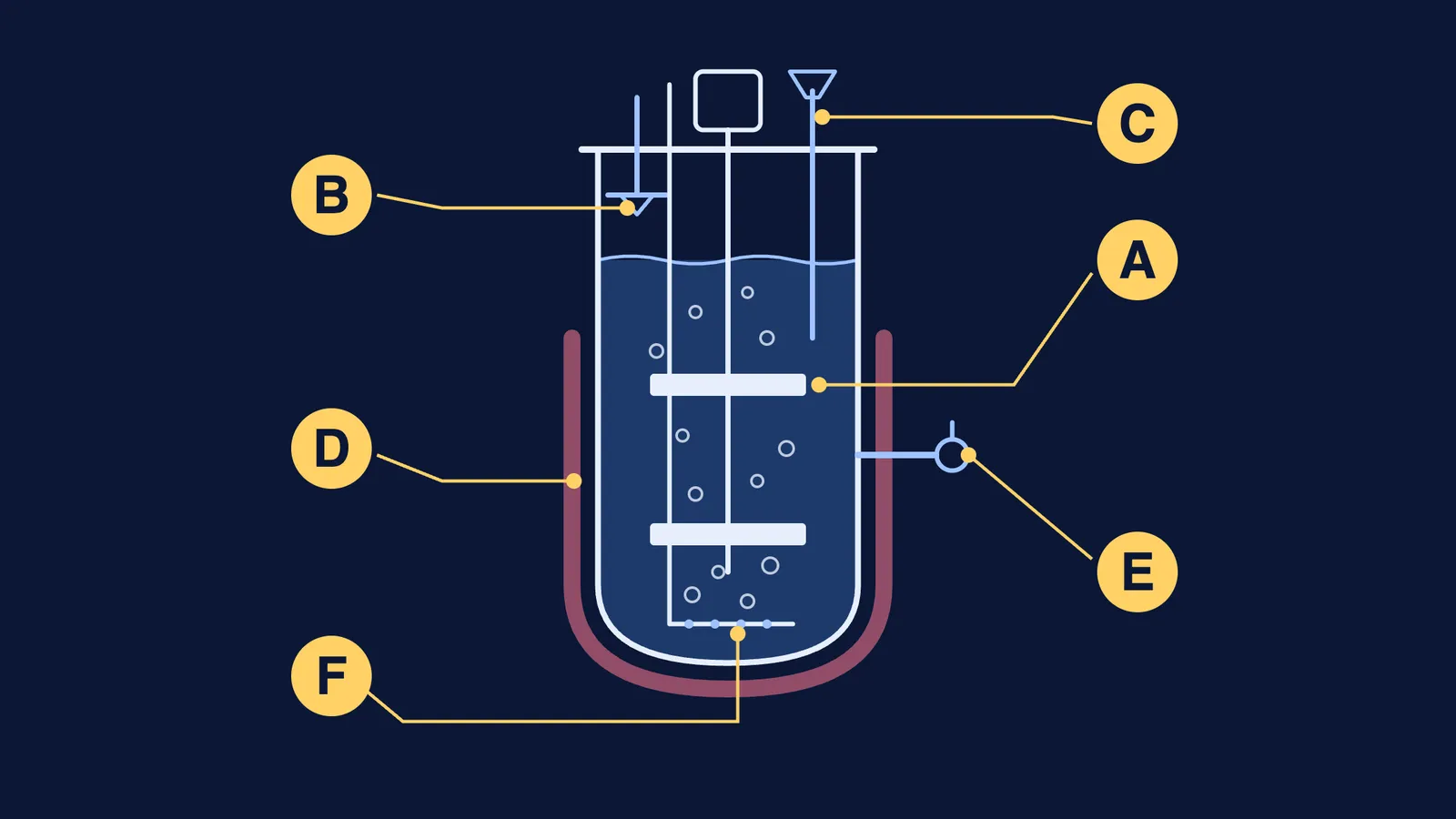
Twelve original questions here work through the figures of Chapter 9, Biotechnology: Principles and Processes, in NCERT Class 12 Biology (Reprint 2026-27). The lettered bioreactor above carries questions 1 to 6; questions 7 to 12 describe the other figures in words.
Which figures can a biotechnology diagram question use?
The chapter has seven figures: EcoRI making recombinant DNA (9.1), a recombinant DNA overview (9.2), an agarose gel (9.3), the vector pBR322 (9.4), DNA spooling (9.5), PCR (9.6) and two stirred-tank bioreactors (9.7).
The NMC syllabus for NEET (UG) 2026 lists "Principles and process of Biotechnology" under Biology Unit 9, Biotechnology and Its Applications.
What should you check before picking an option on a figure question?
Say what the whole figure is for: cutting, sorting, copying or growing.
Give every letter a job as well as a name; options often describe the job.
Check direction: pipes, arrows and gel lanes all run one way.
For a figure given only in words, sketch it roughly first.
Questions 1 to 6: the lettered bioreactor
Write a job beside each of A to F before reading options. Key for every Statement I/II item here: (1) I and II are both true (2) neither is true (3) only I is true (4) only II is true. For matching, fix one pairing you are certain of and drop codes that break it.
Q1. Which lettered part keeps the culture evenly mixed and makes oxygen available throughout the vessel?
(1) E (2) B (3) A (4) D
Q2. Statement I: Sterile air leaves F as bubbles, so this is a sparged stirred-tank bioreactor. Statement II: E adds a substance that keeps foam from building up.
Q3. Which code joins each lettered part in List-I to its job in List-II?
List-I: B, C, D, E
List-II: P. Holds the culture at the temperature it needs; Q. Takes out a little culture now and then; R. Keeps foam in check; S. Holds the pH in the optimum range
(1) B-S, C-R, D-P, E-Q (2) B-R, C-S, D-P, E-Q (3) B-R, C-S, D-Q, E-P (4) B-P, C-S, D-R, E-Q
Q4. Which lettered part sets a sparged stirred-tank bioreactor apart from a simple one?
(1) F (2) A (3) D (4) C
Q5. Statement I: Vessels like this process 10 to 100 litres of culture. Statement II: The curved base helps mix the contents.
Q6. NCERT lists six growth conditions a bioreactor holds at the optimum. Which pair of letters looks after temperature and pH?
(1) A and E (2) D and C (3) B and F (4) E and B
Answer key for the lettered diagram
A stirrer (agitator system), B foam control system, C pH control system, D temperature control system, E sampling port, F oxygen delivery system (sterile air bubbles).
Q1: (3). NCERT credits the stirrer with mixing the culture evenly and spreading oxygen through the vessel (section 9.3.5).
Q2: (3). E is a sampling port; foam control is B.
Q3: (2). Foam, pH, temperature and sampling, in that order.
Q4: (1). In Figure 9.7(b), sterile air bubbles are sparged through the culture.
Q5: (4). NCERT gives bioreactor volumes of 100-1000 litres.
Q6: (2). D controls temperature and C controls pH.
Can you answer the other figure questions from words alone?
Sketch each described figure, then check each choice against your drawing. The two-statement key is the same as before.
Q7. In the EcoRI figure (9.1), where does the enzyme cut each strand relative to its palindrome?
(1) Exactly at the centre, leaving no overhang (2) At random points on each strand (3) Only at the free ends of the molecule (4) Slightly off centre, at the same pair of bases on each strand
Answer: (4). The off-centre cut leaves single-stranded sticky ends (section 9.2.1).
Q8. Statement I: In the overview figure (9.2), vector and source DNA are cut with the same restriction enzyme. Statement II: The recombinant DNA then enters a cloning host, where it multiplies.
Answer: (1). Without one enzyme for both, the recombinant vector normally cannot form; the host is where it multiplies.
Q9. In the gel figure (9.3), wells are at the top and DNA has moved down. Which electrode is at the bottom, and where is lane 3's smallest fragment?
(1) Cathode; nearest the wells (2) Anode; farthest from the wells (3) Anode; nearest the wells (4) Cathode; farthest from the wells
Answer: (2). DNA fragments carry a negative charge, so they travel to the anode; the smaller the fragment, the farther it goes.
Q10. Statement I: The pBR322 map (9.4) marks seven restriction sites, among them Pvu II, Sal I and Cla I. Statement II: The two resistance genes on the map protect E. coli against ampicillin and kanamycin.
Answer: (3). The map shows ampR and tetR, so the genes give ampicillin and tetracycline resistance.
Q11. Figure 9.5 shows fine threads wound out of a suspension. What made them appear, and what are they?
(1) Chilled ethanol; purified DNA (2) Protease; protein fibres (3) Ribonuclease; RNA strands (4) Lysozyme; bacterial cell walls
Answer: (1). Purified DNA precipitates as threads once chilled ethanol is added (section 9.3.1).
Q12. For the PCR figure (9.6), which code links each step in List-I to its description in List-II?
List-I: W. Denaturation, X. Primer annealing, Y. Extension, Z. Repeating the cycle many times
List-II: P. Primers pair with complementary regions of the DNA; Q. High temperature separates the two DNA strands; R. The segment is amplified about a billion times; S. DNA polymerase lengthens the primers using the nucleotides supplied
(1) W-P, X-Q, Y-S, Z-R (2) W-Q, X-S, Y-P, Z-R (3) W-Q, X-P, Y-R, Z-S (4) W-Q, X-P, Y-S, Z-R
Answer: (4). Three steps per cycle, repeated to amplify the segment (section 9.3.3).
What should you do with the questions you missed?
Sort misses into figures you could not picture and facts you mixed up. Redraw the first kind from NCERT with labels covered. For the second, try our two-statement and List-I/List-II set on Chapter 9 or the assertion-reason items on biotechnology principles. Chapter notes are in our board exam guide to biotechnology principles and processes.
Not sure which part of this chapter to revise first? Fermi's AI tutor works out what you already know and builds a plan for the session.