On this page
These 10 original questions cover Biotechnology: Principles and Processes, Chapter 9 of NCERT Class 12 Biology. Every statement was checked against the NCERT chapter (Reprint 2026-27) and sits inside the updated NEET (UG)-2026 syllabus. Need the chapter first? Read our Class 12 guide to biotechnology principles and processes.
How do you answer assertion-reason and Statement I/II questions?
For assertion-reason items, run three checks in order:
Is the Assertion (A) true? Watch for swapped words.
Is the Reason (R) true on its own?
If both are true, join them with "because": "A, because R". Pick (A) only if R is the direct cause NCERT gives for A.
Assertion-reason key, used for Q1 to Q6:
(A) Both A and R are true and R is the correct explanation of A.
(B) Both A and R are true but R is NOT the correct explanation of A.
(C) A is true but R is false.
(D) A is false but R is true.
Statement pair key, used for Q7 to Q10:
(A) Both statements are correct.
(B) Both statements are incorrect.
(C) Statement I is correct, Statement II is incorrect.
(D) Statement I is incorrect, Statement II is correct.
Assertion-reason questions: can you find the real cause?
Source: NCERT Chapter 9.
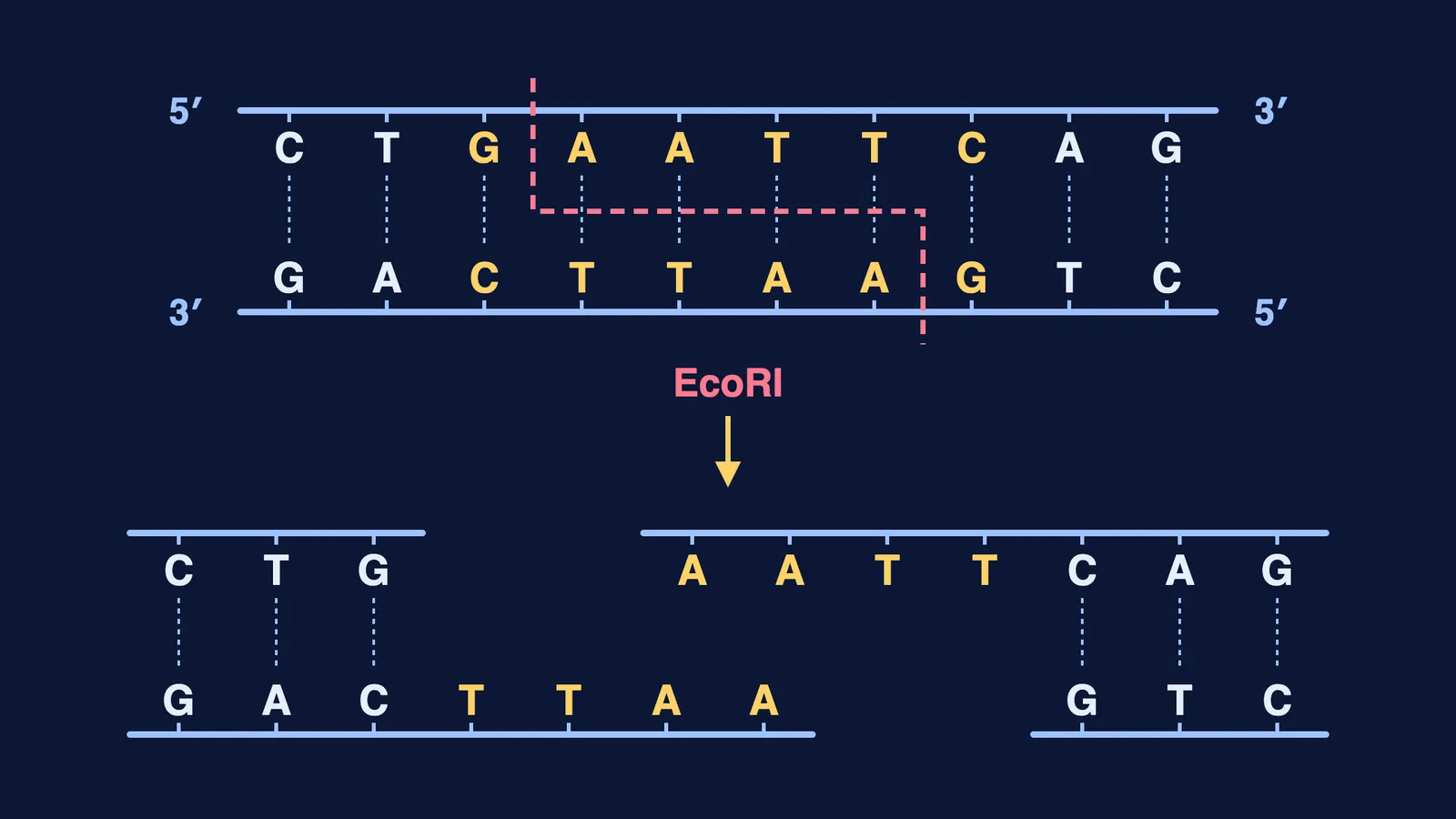
Q1 (easy). Assertion (A): A gene cut out with EcoRI joins easily into a vector that was also opened with EcoRI. Reason (R): DNA fragments cut by the same restriction enzyme have the same kind of sticky ends, which pair with each other and can be sealed by DNA ligase.
Answer: (A). Both are true, and R is the reason: matching overhangs hydrogen-bond with each other, helping ligase join the ends. Trap: thinking ligase alone does the matching.
Q2 (easy). Assertion (A): In agarose gel electrophoresis, smaller DNA fragments travel farther from the well. Reason (R): DNA is negatively charged, so it moves towards the anode.
Answer: (B). Both are true, but R explains the direction of movement, not the size difference. Fragments separate by size because of the sieving effect of the agarose gel. Trap: a true fact about the same gel looks like the cause.
Q3 (medium). Assertion (A): Bacterial cells must be made competent before they will take up plasmid DNA. Reason (R): DNA is a hydrophobic molecule, so it cannot pass through cell membranes.
Answer: (C). A is true; cells are treated with a divalent cation such as calcium. R is false: NCERT calls DNA hydrophilic, and that is why it cannot cross the membrane. Trap: one swapped word turns a correct reason false.
Q4 (medium). Assertion (A): Alien DNA that is neither linked to an origin of replication nor integrated into the host genome will multiply in the progeny cells. Reason (R): The origin of replication is a specific DNA sequence responsible for initiating replication.
Answer: (D). A is false: NCERT says alien DNA multiplies only as part of a chromosome or when linked to an ori. R is true. Trap: assuming the host copies any DNA it receives.
Q5 (medium). Assertion (A): A cloning vector should have very few, preferably single, recognition sites for commonly used restriction enzymes. Reason (R): More than one recognition site in the vector would cut it into several fragments, which complicates gene cloning.
Answer: (A). Both are true, and R is the reason NCERT gives for this feature of cloning sites. Trap: confusing sites with copy number, which the ori controls.
Q6 (hard). Assertion (A): E. coli cells carrying pBR322 with foreign DNA inserted at the BamH I site cannot grow on a tetracycline medium. Reason (R): pBR322 carries ampR, so transformants can be selected on an ampicillin medium.
Answer: (B). Both are true, but R explains how transformants are picked out, not why recombinants lose tetracycline resistance. The real cause is that the BamH I site lies in tetR, so the insert inactivates that gene. Trap: both sentences describe the same plating test.
Statement I and Statement II questions: which half is wrong?
Source: NCERT Chapter 9.
Q7 (easy). Statement I: In EcoRI, the letter R comes from the name of the strain, RY 13. Statement II: The Roman numeral after a restriction enzyme's name gives the number of recognition sites it cuts.
Answer: (C). Statement I is correct. Statement II is incorrect: the Roman numeral gives the order in which the enzyme was isolated from that strain. Trap: reading "I" as "one site".
Q8 (medium). Statement I: Exonucleases make cuts at specific positions within the DNA. Statement II: A restriction endonuclease cuts each strand of the double helix at specific points in the sugar-phosphate backbone.
Answer: (D). Statement I is incorrect: exonucleases remove nucleotides from the ends; cutting within the DNA is what endonucleases do. Statement II is correct. Trap: mixing up "exo" (ends) and "endo" (within).
Q9 (medium). Statement I: PCR primers are small, chemically synthesised oligonucleotides complementary to regions of the DNA. Statement II: The DNA polymerase used in PCR stays active during the high-temperature denaturation of double-stranded DNA.
Answer: (A). Both match NCERT; the thermostable polymerase comes from Thermus aquaticus. Trap: assuming one half must be wrong.
Q10 (hard). Statement I: During DNA isolation, RNA is removed with protease, and purified DNA precipitates on adding chilled ethanol. Statement II: In a continuous culture system, cells are kept in the stationary phase by draining used medium from one side while adding fresh medium from the other.
Answer: (B). Statement I is incorrect because RNA is removed with ribonuclease; protease removes proteins. Statement II is incorrect because continuous culture keeps cells in the active log, or exponential, phase. Trap: one true half inside a statement makes the whole look correct.
How should you use this set?
Cover each answer, mark your key, check.
For every miss, note which check failed: A, R or the link.
Re-read that NCERT paragraph.
Redo the missed items two days later.
For the MCQ side of the chapter, see our NEET notes on restriction enzymes, PCR and cloning vectors. For the method across subjects, see our assertion-reason question strategy.
When a miss is a concept gap rather than a slip, the Fermi Concept Library covers every concept in biology, each with its own lesson and its place in the map.