

On this page
This set of 15 original questions tests Biotechnology: Principles and Processes, Chapter 9 of NCERT's Class 12 Biology (Reprint 2026-27). The NMC's NEET (UG)-2026 syllabus lists it under Unit 9, Biotechnology and Its Applications. The NEET (UG)-2026 information bulletin gives Biology 90 of the 180 questions, marked +4 if correct and −1 if wrong.
For cause-and-effect practice, see our biotechnology principles assertion-reason set.
Which biotechnology statements are correct?
How to attack this format: judge each statement alone and write T or F beside it before reading the options. A false one usually swaps a single word.
Options for Q1 to Q4: (1) Both correct. (2) Both incorrect. (3) I correct, II incorrect. (4) I incorrect, II correct.
Q1 (easy). Statement I: Asexual reproduction permits variation, while sexual reproduction preserves genetic information. Statement II: Traditional hybridisation lets breeders bring in only the desired genes.
Answer: (2). NCERT says the reverse for I; hybridisation often carries undesirable genes too.
Q2 (easy). Statement I: Agarose, the usual gel matrix, is a synthetic polymer. Statement II: Unstained DNA fragments cannot be seen in visible light.
Answer: (4). Agarose is a natural polymer extracted from seaweeds.
Q3 (medium). Statement I: Hind II cut DNA at a particular point after recognising a six-base-pair sequence. Statement II: Hind II was isolated in 1963, the same year as the two enzymes that restricted phage growth in *E. coli*.
Answer: (3). Hind II came five years after those two enzymes.
Q4 (medium). Statement I: Cohen and Boyer built the first recombinant DNA in 1972 by linking an antibiotic resistance gene with a native plasmid of *Salmonella typhimurium*. Statement II: Inside *E. coli*, this recombinant DNA replicated using the host's DNA polymerase.
Answer: (1). Both match section 9.1.
Q5 (hard). Which statements about isolating DNA match NCERT? A. Lysozyme breaks open bacterial cells. B. Cellulase opens fungal cells. C. Chitinase opens fungal cells. D. DNA must be free of other macromolecules before restriction enzymes cut it. E. Precipitated DNA threads can be collected by spooling.
(1) A, C and D only (2) A, B, D and E only (3) A, C, D and E only (4) B, C and E only
Answer: (3). Cellulase is for plant cells; the rest match section 9.3.1 and Figure 9.5.
How do you match the lists in this chapter?
How to attack this format: lock in the pair you are surest of, then cross out every code that disagrees. A second pair settles any tie.
Q6 (easy). List-I: A. DNA ligase; B. Thermostable DNA polymerase; C. Restriction endonuclease; D. Ethidium bromide. List-II: I. Cuts both DNA strands at fixed backbone positions; II. Makes DNA bands glow orange under UV; III. Joins the ends of cut DNA; IV. Extends primers in PCR.
(1) A-I, B-IV, C-III, D-II (2) A-III, B-IV, C-I, D-II (3) A-III, B-II, C-I, D-IV (4) A-IV, B-III, C-I, D-II
Answer: (2). See sections 9.2.1 and 9.3.3.
Q7 (medium). List-I: A. Micro-injection; B. Biolistics; C. Disarmed Ti plasmid; D. Heat shock. List-II: I. Calcium-treated competent bacteria; II. Nucleus of an animal cell; III. DNA-coated gold or tungsten particles; IV. *Agrobacterium tumefaciens* vector for plants.
(1) A-II, B-III, C-IV, D-I (2) A-III, B-II, C-IV, D-I (3) A-II, B-IV, C-III, D-I (4) A-I, B-III, C-IV, D-II
Answer: (1). Heat shock: ice, briefly 42°C, then ice.
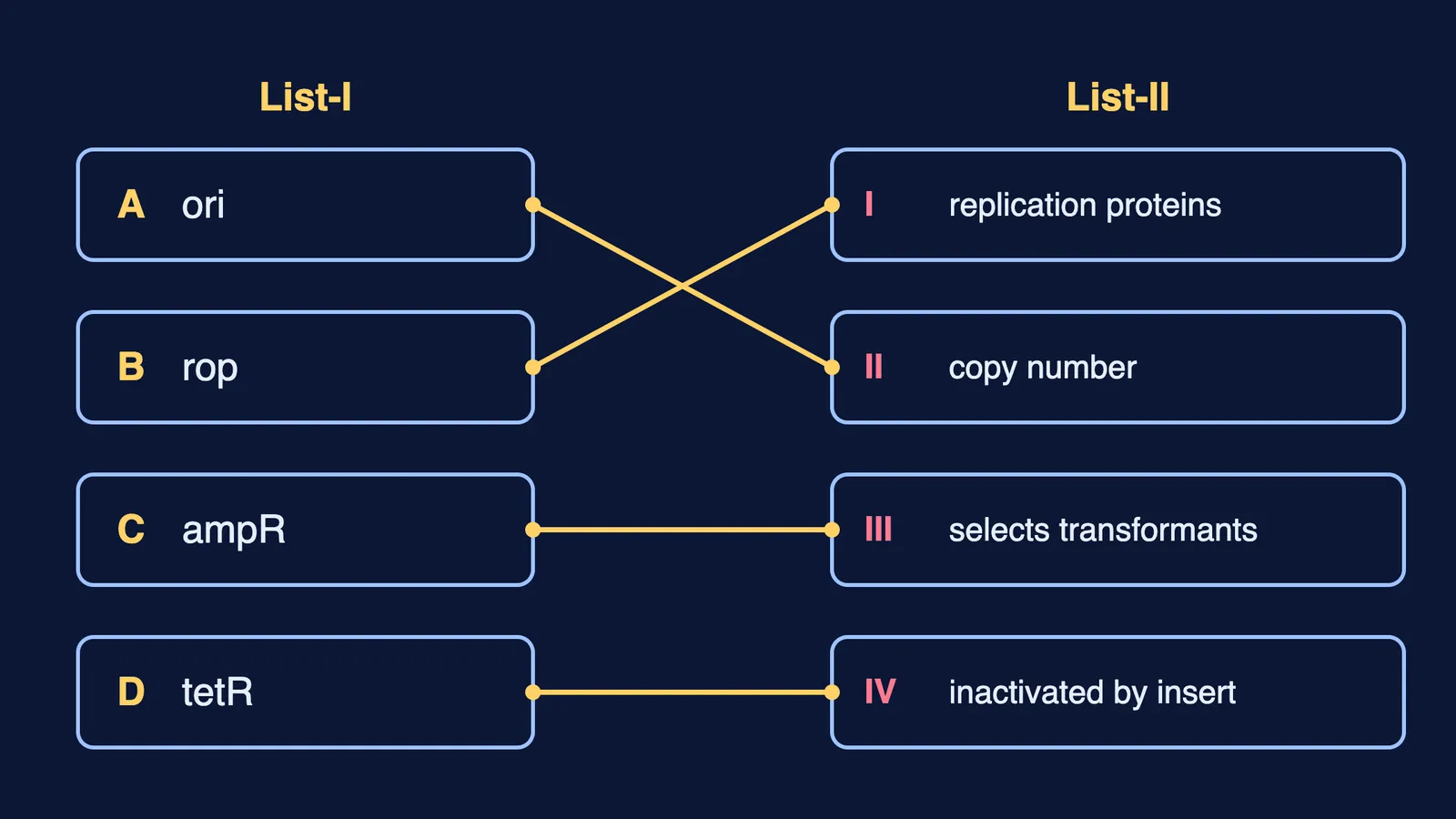
Q8 (medium). List-I (parts of pBR322): A. ori; B. rop; C. ampR; D. tetR. List-II: I. Codes for proteins involved in plasmid replication; II. Controls the copy number of linked DNA; III. Selects transformants; IV. Lost when foreign DNA enters its BamH I site.
(1) A-I, B-II, C-III, D-IV (2) A-II, B-I, C-IV, D-III (3) A-III, B-I, C-II, D-IV (4) A-II, B-I, C-III, D-IV
Answer: (4). The ori controls copy number; rop codes for replication proteins (Figure 9.4).
Q9 (medium). List-I: A. Stirrer; B. Sparged stirred-tank bioreactor; C. Downstream processing; D. Sampling port. List-II: I. Separation and purification of the product; II. Withdraws small volumes of culture from time to time; III. Even mixing and oxygen supply throughout the vessel; IV. Sterile air bubbled through the vessel.
(1) A-III, B-IV, C-II, D-I (2) A-IV, B-III, C-I, D-II (3) A-III, B-IV, C-I, D-II (4) A-I, B-IV, C-III, D-II
Answer: (3). See Figure 9.7 and section 9.3.6.
Which single-correct MCQs come from this chapter?
How to attack this format: answer in your head before reading the options, then pick the one that matches.
Q10 (easy). Which order of steps in recombinant DNA technology matches NCERT?
(1) Isolate DNA, ligate into vector, fragment it, transfer to host (2) Isolate DNA, fragment it, isolate the desired fragment, ligate into vector, transfer to host, culture, extract product (3) Fragment DNA, transfer to host, ligate into vector, extract product (4) Culture host, isolate DNA, ligate, extract product
Answer: (2). This is the order in section 9.3.
Q11 (easy). With a chromogenic substrate, colourless colonies show that:
(1) the plasmid has no insert (2) the β-galactosidase gene was inactivated by an insert (3) the cells were never transformed (4) β-galactosidase is overproduced
Answer: (2). Colourless colonies are recombinants; those without an insert turn blue.
Q12 (medium). In gel electrophoresis, elution is:
(1) staining the gel with ethidium bromide (2) loading the sample into the well (3) cutting out separated bands and extracting DNA from the gel piece (4) applying the electric field
Answer: (3). Eluted DNA is then joined with vectors.
Q13 (medium). Which site is palindromic, reading the same 5' to 3' on both strands?
(1) 5'-GAATTG-3' (2) 5'-GCATGG-3' (3) 5'-AAGCTA-3' (4) 5'-GGATCC-3'
Answer: (4). Its partner strand, read 5' to 3', is also GGATCC.
Q14 (medium). Which sequence is correct for one PCR cycle?
(1) Annealing, denaturation, extension (2) Denaturation, extension, annealing (3) Denaturation, primer annealing, extension (4) Extension, denaturation, annealing
Answer: (3). See Figure 9.6.
Q15 (hard). NCERT calls a protein "recombinant" when:
(1) it is produced in any bioreactor (2) a gene coding for it is expressed in a heterologous host (3) it has passed downstream processing (4) PCR synthesises it
Answer: (2). See section 9.3.5.
How should you use this set?
Answer all 15 in one sitting, then label each miss: wrong fact, misread statement or a coding slip. Re-read only the NCERT section behind it. Our key terms guide for this chapter helps when the misses are vocabulary.
Unsure where your gaps in this chapter sit? Fermi's AI tutor works out what you already know and builds a plan for the session.


