On this page
Chapter 9 of NCERT Class 12 Biology brings a new word in nearly every line. These definitions are in our own words, checked against the 2026-27 reprint of the chapter. The CBSE 2026-27 Biology curriculum lists its content as genetic engineering (recombinant DNA technology). For answer-writing, see our Class 12 board guide to Biotechnology: principles and processes.
What is biotechnology and what are its two core techniques?
Biotechnology: putting living organisms, or their enzymes, to work to make products and run processes that people need. Example: curd and bread are old forms; today it mostly means large-scale work with genetically modified organisms.
Genetic engineering: altering DNA or RNA and introducing it into a host organism, which then shows new traits (a changed phenotype). Don't confuse with: traditional hybridisation, which carries unwanted genes along with the wanted ones.
Bioprocess engineering: keeping large cultures sterile so only the desired cells grow and make products such as antibiotics, vaccines or enzymes.
Recombinant DNA: a DNA molecule built in vitro by joining DNA from two different sources. Example: Cohen and Boyer joined an antibiotic resistance gene to a plasmid in 1972, as the NCERT chapter records.
Origin of replication (ori): the DNA sequence at which replication starts; it also sets how many copies of linked DNA are made.
Cloning: making many identical copies of a piece of DNA inside a host. Don't confuse with: PCR, which copies DNA in a tube.
Which enzymes cut and join DNA?
Restriction endonuclease: a bacterial enzyme that cuts DNA only at a specific sequence. The NCERT chapter says more than 900 are known, from over 230 bacterial strains.
Naming convention: genus initial, two species letters, strain letter, then a Roman numeral for order of isolation. Example: EcoRI comes from Escherichia coli strain RY13.
Recognition sequence: the exact base sequence an enzyme reads before cutting. Example: Hind II recognises a six-base-pair sequence.
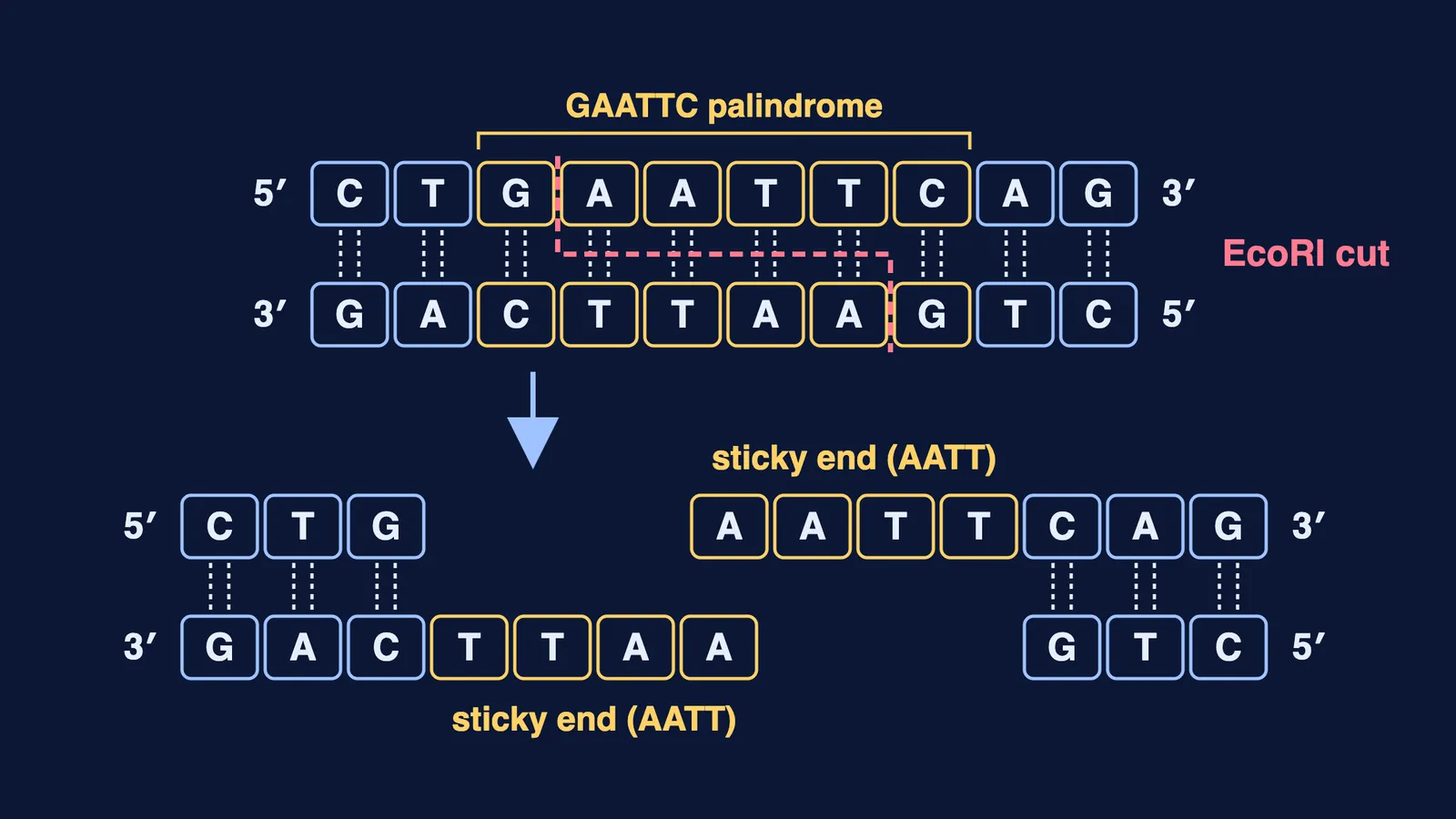
Palindromic sequence: a stretch of DNA that reads the same on both strands when each is read 5′ to 3′. Example: GAATTC paired with CTTAAG.
Sticky ends: single-stranded overhangs left when an enzyme cuts off-centre in the palindrome; they pair with ends cut by the same enzyme.
Exonuclease and endonuclease: an exonuclease trims nucleotides from DNA ends; an endonuclease cuts within it.
DNA ligase: the enzyme that joins cut DNA ends. Don't confuse with: restriction enzymes, which cut.
How are DNA fragments separated and seen?
Gel electrophoresis and agarose: DNA fragments, being negatively charged, are pulled through a gel towards the anode; smaller fragments travel farther. The usual gel, agarose, is a seaweed polymer that sieves by size.
Ethidium bromide: the stain that makes DNA bands glow orange under UV light; pure DNA cannot be seen otherwise.
Elution: cutting a band out of the gel and extracting the DNA from it.
What makes a good cloning vector?
Vector: a DNA carrier, usually a plasmid or bacteriophage, that ferries foreign DNA into a host. A plasmid is circular DNA outside the chromosome that replicates on its own.
Copy number: how many copies of a plasmid or phage a cell holds. Some plasmids have one or two, others 15 to 100 or more per cell.
Selectable marker: a gene, usually for antibiotic resistance such as ampicillin, that lets only transformed cells grow on that antibiotic.
Cloning site: a restriction site for inserting foreign DNA; ideally just one per common enzyme.
pBR322: an E. coli plasmid vector carrying ori, rop, and ampicillin and tetracycline resistance genes.
Insertional inactivation: inserting DNA inside a gene switches that gene off. Example: an insert in the β-galactosidase gene means colonies stay colourless on a chromogenic substrate, while non-recombinants turn blue.
Transformant and recombinant: a transformant took up any plasmid; a recombinant took up a plasmid carrying the insert. Don't confuse the two.
Ti plasmid: the tumour-inducing plasmid of Agrobacterium tumefaciens, now disarmed into a plant vector. Don't confuse with: T-DNA, the piece it transfers.
Disarmed retrovirus: a retrovirus made harmless and used to deliver genes into animal cells.
How does recombinant DNA enter a host cell?
Competent cell and transformation: transformation brings DNA into a bacterium; a competent cell is one treated with divalent cations such as calcium so DNA can enter. DNA is then pushed in by ice, a brief heat shock at 42°C, and ice again.
Micro-injection and biolistics: micro-injection puts recombinant DNA straight into an animal cell's nucleus; biolistics (gene gun) fires DNA-coated gold or tungsten particles into plant cells. Don't confuse the two.
Which terms cover PCR, bioreactors and the final product?
Lysis enzymes: lysozyme opens bacteria, cellulase plant cells and chitinase fungi. Ribonuclease and protease then remove RNA and protein.
Spooling: winding out DNA threads precipitated by chilled ethanol.
PCR (polymerase chain reaction) and primers: PCR copies a chosen DNA segment in vitro through cycles of denaturation, primer annealing and extension. Primers are short synthetic oligonucleotides complementary to the target's flanking regions. Repeated cycles can give about a billion copies.
Thermostable DNA polymerase: the Thermus aquaticus enzyme that survives denaturation heat.
Recombinant protein: a protein produced when its gene is expressed in a host of another species (a heterologous host).
Continuous culture: draining used medium while adding fresh, so cells stay in log phase.
Bioreactor: a vessel, often 100 to 1000 litres, that keeps temperature, pH, oxygen and nutrients optimal. Don't confuse: simple stirred-tank (stirrer only) and sparged stirred-tank (also bubbles in sterile air).
Downstream processing: separating and purifying the product; formulation and quality testing follow before sale.
If any term still feels abstract, the Fermi Concept Library covers every concept in biology, each with its own lesson and its place in the map.
How to learn these terms
Learn in pairs: exonuclease and endonuclease, transformant and recombinant, Ti plasmid and T-DNA, micro-injection and biolistics.
Write GAATTC, its complement and the EcoRI cut from memory, then mark both sticky ends.
Draw pBR322 and trace the BamH I insert: ampicillin plate first, then tetracycline.
Say the seven process steps aloud in order, from isolating DNA to extracting the product.
Test yourself on the NEET version, restriction enzymes, PCR and cloning vectors, then read about bioreactors and downstream processing.