

On this page
If someone has told you to stop chewing your pencil because of the lead, here is a fact worth knowing: there is no lead in it. The US National Library of Medicine's MedlinePlus page on pencil lead says plainly that "pencils have never contained lead" and that graphite "is relatively nonpoisonous". The grey core is graphite, a form of carbon, mixed with clay.
Why is pencil lead called lead if it is graphite?
Blame mistaken identity. In the Borrowdale area of Cumbria, England, a soft black mineral known locally as wad was used to mark sheep, and it also went by the names plumbago and black lead, according to the Cumbria County History Trust. The trust dates the earliest reference to using graphite in what we would now call a pencil to 1565. It looked and smeared like the metal lead, so the name stuck long after chemists showed it was carbon.
French inventor Nicolas-Jacques Conté received a patent in 1795 for mixing powdered graphite with clay and pressing it between two half-cylinders of wood (Wikipedia's biography of Conté). That graphite-and-clay recipe is still what you write with.
What is a pencil core made of?
A 2014 study in Scientific Reports describes the core as "fine graphite powders bound together by clays" (Lin and colleagues, 2014). The paper notes that harder leads contain a higher proportion of clay binder, while softer leads contain more graphite. That is the logic behind pencil grades: the H end of the scale has more clay and draws a light, hard line; the B end has more graphite and draws a dark, soft one.
Why does graphite slide and conduct electricity?
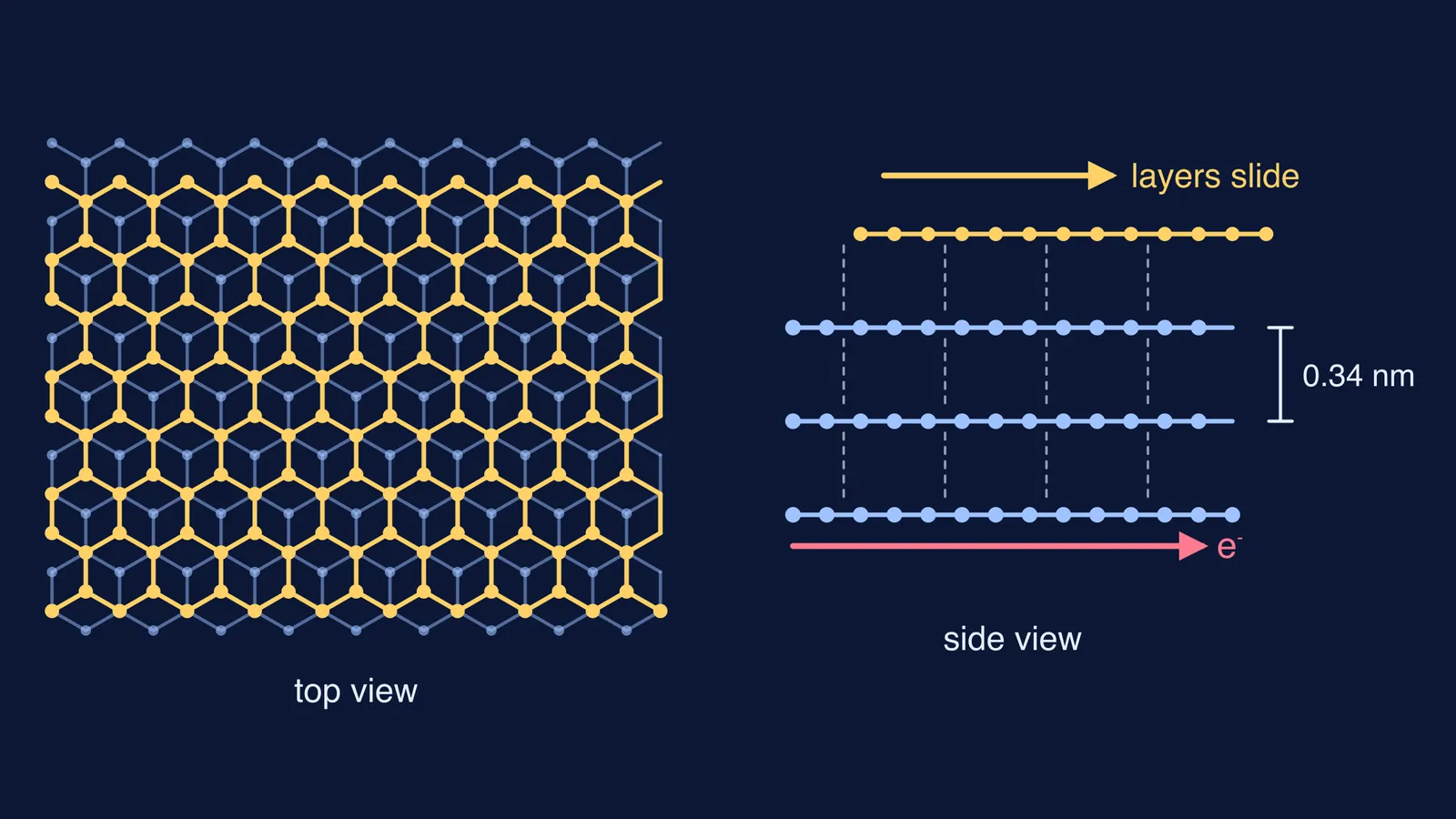
In graphite, each carbon atom is covalently bonded to just three others, leaving one electron spare, according to the Royal Society of Chemistry's allotropes of carbon factsheet. The atoms form flat layers of hexagons, and the spare electrons form a "soup" of delocalised electrons that makes graphite a very good conductor of electricity.
The layers are held to each other only by weak dispersion forces (textbook values collected in The Physics Factbook). Neighbouring atoms within a layer sit 0.142 nm apart, while the layers are about 0.34 nm apart, more than twice as far. When you drag a pencil across paper, layers shear off and stay behind as your mark.
Diamond is the same element arranged differently. Each carbon in diamond bonds to four others, so no electrons are spare and diamond is a poor conductor, the same RSC factsheet notes. Different structural forms of one element are called allotropes, and carbon's also include graphene (a single layer of graphite) and fullerenes such as C60. For the structures side by side, read our explainer on diamond and graphite structure for Class 10, or turn both lattices around in diamond vs graphite in 3D.
If the layered structure is hard to picture from a flat textbook drawing, the Fermi Simulation Lab has interactive simulations for ideas that are easier to see than to read.
How can you test whether a pencil line conducts electricity?
The Science Museum Group's graphite circuits activity needs paper, two wires with crocodile clips, a 4B or 6B pencil, a 9V battery and an LED. Draw a thick, continuous line. Clip the battery's negative terminal to one end of the line, clip the positive terminal to the LED's longer leg, then touch the LED's other leg to the line.
Predict before you test. Lin and colleagues measured the resistance of pencil traces they drew on paper at 200 kΩ for 9B, 500 kΩ for 6B, 2 MΩ for 2B and 20 MΩ for HB (Scientific Reports, 2014), so the HB trace had 100 times the resistance of the 9B trace. Your lines will differ in size, but the order should hold.
Predict: rank lines drawn with a 6B, a 2B and an HB pencil from brightest LED to dimmest.
Draw three lines of the same length, going over each several times until it is dark and shiny.
Test each line and record bright, dim or off.
Touch the LED leg at different points along one line; the Science Museum Group explains that a longer path through graphite has more resistance, so the LED gets dimmer.
Explain your results using clay content and delocalised electrons.
Keep it safe:
Use only a small battery, never a mains socket or a phone charger.
Never join the two battery terminals directly with a wire; it can get hot.
If the LED stays dark, flip it around, shorten the line or switch to a softer pencil before changing anything else.
Younger children should do this with an adult.
Our guide to building a simple conductor and insulator tester uses the same circuit with everyday objects. If allotropes keep blurring together, the Fermi Concept Library gives each concept its own lesson and its place in the map.
Next time someone warns you about pencil lead, tell them it is carbon, then show them the LED.


