

On this page
Building a simple electric circuit is a classic rite of passage in science class. Testing whether a metal spoon or a plastic ruler lets electricity pass makes abstract physics visible. A classic study of 25,000 eighth-grade students published in the *Journal of Research in Science Teaching* found that those who engage in hands-on science activities at least once a week score significantly higher on standardized tests than those who rarely do so (Stohr-Hunt, 19961098-2736(199601)33:1%3C101::AID-TEA6%3E3.0.CO;2-Z)).
What is a conductor and an insulator?
According to the NCERT Class 6 science curriculum, materials that allow electric current to pass through them easily are called conductors, while those that block the current are insulators.
Conductors have "free electrons" that can move easily. Most metals, such as the copper in wires, are excellent conductors.
Insulators hold on to their electrons tightly, meaning current cannot flow through them. This is why electrical wires are covered in rubber or plastic for safety.
To review these definitions, students can use the Fermi Concept Library to find the lesson for each concept and see its place in the map. If you want to understand how a material's intrinsic properties affect the flow of charge quantitatively, exploring the energy bands of conductors and insulators provides the mathematical next step.
How to make a conductor insulator tester?
You only need a few common items to build a conduction tester, based on TeachEngineering's classroom activities:
Batteries: Two or three D-cell batteries to provide a safe voltage.
A small light bulb and holder: A #40 light bulb works well.
Connecting wires: Pieces of insulated copper wire with the ends stripped off.
Test objects: Gather a mix of everyday items like a metal key, a rubber eraser, an aluminium foil strip, and a plastic scale.
The steps:
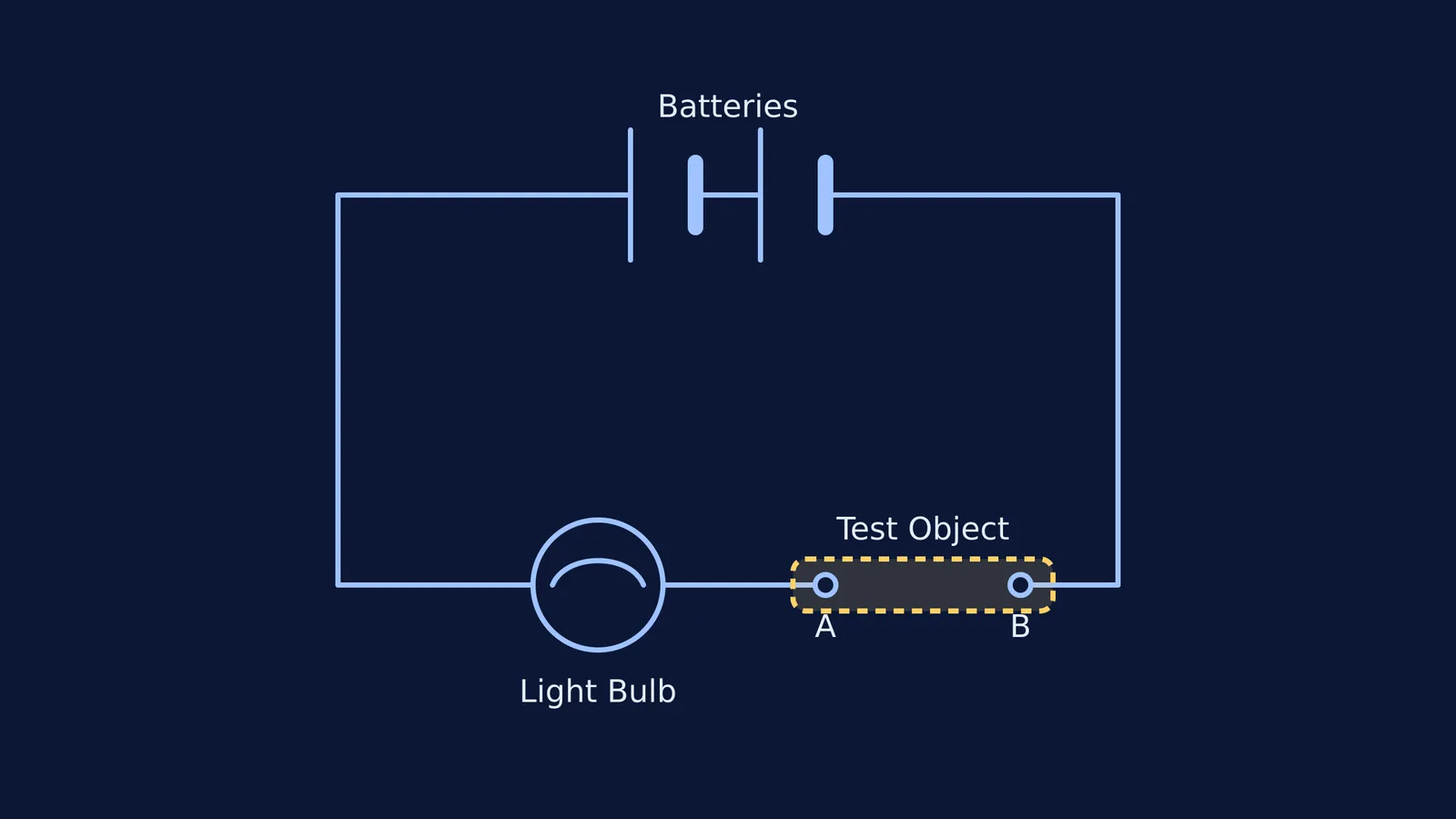
Connect one end of your first wire to the positive terminal of the battery, and the other end to the bulb holder.
Take your second wire and connect one end to the other terminal of the bulb holder. Leave its far end free. We will call this free end "A".
Connect the third wire to the negative terminal of the battery. Leave its far end free. We will call this free end "B".
To test the setup, touch end A to end B. The bulb should light up, confirming that the circuit is complete.
Why is my tester not working?
If your bulb does not light up even when ends A and B touch each other directly, the circuit is open somewhere else. Here is a quick checklist to troubleshoot the setup:
Check the connections: Ensure the stripped copper ends of the wires are firmly attached to the bulb holder and the battery's terminals. Loose wires are the most common reason for a broken circuit.
Inspect the bulb: Look closely at the tiny filament inside the glass bulb. If it is broken, the bulb is "fused" and must be replaced.
Test the battery: The batteries might be dead. Try swapping them with fresh D-cells.
Clean the contacts: Sometimes, a thin layer of rust or dirt on the battery terminals or the test object acts as an invisible insulator. Wiping them with a cloth or lightly scratching them can fix the problem.
How do you test everyday objects?
Once your tester is ready, place the object you want to test between ends A and B. Ensure the wires touch the object securely but do not touch each other directly.
If the bulb glows, the circuit is closed, meaning the object allows current to pass. It is a conductor. If the bulb remains dark, the circuit is broken. The object is an insulator.
Measuring the exact resistance of an object involves finding the cell constant and conductivity of the setup, but this simple visual test is enough to classify most household items.
What are the results for common materials?
When testing items around the house, you will find that materials fall neatly into two categories.
Conductors (bulb lights up):
Metal keys and coins: Made of brass, steel or copper, these are excellent conductors.
Pencil lead: The "lead" is actually graphite, a form of carbon that conducts electricity.
Aluminium foil: Being a metal, it allows current to flow easily.
Insulators (bulb stays dark):
Rubber erasers: Rubber is a standard insulating material.
Plastic scales and pens: Plastics block the flow of electrons.
Wooden matchsticks: Dry wood is a poor conductor, which is why it acts as an insulator.
If you are guiding a student through this activity, encourage them to guess the result before testing each item. This transforms a simple observation into an active experiment, cementing the physics of electrical flow in their mind.


